Roy Garland: Irish News:What Agenda?

Once again Roy Garland the fifth columnist of Unionism, has raised his head above the Alliance party parapet to denigrate the Loyalist Working Class, for the satisfaction of his gluttonous Republican audience.

By means of his column this week in the Irish News, 12/4/13, he likens the behaviour of the defenders of the National Standard, to the behaviour displayed by the IRA terrorists and Republicans who recently fired a volley of shots beside a Republican mural, and paraded very young Children as mini IRA terrorists.

He denigrates Ruth Patterson, for having the honesty to remind the IRA representatives on Belfast City Council of the IRAs sordid, murderous past.

He praises the woolly headed Alliance party, for producing another one of their totally predictable head in the sand amendments of appeasement, in support of their Republican partners on the council, who had refused to respectfully mark, the barbaric slaughter of the two British corporals David Howes and Derek Woods.

This is the same woolly headed Alliance party, which recently supported the rainbow coloured lighting up of the city hall, to celebrate the flaunting of homosexual behaviour.

It is the same woolly headed Alliance party, which then bizarrely opposed the lighting up of the City Hall on Rememberance day, in honour of the Soldiers who sacrificed their lives to ensure the defeat of Hitler and Nazi Germany. Thereby ensuring that homosexuals would be free to flaunt their homosexuality, without fear of execution.

He questions Christopher Stalford for having the honesty and moral decency to distinguish between, the totally innocent victims of terrorism and victims of their own indiscriminate terrorist activities and support of terrorism.     Roy Garland suggests that, the Loyalists who democratically defied the belligerent British Government in 1912, by unanimously supporting and signing the Ulster Covenant in defence of the democratic right of the Ulster People, to decide their own future, were just as guilty of illegality as the indiscriminate murdering terrorists, who  have sought to usurp democracy by barbaric slaughter.

He then finish’s his attack with a plug for his preferred method of election, the wishy washy , if, possibly, maybe, depends what way the winds blowing, Modified Borda Count, as an alternative to decent, honest, straight forward democracy.

This would then of course mean that, the self-righteous elitists of the Alliance party and Roy Girvan could just ignore the results, when they fail to  correspond with their own self-righteous minority opinion of what we, who they consider to be the ignorant Loyalist Working Class lowest common denominators,  really should have voted for.      Which is exactly the attitude they adopted when, the Modified Borda Count system which was used by the Equality Commission with regard to the Flying of the National Standard, resulted in overwhelming support for the status quo.

Charlie Freel.

Share

The Murder of a 12 Year Old Boy: Bobby Cosgrove

Horrible Murder of a 12-year-old Boy. 


Throughout the history of Belfast there have been many harrowing crimes, but the killing of a child still remains the most sickening crime of them all, the following story was one of the cruelest that took place in Ballymacarrett.


Our story begins when on a fine August morning in 1897 when Mrs Isabella Dyer was sitting at the front of her home at 118 Dee Street, she was waiting for her husband to return home of the nightshift at the near by shipyards. She noticed a very frightened young boy coming up the street and as he approached her door she noticed that he was very worried and ragged looking.  She took the boy in and give him some breakfast and then washed and cleaned him up. It was while she was doing this she discovered that he had run away from home and was sleeping rough in the Victoria Park.  She also noticed that the lad had a large number of bruises on his arms and body. Read more »

Share

Bobby Cosgrove: Local Historian: East Belfast

Bobby Cosgrove is an East Belfast man–born and raised in the Willowfield area.  He has a vast historical knowledge of that area and has a particular interest in the period around the First World War.  He has written many articles on all aspects of life in the East of the City and is in great demand throughout the country to share his stories..  In the coming weeks longkeshinsideout plan to print some of those stories here.  Some will be about everyday life in Belfast in the years gone by–there will be reminisces from his own childhood–tales of the myriad of characters from years gone by and others from a historical perspective dating back a hundred years or more.  Hopefully some of the articles we upload will reach a new audience and give Bobby the coverage he deserves.

Share

Sensible Socialism to move the PUL Community Forward.

In his latest chapter on the ideology of New Loyalism, former Blanket columnist and Radical Unionist commentator, DR JOHN COULTER, outlines his principles of sensible socialism as a basis to move the PUL community forward.


If New Loyalism is to give constructive leadership to the Protestant/Unionist/Loyalist (PUL) community, then it must adopt the policy of sensible socialism.

Likewise, New Loyalism cannot afford to limit itself to the Protestant working class. Like the Loyal Orders, New Loyalism must expand well beyond the urban loyalist housing estates and into the Unionist middle and upper classes.

Strategy-wise, New Loyalism must accomplish within the PUL community what Provisional Sinn Fein has achieved within the Catholic community. To eclipse the moderate nationalist SDLP, Provisional Sinn Fein rebranded itself as the voice of ‘responsible republicanism’, fooling tens of thousands of traditional middle class SDLP Catholic voters that it was a party of peace rather than the apologists for ‘an IRA war’.


Read more »

Share

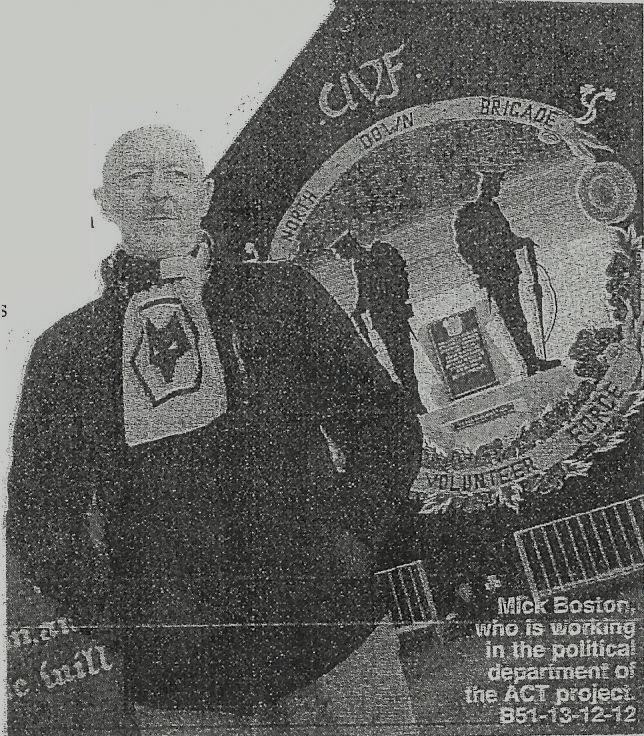
The ACT Initiative – North Down

From violence to peace… and now making a real difference in the community

Jason Boyd meets the ex-paramilitary members who have worked hard to find their place in modern Newtownards society Read more »

Share

SHOCK!!!…HORROR!!!…GERRY ADAMS and the word TRUTH in the same sentence.

In a column in last nights Belfast Telegraph–Thursday 11th April-Gerry Adams–IRA man–former Sinn Fein president and current TD for County Louth, gives an opinion on how governments have failed to honour obligations on crucial issues. His take on the GFA 15 years on is that we have “stable power sharing arrangements and political institutions that are working and continue to enjoy popular support”.  Arrangements being the operative word here.  What we have all these years later is certainly an arrangement–one between the $inners–who beforehand were totally opposed to administering British rule, but obviously dont have a problem now after they have discovered how lucrative it can be–and The Dupe$-who collectivelly would sell their souls to the devil–or highest bidder-an arrangement that is very cosy and will see both sets of lovers tucked up in that King sized bed that is Stormont for the forseeable future.
Adams continues in a similar vein where basically he copper fastens the old tenet”Dont let the truth get in the way of a good yarn”.  On this occasion he would have us believe that the Good Friday Agreement and the subsequent events since have given us ” an example of how deep rooted conflicts can be resolved”.  You’re having a laugh Gerry?  What the GFA and its aftermath has delivered to the already beleagured working class areas throughout Northern Ireland is more of the same and in many cases worse doses of it.  Can we honestly say that post GFA that we are less sectarian than we were?  That we are less suspicious of the “other side”?  Flags issues–the perennial parading issues–accusations of discriminatory tactics by ” both sides”–acute polarisation within the working classes–and particularly from protestant/unionist working class claims of being misled by elected representatives and of feeling disenfranchised.  Working class areas throughout Northern Ireland and Belfast in particular are most assuredly no better off than they were a decade and a half ago–despite what Mr. Adams says.  Perhaps if we are told something often enough then we will believe it.  Gerry argues that since the agreement Unionist leadership has sought to minimise the implementation of the agreement whilst republicans have argued for maximum implementation. When it suits Gerry.  He blaims failures of both British and Irish governments to implement certain issues–a Bill of Rights for instance.  For the north of Ireland he says..not Northern Ireland where his party help administer British rule.  And pointedly he also asks that issues such as an independent inquiry into Pat Finucanes death should be addressed along with the abuse of human rights–quoting examples like martin Corey and Marion Price–nut unashamedly leaving out clerical abuse–I wonder why–or the ongoing witch hunt by the HET inpursuit of elderly loyalist ex combatants.  But as always in good stories the best is left to last.  The punch line if you like.  I quote…” But it is in respect of a victim centered truth and reconciliation process that much work still needs to be done”.  Yes..he wants an Independent International Truth Commission set up where governments and ex combatants need to be part of the process.  Their can be no heriarchy of victims he says.  And you know what Gerry?  Virtually every reader would agree with all of these sentiments.  That is if they thought you were genuine and not lying through your bushy beard.  Lead by example on this  Gerry….start telling the truth on matters such as membership of the IRA—your continuing role as a senior figure in the Army Council long after the ceasefires and GFA—your involvement in atrocities like La Mon and Bloody Sunday–your role as chief judge/jury/executioner in the saga of the so called disappeared.  Hold your hands up to the McConville family and tell the TRUTH around the disappearence of their mother over 40 years ago.  Until you do it is highly unlikely that anyone in this country could give any credibility to you even uttering the word.

Share

The Volunteer: Anonymous

I was reading some poetry this morning and John Baileys poem The Volunteer urged me to write this little ode and it’s fitting due to the 100th Anniversary of the Formation of the UVF.

UVF & RHC Volunteers

Its been 100 years since the first falling in

And the call for volunteers did begin

Since then things have changed and conflicts have gone by

Yet still if we’re called we would still prepare to die

Years later the call for support came again

And new volunteers gave their lives without asking for gain

We secretly hope that none of us will fall

And our comrades don’t read our names on a wall

The damned politicians they don’t truly know

About the hurt they have caused in their “Ulster Says NO”

And for our family who can only just sit and pray

Please don’t volunteer please don’t leave us today

They don’t blame us for going as well they might

As the wardens lead us away they promise to write

Comrades reassure family that we will be well

But we all know our family will travel through hell

We never asked for richness for the service we give

Just a nice peaceful Ulster where we all could live

But if this time around Im the one that should fall

Just head round the corner and read my name from the wall

Anonymous

Share

Book Review from London School of Economics.

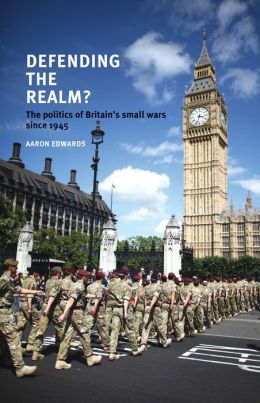
Book Review: Defending the Realm? The Politics of Britains Small Wars Since 1945

Aaron Edwards 

Britain is often revered for its extensive experience of waging ‘small wars’. Its long imperial history is littered with high profile counter-insurgency campaigns, thus marking it out as the world’s most seasoned practitioner of this type of warfare. In Defending the Realm? Aaron Edwards details the tactical and operational dynamics of Britain’s small wars, arguing that the military’s use of force was more heavily constrained by wider strategic and political considerations than previously admitted. Andrew Holt finds a concise, readable text that should be of interest to students and scholars of British foreign policy, international relations, and security studies.

Defending the Realm? The Politics of Britain’s Small Wars Since 1945. Aaron Edwards. Manchester University Press. December 2012.

Find this book: amazon-logo

In March 2003, British forces joined a US-led coalition in invading Iraq. Within a month President Saddam Hussein had been toppled. However, it was not until 2009 that British combat troops pulled out of the country, with the situation following the pattern of many other ‘small wars’. These conflicts, typically clandestine in nature and fought against non-state actors, “have been an integral part of British military experience for hundreds of years” (p. 2). They were particularly prominent for the United Kingdom in the aftermath of World War II as decolonisation progressed. Thus, as we mark the tenth anniversary of the beginning of the Iraq War, and with British troops finally on the verge of withdrawal from Afghanistan following the conflict that began in October 2001, now is an opportune moment to examine the contemporary historical record of Britain’s small wars.

In his new book, Aaron Edwards focuses on the strategic dimension of these conflicts, paying particular attention to relations between civilian and military leaders. The first five chapters consider colonial operations in Palestine, Malaya, Kenya, Cyprus and Aden respectively. Malaya is of particular interest. This campaign has often been highlighted as an example of how to successfully fight an asymmetrical war, yet it was far from an unmitigated success. Indeed, Edwards shows how “failure was only narrowly averted” thanks to the actions of the colonial government’s reorganisation of civil and military leadership (pp. 61–62). In contrast, “in terms of civil-military relations, Aden was an unmitigated failure” (p. 179) with Lt Col Colin Mitchell (‘Mad Mitch’) at the centre of events after leading the reoccupation of Crater in July 1967.

Closer to home, Edwards demonstrates how, despite its “intellectual reservoir of colonial experience”, “the Army was woefully unprepared for operations in Northern Ireland” (p. 193). This chapter is particularly comprehensive, no doubt benefiting from the author’s earlier research on Ulster. Taking place on home soil, the troubles represent a very different small war. There was the added complication of coordinating with the police, which was eased by 1977 by the ultimate emergence of police primacy. Managing the gap between London’s strategic lead and tactics on the ground also proved difficult, with ‘Mad Mitch’ warned of just this in the House of Commons after his election in 1970.

The final two chapters are somewhat different. The operations in Iraq and Afghanistan are too recent for the full range of archival sources to be available, though the author does make use of the material declassified as part of the Chilcot Inquiry. Both missions were also notable in the sense that Britain was part of a coalition, and eventually also had to liaise with a host nation. The chapter on Afghanistan would benefit from being from being a little longer, though it does highlight issues of political interference. On Iraq, Edwards is at times particularly damning, arguing that “Despite the dedication and professionalism of the armed forces in implementing government policy, the politicians failed the soldiers” (p. 252). Planning was rushed and hidden, with the Chief of the Defence Staff even prevented by the Defence Secretary from liaising with the Chief of Defence Logistics for fear that, if leaked, knowledge of such a meeting could damage the negotiations taking place at the UN.

Each case study engages the relevant literature and shows how lessons from earlier missions were applied – or not, as the case may be. Indeed, “it is the tendency to identify the wrong lessons that has often spelt disaster for Britain” (p. 267). Knowledge gained from Northern Ireland was misapplied in Iraq; the reasons for success in Malaya and elsewhere not suitably considered in Afghanistan. The importance of intelligence is another common theme, and is highlighted and elucidated very well. Again, lessons were sometimes learnt slowly. Structural problems of intelligence were identified in Aden despite its importance in Malaya, while intelligence failures were also partly responsible for the events of Bloody Sunday.

The book provides an excellent overview of a number of significant case studies, showing how “The initial absence of an overarching end goal has been the signature piece of most of Britain’s ‘small wars’” (p. 247). It is well-informed by the literature of strategic studies, but also handles an array of historical source material expertly. Government documents and the collections of private papers are supplemented by interviews with soldiers who saw active service. While acknowledging British successes where appropriate it concludes that “Britain has typically misapplied force against its irregular opponents in the short term, before, finally, re-calibrating its approach for success in the long term” (p. 288). The book is concise, readable and should be of interest to students and scholars of British foreign policy, international relations and security studies.

Share

Thatcher’s Legacy: Tory links to Ulster broken: Irish links to Britain built?

Dr John Coulter is a ‘Radical Unionist’ commentator and former columnist for the Blanket. He writes for the Irish Daily Star.
.
‘Maggie, Maggie, Maggie, Out, Out Out!’ That was a popular chant of the late 1980s. But that chant was not heard at a republican rally or a miners’ demonstration. This chant was being yelled by Unionists at a rally to protest at the 1985 Anglo-Irish Agreement.

As a young News Letter reporter, I spent late 1985 and much of 1986 tramping the damp and cold streets of Loyal Ulster producing column inch after column inch of copy on the Ulster Says No and Ulster Still Says No protests.

It is rather bemusing to see Unionists heap praise on the recently departed former Prime Minister Margaret Thatcher when in 1985/86, burning effigies of the Tory PM was the order of the day at anti-Dublin Diktat rallies.

Much has been made in the media about the so-called ‘celebration’ parties surrounding her death, especially in republican districts in Northern Ireland and mining communities in Britain. It makes me wonder what the reaction in Unionist communities in Ulster would have been if Thatcher had died of a sudden stroke in early 1986 instead of 2013.

I recall reporting on one of the biggest Ulster Says No rallies outside of the massive Belfast City Hall protest in my home town of Ballymena in North Antrim in 1986. On the platform sat the then Unionist leadership – Ian Paisley senior of the DUP, James Molyneaux of the UUP, and Jim Kilfedder from North Down of the Ulster Popular Unionist Party.

I looked up to see an effigy of Maggie being waved above my head. Suddenly, there was a loud cheer and the effigy erupted in flames above my head! I pushed people behind me to get away from the ‘flaming Maggie’ as moments later the effigy fell to the ground.

I just wonder what the thoughts of many of the thousands of loyalists who attended that Ballymena rally on that cold day in early 1986 are today with Mrs Thatcher now dead.

She was regarded as a devout supporter of the Union, yet from 15 November 1985, on the day she signed the Anglo-Irish Agreement with Garret FiztGerald at Hillsborough, she became almost as big a hate figure in Unionism in Northern Ireland as in the republican community.

When she died, did she redeem herself in the eyes of the Unionist community, or even had she been forgiven by the time of her political downfall in the early 1990s?

Thatcher the Snatcher was another nickname she was labelled with – that’s how loyalists came to hate Maggie after she ‘snatched the Union’ away from Protestants by signing the Anglo-Irish Agreement. Signed at her Hillsborough bolthole in Co Down with then Taoiseach FitzGerald, with the stroke of a pen Thatcher became the most hated woman in loyalism since the conflict erupted in 1968. In four years, the Tory PM went from hero to zero among loyalists despite her tough stance against the republican hunger strikes in 1980 and 1981.

While IRA hunger striker Bobby Sands MP saw an estimated 100,000 walk behind his coffin in 1981, Thatcher’s signing of the Dublin Accord four years’ later saw an estimated 250,000 loyalists attend a massive Belfast City Hall protest rally at which Paisley senior issued his defiant ‘Never, never, never.’ speech.

The Anglo-Irish Agreement gave the Republic its first say in the running of the North since partition in the 1920s. The Dublin Diktat, as it was dubbed, led to the formal opening of the Maryfield Secretariat near Belfast where Southern civil servants were based.

But in reality, did Maggie really become Thatcher the Hatcher rather than Thatcher the Snatcher? Did she hatch a plan to give Unionists an effective say in the running of the Republic, but they were so busy protesting they failed to see the political gift Thatcher had handed them? While some may suggest that in signing the Anglo-Irish Agreement, Thatcher laid the foundation for the 1998 Good Friday Agreement and the modern peace process, is the real legacy of November 1985 still to be written?

Is the true legacy of the Anglo-Irish Agreement the foundation for the Republic to rejoin the Commonwealth and for southern Ireland to join the United Kingdom in leaving the European Union? On the surface, Maryfield was an historic compromise which angered Unionists. Was it simply to get greater cross-border security to force the Provos to the negotiating table, and ultimately the 1994 ceasefire?

Unionism failed to return the serve of Maryfield. Unionists took to the streets in their tens of thousands instead of the then Unionist leadership demanding an effective say in the running of the Republic. Partition was The Great Betrayal when Carson and Craig condemned tens of thousands of Southern-based Unionists to their fate in a Catholic-dominated, nationalist-run Irish Free State. What about the contributions which Southern Ulster counties had made to the original Ulster Volunteers?

In 1985, Messrs Paisley senior, Molyneaux and Kilfedder should have been on the first train to Dublin to open a Unionist Embassy in Leinster House and demand that the Dail address the faults of the make-shift banana republic. Perhaps in 1985 if Unionism had whined in Dublin rather than walked in Ulster, the IRA and INLA would have been brought to their knees sooner than the 1990s?

The anti-Thatcher ‘Ulster Says No’ campaign saw a mobilisation among loyalists not witnessed since the Ulster Workers’ Council strike of May 1974 which collapsed the Sunningdale Executive. However, just as Thatcher had faced down republicans over the hunger strikers’ demands, so too, she was equally determined to face down loyalist demands to ditch the 1985 Agreement.

Not only did moderate Unionists mobilise by joining the mainstream Unionist parties, but Thatcher’s determination to keep the Agreement saw a huge boost in membership of loyalist death squads such as the UDA and UVF. It also sparked the creation of numerous new hardline groups as loyalists frantically searched for means to topple the Agreement. Working class loyalists launched the Ulster Clubs movement, which was a mirror image of the Unionist Clubs network formed in the early 1900s to combat Home Rule for Ireland.

The most notorious of the groups was the red-bereted Ulster Resistance, once openly supported by former and current DUP leaders and First Ministers Ian Paisley senior and Peter Robinson. Army agent the late Brian Nelson arranged for a huge consignment of South African weapons to be smuggled into the North for Ulster Resistance, the UVF and UDA, a move which resulted in the murders of dozens of nationalists.

The extremist Movement for Self-Determination (MSD) was also launched to campaign for an independent Ulster, with the racist National Front also arriving in the North to try and take advantage of loyalist unrest.

The Agreement also ended the historic link between the Ulster Unionist Party and Thatcher’s Tory Party when the Ulster Unionist Council withdrew from the National Union of Conservative and Unionist Associations. When she gave her blessing for the launch of Conservative Associations in the North, the project quickly floundered such was the anger against her. While many who established the Conservative Associations in Northern Ireland in the late 1980s were themselves Right-wingers and loved to be photographed with Thatcher, the immediate legacy of the Anglo-Irish Agreement meant that the Tory move into Ulster was doomed from the start. What right-thinking Unionist would vote for the party which had signed away the Union?

In 1985, Thatcher was seen as a traitor by Northern Ireland Unionism for signing the Anglo-Irish Agreement. That was her immediate legacy among the Unionist community. But when – not if – the Commonwealth standard flutters over Leinster House, and as the south grows through Ulster ever more interconnected with the mainland, Unionist history may quickly rewrite her legacy.

Share

Not Enough Has Been Done To Uphold The Good Friday Agreement: David McCann

Column: Not enough has been done to uphold the spirit of the Good Friday Agreement

It’s true Northern Ireland has come a long way over the last fifteen years, but we cannot afford to hang the ‘mission accomplished’ banner over the peace process, writes David McCann.

                                        David McCann

WE ARE FAST  approaching the fifteenth anniversary of the signing of the Good Friday Agreement. When the deal was eventually agreed there was a palpable sense of hope that after thirty years of violence and 3,529 deaths that the Northern Ireland problem had been solved for good. Ever since then despite all the challenges the agreements basic principles of power-sharing and inclusion are still intact. At the last election just one MLA was elected on a platform to dismantle current institutions in Northern Ireland.

So we have a durable form of government with broad popular support what on earth could possibly be wrong with that?  Scratch the surface and there is quite a bit. In any debate about political life in the North we tend to get hypnotised by this argument that we should simply be grateful that the province has a functioning government. Yet more than a decade after the signing of the agreement I think it is now time that we started asking what exactly the current executive in Northern Ireland is doing to help heal our divided society.


Read more »

Share