
From violence to peace… and now making a real difference in the community
Jason Boyd meets the ex-paramilitary members who have worked hard to find their place in modern Newtownards society
It has been a challenge convincing people they are no longer ‘the men with woolly faces’, but as two ex-paramilitary members told the Chronicle, an initiative helped them move away from violence and become advocates for resolving conflict peacefully, and it can do the same for others.
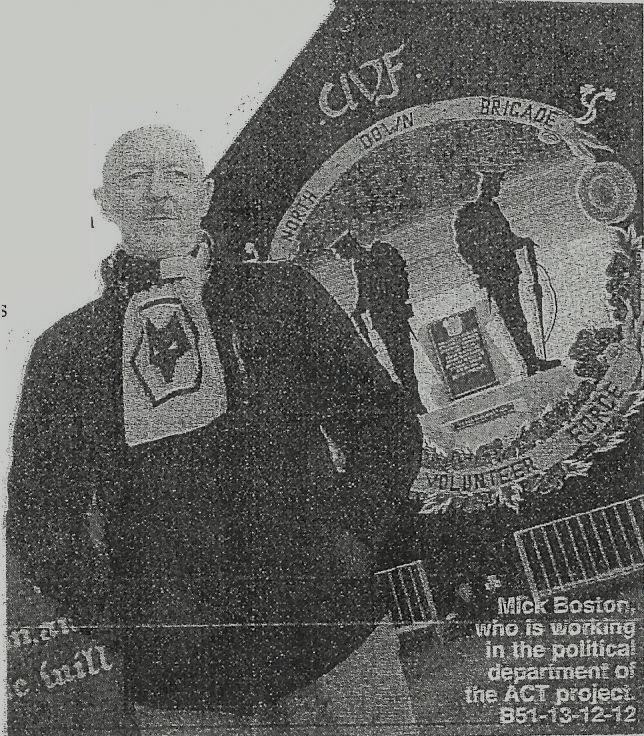
Leaving a background of paramilitarism and becoming active members in their local communities is the aim behind the Action for Community Transformation (ACT) Initiative, which was set up in 2008 and has slowly been gaining ground across the whole of North Down as more ex-paramilitary members get on board.
When the Good Friday Agreement changed the face of politics and governance in Northern Ireland in 1998, paramilitary groups recognised that they no longer had a future in this new society and demobilised. This included the Ulster Volunteer Force (UVF) and Red Hand Commandoes (RHC), which had a particular stronghold in the Ards Peninsula and the rest of North Down.
However, for those ex-members, this new society was one that many of them struggled to find a place in, and it was out of this that ACT was developed.
David Carson, from the Bowtown estate, and Stephen Clarke, from Bangor, are both ex-prisoners but now play key leadership roles in ACT across North Down, overseeing its workshops, meetings and liaising with other organisations. They told the Chronicle one of their main objectives is to make sure others do not go through what they did.
Despite having a positive impact on his life, David said it took him a while to accept ACT: “I wasn’t sure about it, to be honest.” When he saw that society had changed he realised that he had to as well: “This was one of the reasons why I felt it was important to educate others – to lead to a peaceful society. No one else was going to do things for other people, so we took an attitude: nobody helps us so we’ll help ourselves.” This included a change in mentality and further education, which he now hopes others will follow.
And looking back, how has ACT impacted them? David said: “The most important thing I learnt – although I don’t apologise for what I did, because I felt what I was doing was for my country – is that there’s different ways to get things done. I thought at this time there was only one way.” His experience in prison also added to his determination: “I got nothing out of going to jail but misery. When your cell door closes and you’re looking at a roof you think, why did I do this?” Going to prison also greatly impacted his family life. His mother and father raised him in a Christian home but when police lifted him in Markethill carrying ammunition ‘it was a shock to my family.’
“My son’s 16 years of age,” he said. “He was seven years old when I was lifted. I don’t want him going through the same thing that I did.” He added that, even now, so many years later, he’s still trying to repair relationships. However, his parents got the chance to see him join ACT and move away from paramilitarism. Similarly with Stephen: “I think I have a better understanding of diversity now within society in Northern Ireland. I think it’s very important to recognise society is diverse, especially in the North Down area, because you have Roman Catholics, Protestants, Eastern Europeans living together now. We’re trying to promote diversity amongst our guys to make them politically aware and respectful to other communities. We certainly didn’t have that when we were growing up through the 80s and 90s.”
Some of the challenges that they face include making sure young people do not feel they have to go along the paramilitary route, even though no paramilitaries operate in North Down. “Our main objective now is to install confidence into young people, to make them feel that there’s somewhere where they can go if they have problems,” Stephen said. “Anti-social behaviour can be addressed in different ways than it would have been years ago – we’ll go out and speak to the kids involved and we’ll try to make them aware of the youth clubs in the area, there’s things they can do, they can come here and do computer courses, they can go online at night time if they want to. We’re trying to promote a bit of a more community sense of well-being, where the men with woolly faces are no longer here, and we think it’s important to do that.” David added that it was a problem at the beginning when people did not want to work with the PSNI, but that attitude had begun to change, especially now when they see that those who were once on the other side of the law are now working alongside the police.
As well as anti-social behaviour, alcohol and drugs addictions are two of the biggest issues that involved the men interacting with the community as early as possible. David noted that methadone addiction had become a problem with youth in the estates, but, despite the common perception, it is not just young people who struggle with it. Both men highlighted that many ex-paramilitary members, and especially those who served life sentences in prison, had become addicts because they found it hard to adapt to the changes in society. David recalled that he knew of some who purposely reoffended so they could be put back into ‘familiar’ prison and for some others the strain was so big it led to suicide. ACT provides a new programme for such people, called ‘Who Am I?’, which gives them the opportunity to spend a residential weekend away to ask important questions about themselves and come to terms with their life. “So, again, it’s about trying to interact with guys who maybe would have been involved in the movement 30 years ago who feel they’re shunned by their community,” Stephen added: “I think it’s important to realise that’s a big thing in loyalist working class communities. At times we have this feeling that, if a republican went to jail he was accepted back into his community with open arms, where, if a loyalist goes to prison he struggles when he comes home.”
To date, over 70 people are involved in ACT across North Down, with more in the pipeline. As Stephen said: “We’ve got 15 other guys in training here as well. They’re undertaking two courses in OCN: Understanding Diversity in Society and Confidence Building.” As well as that they frequently hold cross cultural days with the youth, taking them to meet young people from the Bogside, who in turn visit the estates here. All of this is with the goal of broadening their understanding of what it means to be Irish and British.
Whilst the programme is still in its early stages, Stephen added: “We’ve touched base with local MLAs – with Mike Nesbitt, with Jim Shannon – with the PSNI – Sergeant David Lindsay. We work closely with Mike Harris from Community Police. We’re also working with North Down Community Assistance and Bangor Alternatives. So, we’re trying to create links with statutory bodies and community groups to make them more aware that we’re here”.
Charlie Kincaid, one of the men behind kickstarting the ACT initiative in North Down, told the Chronicle that while they supported the peaceful protests in support of the union flag, they condemned the recent attack on Alliance councillor Linda Cleland’s home in the Bowtown estate. He said that it was not carried out by local people.


