Review of “Meeting at Menin Gate”: Primo

The Road to Menin Gate.


I went to see this play, and as I have seen many of Martin Lynch’s plays, had a rough idea of what would happen. Victim’s daughter meets her father’s killer.  Angst, anger, resolution.  I was slightly out there and I didn’t see what was coming, which when it did was excruciating at times to watch (or endure).  It was a play of two halves.  It was dichotomous, which reflects nicely, I suppose, the situation in our ‘wee country’.

The play was well acted, but poorly attended.  I would recommend seeing it – unless torture is not your thing.  The first half of the play is pretty standard and concentrates on developing the backgrounds of the two main characters.  At the break you are left wondering how the policeman’s daughter is going to react.  She does react and not half. She obviously has problems and issues from the loss of her father some 30 years prior and I suppose Lynch gives vent to how some people feel but can’t express those feelings in ‘proper’ society.

I see the play on a number of levels with different themes.  First of all victims.  An unsolvable issue for our society with our attitudes and history.  True forgiveness is so great because it is so rare. Here a victim can give vent to their pain and hurt on a target.  But this is victimhood verging or toppling into psychosis and becoming as bad as the perpetrator?  There is also a release. A violent catharsis? I think Lynch is extremely brave to cast the victim as dancing, singing and nearly in rapture at the realisation she has captured her father’s killer.  And inflicted a lot of directed pain and suffering. Two wrongs making a right?  Maybe in our wee country.  The social narrative is that victims are nice, long suffering and sombre.  The problem with N.I is that there are 3 social narratives going on as regards victims hence the confusion and intractability.

But I could view the two characters as two of the main ‘chunks’ of society today.  The woman as law abiding, middle upper class ‘decent’ core unionists.  The man  as, well,  violent republicanism, Sinn Fein, et al.  The play shows up one image of how things would be if those unionists could give vent to their hurt if only they could get the Shinners hamstrung the way poor Terry ends up.  And would the unionist victim’s gloat and rage over their captive?  Some would.  Of course that is not going to happen.  Terry does his best to explain what he went through and the very human feelings of guilt with ending two men’s lives. (Be they brits, peelers or whatever other label you wish to use).  I was left with a huge question.  Terry eventually– under torture– apologies and admits murder. But did he really kill/murder/execute her father?  I don’t know.  At some point she has lost the realisation that she isn’t after the truth. She is after plain old common revenge.  All in all this was a great play looking at some really complex issues.  I am left wondering  if one of the plays messages is  that, if we took all the killers and forced confessions out of them by torture that everything would be fine.  Is this the way to resolve the Troubles legacy issue?  I don’t think so.

Primo


Share

From Cage To Block: End of an Era: June 1988: Primo

The Leaving.

It is June 1988. A little part of prison history is taking place. Set inside the history of the troubles this event does not rank high. However we are the remnant of the men who conducted the violence of the early 1970s.

I am special category prisoner, a lifer who has served most of my time in Compound or Cage 21 of the Long Kesh prison camp. But today we are leaving that all behind.  We remaining lifers are going to H 2, across the wall. We have packed all our stuff in boxes that have been sent on ahead.  We are taken, a small group at a time, in the prison mini bus. The windows are covered over ‘for security reasons’. There are many mixed feelings.  Firstly there is fear.  We are placing ourselves in the hands of a prison regime that for years was hostile, vindictive and political in it treatment of us. We are now trusting them to honour an under the table deal that sees us go to a H Block in order to end the compound system and the reward is that we will get out sooner.

Another feeling is excitement. We are going somewhere new. Over the last decade we have walked every square inch of this space. We watched summers come and go, endured the winters which painted the wire white with hoar frost.  The rains that battered the round tin roofs. We seen 1000 sunrises and sunsets. And on a grey overcast day with the greys of concrete walls we were like in one giant grey foreboding box. This move is a step along the life sentence.

Another feeling in this strange mix, and one that puzzles me,  is one of sadness. How can I be sad to see the end of this? My dream was to get out of it? But this place has seen a full decade of my life. I came in as a teenager and now I’m leaving as a thirty something. I suppose its the memoires. God knows there was some dark times.  Days of fear. Fights, disputes. A furious rage as maturity takes hold and you know what you are missing. But it is the memories, the good ones, that outsiders won’t understand. We had good times. We had to make the best of our situation. And indeed there where many more good men here than bad. There was the joker s, the fools, the wise, the deep, the psychos and the rest. This is where you find true friends. I recall on night crying with laughter at the antics of some of men in the hut. Wee H from the Bay playing the waw waws. A from of music that will never reach the charts(I hope).  But this still is a hard place. Kindness and softness  aren’t in abundance here but they exist between friends. We were a small community bounded by our past deeds and beliefs. Our common purpose.  A meaning that will survive these walls.

During our time here, and through all our protests,  we seen the hunger strike pass by. Only 500 yards over a wall but a million miles from us. We watched and cheered in ‘85 as Mc Guigan took a world title. We watched the space shuttle burn and crash. We spent a Saturday watching Live Aid, first in London then New York. A great day. We had raised money for the charity by donating money from handicrafts.  We enjoyed the Boys from the Blackstuff. We watched in with disbelief as Stoner done his thing. Feeling and anger was stirred as we watched 2 men, 2 soldiers, being slaughtered. Supergrasses trials came and went. The screws strike. Stand offs with the screws. An attempted escape ending in death.  The Cup finals and Matches of the day.  Men released never to return.

I got a Degree and also learned how to fight properly. Met up with an American Kennedy and men from the International Red Cross. We learned about ourselves and the ‘other side’. The endless drilling now a memory. How many wallets and purses  where produced in those years? All the visits from family and friends. The many times we cleaned those toilets, the study hut, the canteen and our cubes. Painting the huts.  All those searches. The Christmases. Snowball fights and pushing weights. A unique jumble of memories. I leave this all behind.  I am sad. I am happy.  The mini bus door shuts. I will never be back here.


Primo.

Share

LOYALIST HAASS TALKS COULD BE BLUEPRINT FOR SYRIA: DR. JOHN COULTER

LOYALIST HAASS TALKS COULD BE BLUEPRINT FOR SYRIA


The forthcoming Haass talks to resolve the peace process crisis provide Loyalism with the perfect platform to become a template for a diplomatic solution to the Syrian crisis. Radical Unionist commentator and former Blanket columnist, DR JOHN COULTER, outlines his controversial thinking.

Not one drop of Ulster military blood must be spilt in Syria!

At first reading, this article may seem as going totally against my stance that the United Kingdom should have used tactical nuclear weapons against Saddam Hussein in Iraq, the Taliban in Afghanistan, and if the Western powers had needed – used nukes against North Korea.

I am completely against any Allied attack on Syria, not because I have become some kind of trendy, liberal peace campaign, but because it would be a huge tactical error and a complete waste of previous troops, many of whom will have Northern Ireland connections.

Just as the Irish conflict has been a sectarian was within Christianity – Protestants against Catholics – so, too, the Syrian crisis has become a vicious sectarian conflict within Islam, especially between the majority Sunni Muslim faction in Syria, and the Middle Eastern state’s minority Shia Muslim community.

Given this scenario, why would American President Barack Obama want the green light to send in his bombers against Syrian dictator Bashar al-Assad, thereby embroiling some of the Allied powers in what is only a muslim civil war?

If Iraq and Afghanistan are benchmarks, air raids will soon be followed by ground troops and the Yanks will commemorate the 40th anniversary of the start of the Vietnam War by invading yet another nation and butting their noses into a religious conflict.

‘Basher’ Assad is kicking the asses of the radical Muslim Brotherhood-run Free Syrian Army.

Okay, Shia Muslim ‘Basher’ may allegedly be using chemical weapons against the Sunni Muslim rebels, but if Obama’s planes begin bombing, the real people to suffer will be Syria’s 2.5 million Christians, who comprise 10 per cent of the country.

Ironically, ‘Basher’ Assad has a reputation of being more tolerant of Syrian Christians than the fanatical Muslim Brotherhood leaders of the anti-Assad rebels.

Many American and British troops are of Irish and Ulster decent. How many Irish and Ulster families lost loved ones in the needless conflicts in Iraq over Weapons of Mass Destruction which did not exist, and in Afghanistan to eliminate the heroin poppy industry?

We should not forget, that in many global conflicts, Ulster-born or Ulster-related troops have paid a key role. In 2016, the island of Ireland will commemorate the centenary of the opening day of the bloody Battle of the Somme on 1st July, 1916, when the British forces suffered some 56,000 casualties.

The 36th Ulster Division – formed from Lord Edward Carson’s Ulster Volunteer Force – suffered particularly horrific losses with some 5,500 casualties. Indeed, many Catholic nationalists who had signed up for the Crown and fought with the 10th and 16th Irish Divisions also suffered terrible casualties.

As the current Syrian crisis deepens on a daily basis, even with Obama struggling to compile a fledgling alliance to gain support for either bombing raids or missile strikes against Damascus, we should remember the words of the United Kingdom’s famous Second World War Prime Minister Winston Churchill – it is better to jaw jaw than war war.

If the Loyalist delegations at the Haass talks on issues affecting Northern Ireland can bring about an agreed solution which maintains the peace process, then the Loyalists’ Haass solution could become a major template for the Syrian crisis.

If the Haass talk run aground, the peace process will be in serious jeopardy, especially with discontentment in the Loyalist community running at an all-time high.

All the indications point towards the fact that a violent dissident loyalist terrorist network is emerging in the aftermath of the recent Marching Season and Union flag riots.

Indeed, a new dissident loyalist terror movement of three-man cells is being formed to attack the police, Sinn Fein, and Parades Commission members, according to a key loyalist strategist behind the new movement.

Speaking exclusively to me, the loyalist source revealed the cells also planned to attack a future republican parade – preferably a dissident one – with snipers.

In an equally chilling warning, the loyalist strategist behind the planned movement said that some DUP politicians “who have let the loyalist people down” would also be targets.

“Unionism needs strong leadership at this time from the top. We are not getting this from either the DUP or UUP. We need a traditional unionist from the old school of Unionism to lead us.

“We cannot see the point of attacking the Irish Republic as the battle will be in Northern Ireland. There is no point in adopting the republican view that one bomb in London is worth 100 in Belfast. We will get no support if we target places in Great Britain.

“The DUP is heading for a downfall because it has lost the discipline at grassroots level. The PSNI cannot live in Protestant areas without the support of the Unionist people.”

Referring to the recent riots around a contentious anti-internment rally in Belfast by republicans, the loyalist strategist said: “It seemed initially that loyalist tactics were working – flood the centre of Belfast with loyalists and bring the place to a literal standstill.

“But then the police began attacking our people with batons and water cannons. If our snipers have to shoot at the police, they will.

“This is not like the early Drumcree standoffs where many of the police officers were locals and known to people. Many of these riot cops used against the loyalists are from outside Northern Ireland, so we won’t be shooting our own.”

Another loyalist source not connected to this new dissident loyalist network had claimed that gunmen armed with M16 automatic weapons were among the loyalist crowd in Royal Avenue ready to shoot republicans if the anti-internment parade made it to the city centre.

There have been unsubstantiated claimed these gunmen were from the banned UVF. During disturbances following that anti-internment parade, more than 50 officers were injured according to PSNI Chief Constable Matt Baggott.

The loyalist strategist’s chilling warning sparked memories that the first police officer to die in the past Troubles was 29-year-old Protestant Victor Arbuckle who was shot dead by the UVF in the loyalist Shankill during serious rioting.

My source claimed the key pulses of the new loyalist dissident movement would be East Belfast, the Shankill, Whiterock, Carrickfergus and Coleraine.

“Sinn Fein is trying to create a situation whereby dissident republicans fall into line behind the mainstream republican movement. The effect of our campaign will be to bring British troops back onto the streets of Ulster – which is what Sinn Fein certainly doesn’t want.

“But the gamble we are taking is that if the Army does come back, would they start shooting at us loyalists?

“Loyalism is facing new threats from republicans. Take their Tyrone Volunteers parade. It was always held in a solidly republican area. Now they want to push the barriers that wee bit further by bringing the parade to a Protestant area.

“We have to be very careful how we organise as loyalism – like the dissident republicans – has been totally infiltrated by MI5 and MI6. There are people in loyalism who would sell themselves for a pint of beer.

“The lone wolf tactic of a single terrorist acting alone, which is favour by the extreme Right, is no use as people are not fully trained.

“The dissident republicans use cells of five members, but these can be infiltrated by the security forces, so we will use cells of three. MI5 and MI6 are now so sophisticated that you can no longer use conventional electronic devices.

“We want to base our network on the Greek terrorist structure – teams of three not known to each other. Even if one cell is taken out, it does not mean the end of the organisation.”

This was a reference to the Greek Cypriot terrorist group, EOKA, formed in the 1970s against British rule in Cyprus. EOKA stood for Ethniki Organosis Kipriakou Agnonos, which is Greek for the National Organisation of Cypriot Struggle.

“It’s like the honeycomb effect – just because you empty one comb, doesn’t mean the whole honeycomb is emptied. The smaller the cell, the more effective we become. The weakness will always be on how we train a cell.

“Once an overall training network is set up, that’s when it becomes infiltrated by MI5 and MI6.”

This is not the first time a dissident loyalist terrorist group has been established. In the aftermath of the original loyalist ceasefire in 1994, the leading Mid Ulster UVF terrorist Billy ‘King Rat’ Wright split from the Belfast-controlled terror group to set up his own Loyalist Volunteer Force.

After the 1998 Good Friday Agreement, other dissident loyalist groups emerged including the revamped Orange Volunteers, the Red Hand Defenders, and the Real UFF.

While mainstream loyalists rallied to the banner of the Combined Loyalist Military Command which called the 1994 ceasefires, dissident loyalists formed their own umbrella group called the Protestant Military Alliance.

The challenge, therefore, facing any Loyalist delegations at the Haass talks is to ensure that this emerging dissident Loyalist genie is returned to its bottle and the lid on that bottle firmly sealed.

Even if the Loyalists succeed in restoring peace in Northern Ireland as a result of the Haass initiative, it may not be enough to be a successful negotiated blueprint for the Syrian – and indeed, the wider – Middle Eastern crisis.

The influential Egyptian Society of Northern Ireland has its finger on the pulse of the crisis. In July 2012, there was a cautious welcome for the then Muslim Brotherhood-backed President Mohamed Morsi, who had overthrown the dictatorship of Hosni Mubarak.

But Morsi is out of power and the remnants of the Brotherhood have resorted to a vile terror campaign against the police and army in Egypt. As the Brotherhood has lost its street support, its more militant members have formed a brutally violent dissident Islamic faction, with some linked to the al-Qaeda terror network formed by the late Osama bin Laden.

The Muslim Brotherhood was formed in Egypt in 1928 by an influential religious leader, Hassan al-Banna. Rather than a political movement, al-Banna wanted the Brotherhood to become an Islamic religious organisation which would spread a militant Muslim message well beyond the boundaries of Egypt.

Ironically, just as in 1928, the modern-day Brotherhood aims to put in place an agenda which is attractive to young Muslims. Its leadership wanted the Brotherhood to spread globally under the banner that it was a radical religious movement to combat the spread of atheistic communism.

In Egypt, the Brotherhood was blamed for an unsuccessful assassination bid on one president and the successful murder of another. Under Morsi, the Muslim Brotherhood came to power for the first time after years of persecution, but quickly began to mishandle the situation in the country.

Morsi’s major problems stemmed from the fact that he began to release Muslim Brotherhood prisoners similar to the way in which in Northern Ireland, Loyalist and republican inmates were given early release under the terms of the 1998 Good Friday Agreement. As with Northern Ireland, this created a lot of concern in Egypt.

Morsi was also hit with a petition signed by 22 million Egyptians calling for him to call a referendum if he should serve his full term as President, or should be call elections and step aside immediately. Morsi’s refusal to grant a referendum sparked the second student-dominated revolution which overthrew both Morsi and the Muslim Brotherhood.

The Muslim Brotherhood would never accept offers of talks, demanding that Morsi be re-installed as President before any negotiations for a new Egyptian constitution could begin – a demand the majority of Egyptian people rejected.

The Muslim Brotherhood still see Morsi as the rightful President. Initially, the Brotherhood’s sit-ins were peaceful, but soon guns were produced at the ensuing riots. The Egyptian army took decisive action to dissolve the Brotherhood sit-ins, but the Brotherhood began arson attacks against police stations in retaliation.

With the arrests of the Brotherhood leaders, the organisation is becoming more hard core and more violent. Essentially, the Muslim Brotherhood is trying to convert the political situation into a religious crisis.

In Syria, the people of the Free Syrian Army don’t want to talk politics – they want to talk about the situation as if it is a religious conflict among Muslims.

Two Cairo university students, brother and sister Bassem and Nouran Fawzy, told me how they risked their lives to take part in the two Egyptian revolutions, firstly against Mubarak and then against Morsi.

They want the liberal politician Mustafha Hegezy to become president as he is a big hit with Egypt’s youth. Just as we have the scourge of the ‘brain drain’ in Ireland where thousands are leaving the island, so the common chant of many Egyptian young people is – ‘happiness is leaving Egypt’.

While the Egyptian and Syrian conflicts are internal, Northern Ireland should not tumble into the pitfall of dismissing them as a Middle Eastern problem. Like both world wars of the 20th century, there is the real danger Syria could escalate into a global conflict.

Many in the anti-Morsi camp suspect the Brotherhood has been funded to the tune of eight BILLION dollars by Obama, who basically wants to use the Brotherhood to control as many states around Iran as possible.

Obama has been left with egg on his face because the Brotherhood has lost power in Egypt.

Many Egyptians draw a comparison with the Americans trying to run the Brotherhood with the way in which the British manipulated Sinn Fein through agents, informers and funding to eventually run a partitionist parliament at Stormont.

Allied involvement in Syria is only a springboard for the real offensive – the invasion of Iran. The US wants to use its manipulation of the Muslim Brotherhood to control the Middle East.

The Brotherhood now has significant grip in Libya, Tunisia, and Yemen, with links to the al-Qaeda movement.

Obama’s billions were to be used by the Brotherhood to placate Israel by expanding Gaza and the Sinai area for the Palestinians.

The Syrian conflict is an inter-muslim civil war between the Yank-funded Brotherhood and its pals in Hamas, and ‘Basher’ Assad with his Shia mates in Iran and the radical Hezbollah terror group.

To bring real peace to Syria, if the Assad regime is toppled, it would be best if a moderate Sunni Muslim became the new democratically elected President. The Muslim Brotherhood in Egypt – because it is closely aligned to the Muslim Brotherhood in the Free Syrian Army – wants the US to strike in Syria.

Liberal Egyptians activists who do not support the Muslim Brotherhood warn that the Brotherhood has been attacking Christian churches, cathedrals, shops and homes when it was in power in Egypt. The same fate awaits Syria’s Christian population if the US and UK backed Free Army wins in Syria.

Throw into this mix that the US can use Syria to attack Iran. American forces may even use its NATO bases in Turkey to attack Syria.

Iraq is already descending into an Islamic civil war, and Afghanistan is going the same way. While an Egyptian royal family exists in exile, young anti-Muslim Brotherhood activists insist any return of the monarchy is a non-starter.

Clearly, too, some of the Gulf states, such as Saudi Arabia, are worried by the spread of the Muslim Brotherhood and especially at Obama’s perceived support for this radical Islamic movement.

Let’s hope Obama has a Biblical-style Road to Damascus conversion about bombing Syria, because like many wars over past centuries, it will be people from Northern Ireland who will do the fighting and dying.

Could hope be on the horizon? If the Loyalists can use the Haass initiative to bring an end to the sectarian strife in Northern Ireland around parades, flags and emblems and the street protest, then just maybe more Ulster lives can be saved if that template can be applied to Syria.

It does seem very strange, however, that supposedly Christian Western leaders are backing the vehemently anti-Christian Muslim Brotherhood in the Syrian crisis. The bottom line is, Syria is really only a training exercise for the real agenda – the full-scale invasion of Iran. Then again, at what point does Israel decide to enter the conflict?

And just because the Haass talks yield results in Northern Ireland, does not mean success in Syria.

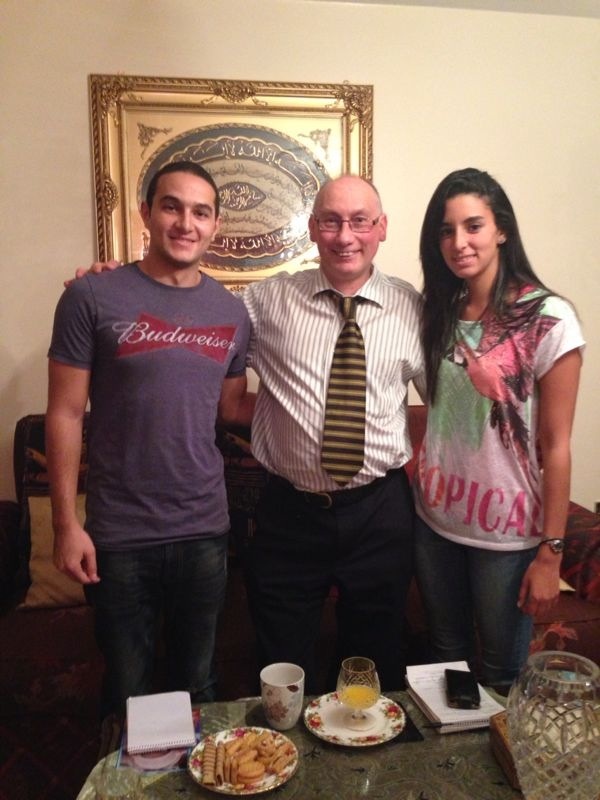
Our caption shows Radical Unionist commentator, Dr John Coulter, (centre) with Cairo university student activists who took part in both Egyptian revolutions, brother and sister Bassem (left) and Nouran Fawzy.


Share

The ACT Initiative – Greater Shankill

Three years ago the Springmartin community in West Belfast decided to build a small garden of reflection to remember the sacrifice of those who fought at the Battle of the Somme. The stunning 3 column monument was the work of local artist Ross Wilson, the columns remembered the men of the 10th and 16th Irish Division, the West Belfast Volunteers and the 36th Ulster Division.
Read more »

Share

Interesting Report from the Mid Eighties.

Share

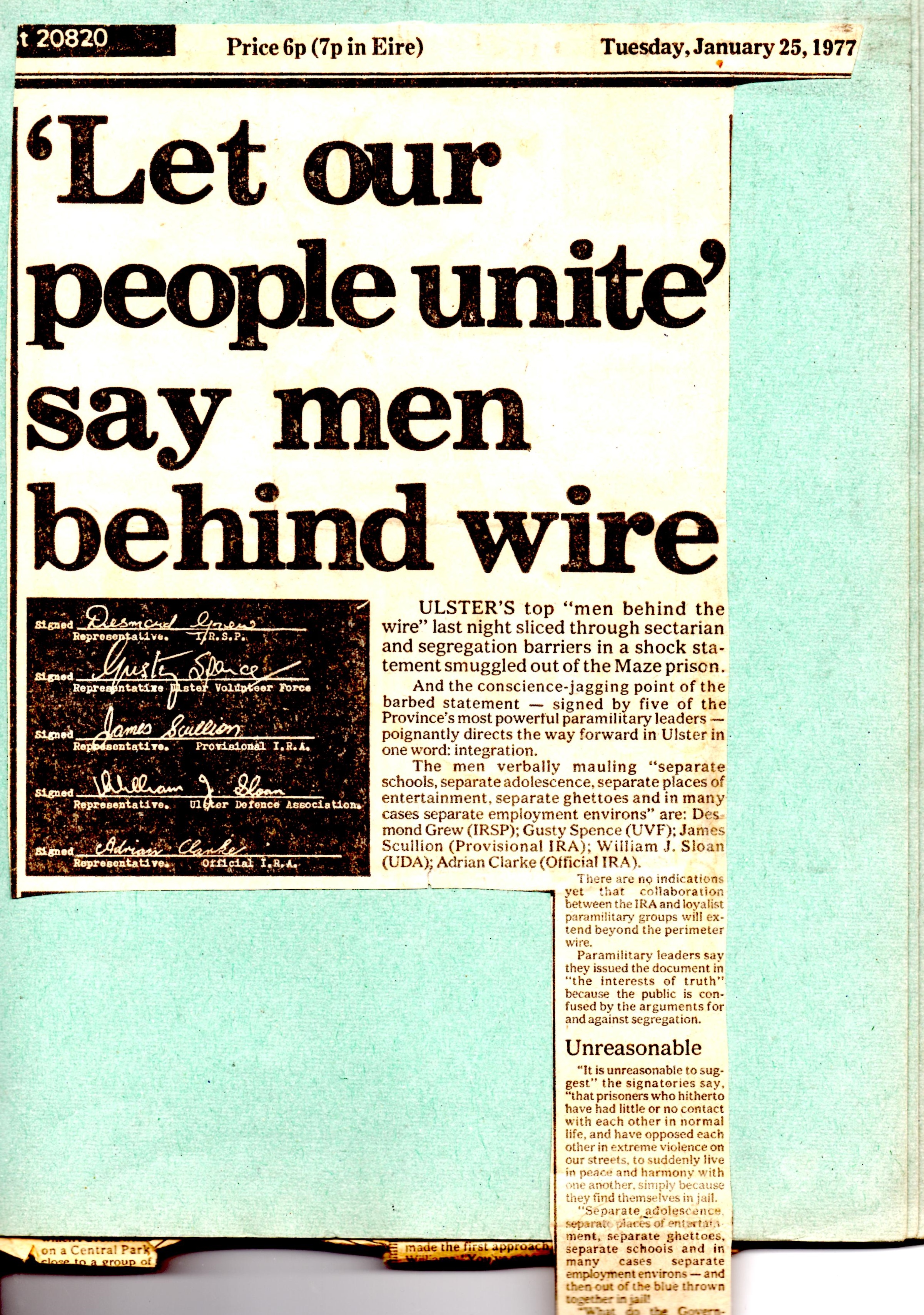
Joint Statement From Behind The Wire:January 1977

This remarkable excerpt from a daily newspaper dates back almost 40 years.  The original cutting was kept as part of a scrap book which had a starting date of October 1976 and was the property of a UVF Life Sentence prisoner who at that particular time was incarcerated in Compound 19.
It clearly shows that even in those darkest of days that many of the so-called protagonists were thinking of a positive way forward.  As was aptly illustrated in Tony Novosel’s recent book–The Frustrated Promise of Political Loyalism–loyalists-in the shape of the UVF/RHC were quite prepared to take chances for peace.
It is through articles such as this that people of today can look back and learn about the attitudes of ex combatants.  It will also illustrate in a very clear way that many of these far sighted initiatives were condemned to the dustbin by those who are now firmly esconced in power–the same people who were quite prepared for the “commoners” to continue fighting until their own selfish dreams were fulfilled.

Share

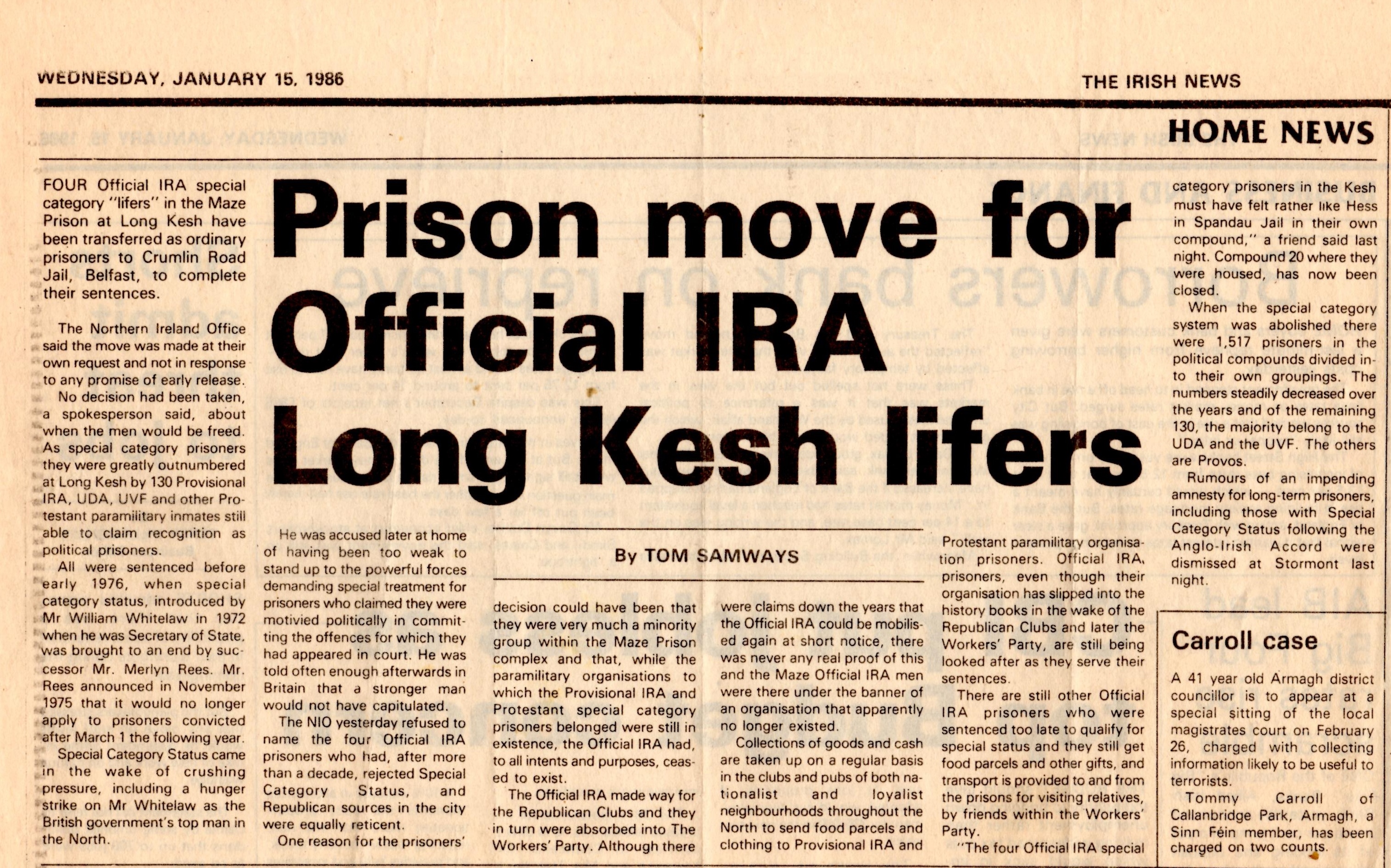
Compounds Closure: Late 80’s Long Kesh

As this article in the Irish News shows plans were implemented as early as 1986 to close the special category compounds.  This article tells the story of the closure of Cage 20 which then housed the remaining Official IRA-Stickies-prisoners.  Just over a couple of years later the remaining UVF/RHC political prisoners were transferred to H2.

Share

A Little Bit of Long Kesh History: Primo


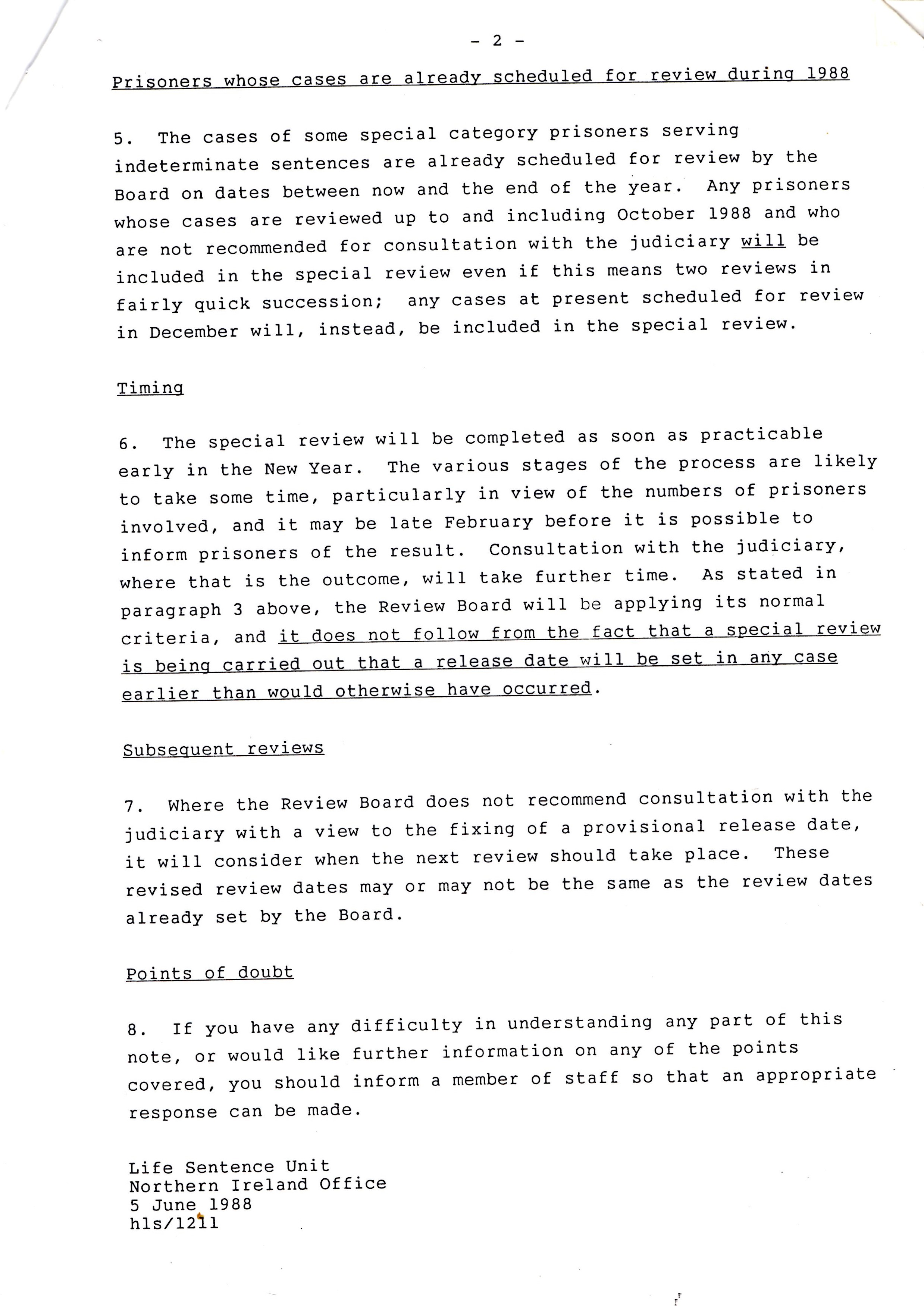
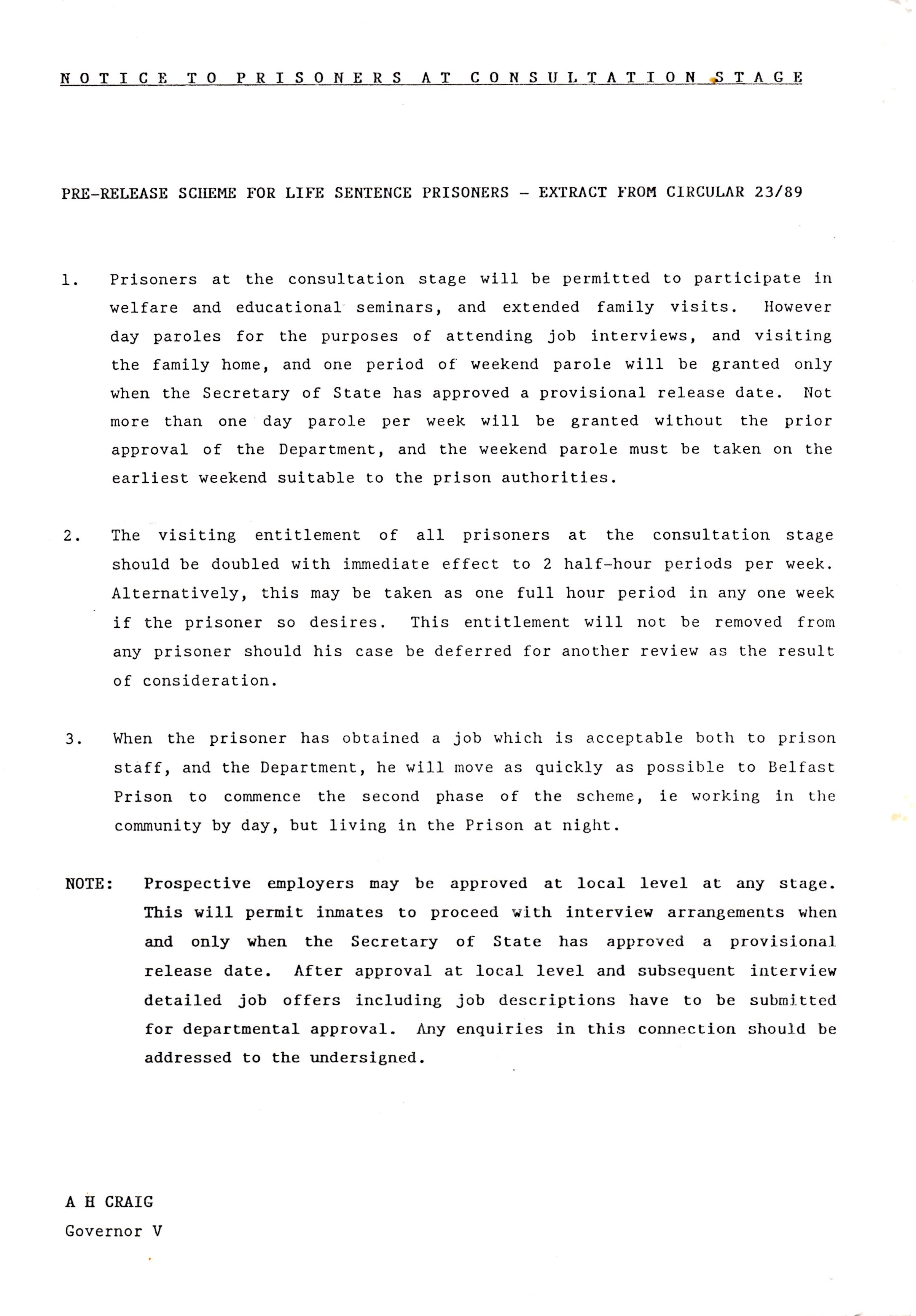
With the granting of political status in late 1972 the compound-or cage-system was set in place to house those prisoners who were deemed to be politically motivated.  Four years later and government policy had changed with the inception of the new H blocks where those still deemed to be incarcerated for politically motivated “offences” had to endure a system set in place to criminalise them.

The compounds that remained from a UVF/RHC perspective diminished in keeping with the number of men being released when their determinate sentences expired.  Gusty Spence was released in 1983 and two years later the last of the men who had been sentenced to 20 years were also gone.
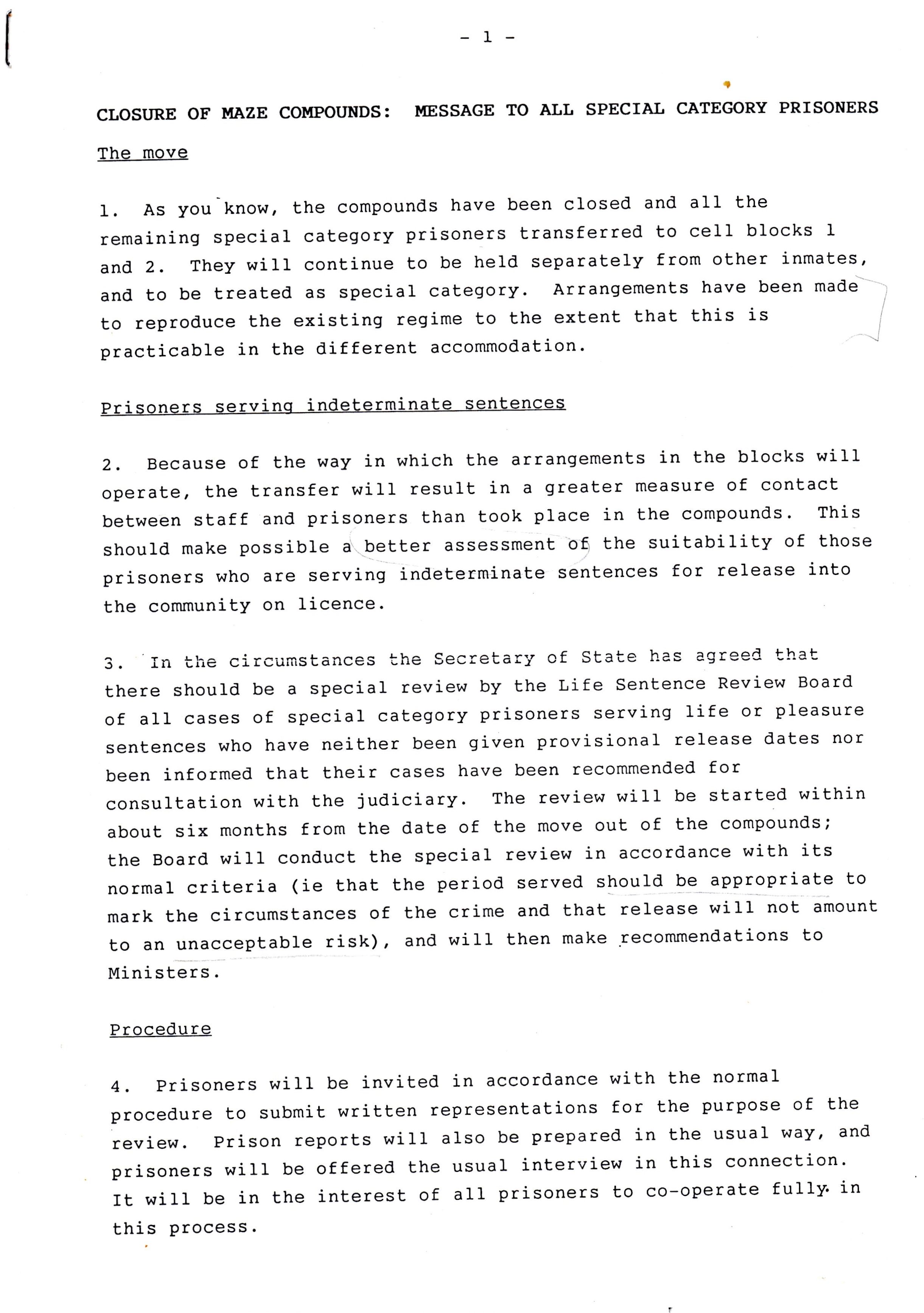
In effect what was left was a group of men–now housed in a single compound-21–who were either Life Sentence prisoners or SOSP’s.–younger guys who were serving Secretary of State’s Pleasure.  No new faces arrived into Long Kesh after early 1977 and they were people who had been sentenced for something that occurred pre March 1976.  With the numbers dwindling–not just in the UFV/RHC compound–but in the others–compound 20 housed Official IRA men and the numbers there dropped to 3 before the decision was taken to close the compound and move the trio to the Crumlin Road jail.  The talk then was the authorities had “done a deal” with the Stickies to close the cage.  The theory was that they would be looked upon favourably in the next Life Sentence review.
By 1988 the writing was on the wall for the entire compound system and we knew for quite a while that the move was inevitable. The move actually came in June that year after much wrangling about how we would be locked up–free association–doors unlocked–yard opened up for running–being able to keep pigeon lofts and bird cages etc;  By the time we moved there was less than thirty of us–just enough to occupy one leg of H2.  There was–through our compound command staff–much negotiation and a host of communication from the highest echelons at Dundonald House.  Here LKIO produce some of those communications that still–25 years later–make for fascinating reading and gives an insight into the lives of our Life Sentence prisoners.

Primo

Share

Dispelling The Myth of The Knuckledragger: Primo

The University of Anti terrorism.

“He who opens a school door, closes a prison”,  Victor Hugo

As it became obvious that I wasn’t going home for a while I started to turn my attention towards education. I was a loyalist life sentence prisoner in Compound 21. I had begun my sentence by completing a fair bit of art work. It was a discussion with Davy Ervine that led me to veer towards education as a full time ‘occupation’. He said to pick one or other and give it my full attention. I picked, thankfully, education. ( I would keep on doing some art work over the next 10 years  as a pastime). I started off fairly easy with an ‘O’ level in Art.  At this time some of the men had started their Open University courses. I was prompted to begin a Social Sciences course and started this by undertaking D101 Making Sense of Society. Quite ironic really, when I reflected on my life experiences to date. The course involved some geography, some psychology, sociology, etc. I passed it and decided to go for the Degree. At this time we were limited by what the prison would allow us. This course was a full credit and we could only do one credit per year. Later I would do 2 half credits in a year. That was a lot of work.

The next course was an introductory Technology course, ‘Living with Technology’. I really enjoyed this and came away with a top class mark. But I now decided to select Psychology as my basic degree. There was Mathematics (I wasn’t bright enough), Computers ( had not a clue), Philosophy ( still less of a clue) and so Psychology it was. As well as academic studies there were other courses available. Evening time classes involved a teacher coming in and delivering various courses such as English, Maths, etc. Some of the men in the cage learned their own foreign language, German being a common one. Gusty already had some men learning the Irish language.

One course I do recall was the Football Coaching course as run by the IFA. This was demanding, required a high level of fitness, ability to understand football theory and then a fair degree of social skills to implement and interact while being assessed.  This was a tough course which happy to say I passed.

In the Open University I moved onto the Introduction to Psychology which I found surprisingly difficult. I may have passed but no top marks. Within the O.U. there were basic sets of courses that would get recognition by outside bodies, so from here my courses where easily chosen. The next course was the most difficult; Cognitive Development: from Birth to Adolescence. It was heavy going that required a lot of reading, rereading and writing. Next was ‘Personality and Learning’ which was informative and applicable to myself and others.

Passing it I went onto what was regarded as a very difficult course called the Biology, Brain and Behaviour. It was amazing and a new world opened up. However I loved this course and fared well. By this time I had run foul of the security department of the prison who seemed to thrive on blocking and annoying students at every turn. One of the funnier times came up over a plastic model of half a human brain which outlined all the different parts of the brain, occipital lobes, medulla, etc. This was held by security for some reason. The joke was that some of them wanted it for themselves. So it was M.P.s and petitions to Governors and what not. What a farce. So compare and contrast visions of men at bomb classes against me learning about a human brain. ( As a side note, I never once seen one of these bomb, gun or terrorist classes.) The O.U. courses involved meeting with a tutor on a monthly basis to go over essays and other issues. I found all the tutors very intelligent, dedicated and of a great help to me.

I started on level 3 courses. I began the Social Psychology full credit. Here was the real meat of the course.  This was superb and parts of it could be applied to my prevailing situation. How do we all interact? Why do we follow certain people and ideas? Why are we social animals and why does conflict occur between individuals and groups?

Possibly the most interesting course and relevant (in a way) was the course ‘Crime and Society’. This of course was geared to the British system of Law and Order and not our lovely little spot with its Diplock courts, internment (although that was used in the war years on the mainland), scheduled offences, supergrasses, hunger strikes, etc. However here was a clear and systematic explanation of the normal criminal justice system. From the police to the courts, from the law makers to the prison and probation. I was of course interested in the stories about lifers in G.B.

An interesting course (A Level) was Government and Politics. Here was one of the few times that 3 of the factions could study together. Due to declining numbers of Special Category prisoners a compound came free which was turned into a study place. Both the UDA, the Sticks (Officials) and UVF/RHC could study together. A few of us on the politics course had discussions. Of course ‘real’ politics was a faraway cry from N. Ireland.

Another funny event was when one of my evening time teachers said he was getting a new job and would not be back. I wished him well and thanked for his time and effort. Shook hands and said goodbye. It was a short time afterwards that I saw him walk back into the phase accompanied by lots of staff. He had got another job all right. He was now an assistant governor! I laughed. We did speak later and I still held my respect for him.

At this time I was undertaking many courses to help pass the time and there was quite a variety. I studied Yoga (pretty good) except I was so relaxed I kept falling asleep! But very useful when I was on punished, by being on the boards. I took up Statistics following on from my Psychology stuff. Next I completed an ‘Awards for All’ in Weightlifting. I finished an Athletics coaching course with one of the senior instructors from outside. A few of us completed a Boxing course with an absolute gentleman who was the Irish boxing coach at one time. Some of us tried our hand at Irish History. Quite a laugh.

A decade of captivity had passed now and with a shift to the H blocks away from the cage/compound I undertook ‘A’ Level Art and ‘A’ level Statistics.  But I have to admit I have easily failed ‘A’ levels Maths three times!  I was very happy at passing the ‘A’ level Statistics which required a lot of revision.

However at this time I had gained my Honours Degree in Social Sciences (Psychology) and had to decide what I was now going to do. Fairly simple, start another degree! This time it would be Science as other lads had blazed the trail. So I started S101 but I was not to finish it. Events moved quickly and I was to be released. However I had been paid into the course and I was pushed to undertake the Summer School part of the course.  None of us ever had completed a summer school while in the Kesh for obvious reasons. Of all places I had to go it was Stirling, Scotland. I had never been to Scotland before.  I had been to England once and never out of the British isles.

So while still technically a serving life sentence prisoner I went to Stirling University which was brilliant. The people there knew nothing of my background or circumstances but I made friends and we had a great time.  However, I would not finish the course as life events over took it. I was back at home, had a job for a year, was building up new relationships and getting back into the real world.  During my workout phase I began a Creative Writing evening course in QUB. That was really good, but a bit odd. On Monday night I would be sitting in a class in QUB and the next evening I would be back in the Crum ‘work out’ unit locked in a cell.

Being a glutton for punishment I went for some reason to QUB to do of all things an MSc in Computer Science. Not one of my better choices. Totally flunked it and went and got a job in 1990 at the grand wage of £50 per week.

So my time inside was not totally wasted. One funny recollection concerns the term ‘University of Terrorism’. As I said above not once did I see a bomb or gun class. There was no talk of armed conflict and the use of terror. Obviously I have missed all that. I had people like Davy Irvine, Gusty and Billy Mitchell all urging us to use our brains. And I did discover, the pen is mightier than the sword (or gun).

I came out with quite a few qualifications which was satisfying but meant nothing in the face of prejudice, ignorance and discrimination. I have carried on my education and training since then and I don’t think I’ll ever stop. I enjoy studying and learning. I can only hope to pass that attitude on to the young people (and older ones) that I meet and work with.

Primo.

Share

A Life In The Day: Just Another Day In The Compounds.

I awake but lie still listening to the sounds that come though the open window. I know it is night outside. It is December, but light streams in from the hundreds of orange and red lights that surmount the walls, fences and gates. It is cold. There are no heaters in the hut. Above me is the steel corrugated iron roof. I am in my room or cube on my own, a welcome change from being doubled up with someone for years. I have been here for over 10 years now. It is very quiet in the hut that has 20 men. There used to be over  30  men when sharing was a necessity.


It is 7.15am and the hut will be opened by the guards in 15 minutes. In the stillness I can hear them coming through the gates from far away. The clangs ring loud and clear as they have done since the Long Kesh /Maze prison opened in 1972 as hundreds of prisoners swamped the meagre prison system. I get up and put on my training gear. There are 3 or 4 people waitng to get out to go the gym or their early morning run. We wait in silence as the rest of the men do not need to get up until 9am. We hear the footsteps, the jangle of keys. Locks being opened and bolts being snapped back.


We get out. I go to the gym. The gym is a large Nissan hut divided in two. There are punch bags, lots of old rough free weights and some gym items such as parallel bars. It is a weekday and I have no visit. We get 30 minutes a week with our visitors.  The gym routine is sit ups, press-ups and some light weights. Later I will go out for a run. After 3 miles I go back to my cube, get my stuff and go to the shower. It is primitive and spartan. Concrete floors, wooden roof and plastic sheets divide the showers. Other men are getting up. Those on visits usually get in early to get the warm water before it runs out. I find that exercising early warms me up and keeps out the cold that settles in with a vengeance. One year I had frost and ice on my window. On the inside.


After this I go and get breakfast. Tea, cornflakes and some bread; if there is any. We all have chores after 9am, the lights go on and the place comes alive. Men cleaning out their own space – their cube. Then the communal areas are cleaned. The central space running the length of the hut, the toilet and shower block. Outside the main huts men are picking up litter and butts. After this I go to the small square wooden study hut. I am completing my Degree with the O.U. Forward planning and a realisation that I’m not getting out of here for while yet.  This is Compound 21 of the special category section of the Maze prison.  Less well known than the big brother across and behind,  the 20 foot high concrete walls of the infamous  H Blocks. Prison life continues on inside and there is a sense of normality despite being in, it was claimed, the highest security prison in Europe. Men go to visits. A guard comes to the wire, shouts a name. Both men will go in a mini bus to the visiting block. Men also go to see the doctor or the welfare.  It approaches lunchtime. Some men supplement their food from parcels that were left in by visitors. Others go to the canteen to see if it’s edible today. Stew is always a careful meal to eat after finding some things in it such as the mouse’s head, bits of a brillo pad, etc. There is time to talk to friends and engage in some craft or artwork. In the afternoon I get ready and go for a run or back to the gym. We run round the wire fence that surrounds us and becomes the first line of defence for the prison system.

We run 21 laps to cover 3 miles. It is a short section at the back of huts then turns left. Up the side of the gym, and turn left. Up to the corner of the compound and turn left. The long straight parallel to main concrete wall and turn left back in behind the 4 huts. And so on and so on. Daily, weekly, monthly,  yearly.  Looking through the steel mesh of the fence I can see other men in other cages doing exactly the same thing.


I go in get my stuff and go for a shower. At 5pm dinner is served. Some men take it, some do not. People gather around the single black and white T.V.  in the hut to watch the news for the day. Some days there is plenty of news about prisons, protests and releases. Those who had visits would receive a parcel from their visitor about 6 o clock. Its checked for smuggled items. A good excuse to mess up someone’s highlight of the week. Not all of the staff are sadists but there’s usually one there to mete out some injustice. Today there is nothing on the news. Many men wait for the increasing number of TV soaps to come on and live out lives in another place away from this concrete grave. Evenings are spent writing letters. By 8pm most men are out walking the wire. Groups of  2 or 3 men walk and talk. After 10 years of prison it difficult not to recover precious memories from a time of freedom that seems long ago and dream like. Much talk is about the troubles outside and what we will do in the future when we get out. Whenever that may be. Better to live in hope that wallow in reality.


At ten to 9 we see the screws gathering at the compound gate. They walk in and we know it is time to lock up. We go to our huts. They count heads. That’s it for the night. The hut seems bright and lively. Men get tea and toast on. It is warmer now. There is debate and discussion about what to watch on the TV. Films are a favourite. Some men go to a friends cube to talk the night away. To relive their war memories and some spoof the night away. Others are still writing letters or re reading one left in from a visit during the day.

Another day gone.  Another day closer to getting out? Don’t really know. A lifer doesn’t have a date.  Midnight and the lights are put out by the hut officer.  Most men are in bed but the die hards can watch the TV in the dark as long as the volume is turned down. The fence lights shine all night. We have curtains to keep the light out. It’s quiet now except for the birds singing away. Fooled by the thousands of lights. I read for a while until sleep overtakes me.


I awake. It is 7.15am and the hut will be opened by the guards in 15 minutes. In the stillness I can hear them coming through the gates from far away.

Another day.

G.Igitur


Share