Alan Seeger: I Have A Rendezvous With Death


Alan Seeger was born in New York City in 1888.  His family moved to Mexico City when he was 10 years old and it was this period of his young life that was to influence much of his poetry.  By the time he was eighteen Seeger had enrolled in Harvard University.  Seeger’s brother Charlie was the father of the famous Seeger siblings…Pete, Mike and Peggy..pioneers of the American Folk music scene.

In late 1914 and at the start of the First World War Seeger enlisted in the French Foreign Legion in order to fight for the Allies..the US hadnt entered the War at this stage.  On the 4 July 1916 Seeger was wounded a number of times by machine gun fire at Belloy en Santerre..it is claimed that he continued to shout encouragement to his fellow troops as they mounted an offensive-despite his grave wounds.  he died from those wounds.  All of Seeger’s poetry was published posthomously-his first book being published in December 1916.  By the next year his most famous poem was released for the first time and remains a standard almost one hundred years later.  By now the quality of his poetry attracted great acclaim and drew comparison with the great British poets of the time, in particular Rupert Brooke.
In 1923 the French government erected a monument to the 24 members of the French Foreign Legion who died during the conflict between 1914-18.  On the monument are inscribed these words..from the pen of Alan Seeger……….

They did not pursue worldly rewards; they wanted nothing more than to live without regret, brothers pledged to the honor implicit in living one’s own life and dying one’s own death. Hail, brothers! Goodbye to you, the exalted dead! To you, we owe two debts of gratitude forever: the glory of having died for France, and the homage due to you in our memories.

I Have a Rendezvous with Death

Alan Seeger
I have a rendezvous with Death   
At some disputed barricade,   
When Spring comes back with rustling shade   
And apple-blossoms fill the air—   
I have a rendezvous with Death
When Spring brings back blue days and fair.   

It may be he shall take my hand   
And lead me into his dark land   
And close my eyes and quench my breath—   
It may be I shall pass him still.
I have a rendezvous with Death   
On some scarred slope of battered hill,   
When Spring comes round again this year   
And the first meadow-flowers appear.   

God knows ‘twere better to be deep 
Pillowed in silk and scented down,   
Where love throbs out in blissful sleep,   
Pulse nigh to pulse, and breath to breath,   
Where hushed awakenings are dear...   
But I’ve a rendezvous with Death
At midnight in some flaming town,   
When Spring trips north again this year,   
And I to my pledged word am true,   
I shall not fail that rendezvous.

Beano
Share

Inside Man:by William Plum Smith-a review by Balaclava Street.

“Inside Man” by William “Plum” Smith: a review

1412153997

Inside Man, the prison memoir of former Red Hand Commando and Progressive Unionist Party chairman William “Plum” Smith is, foremost, a necessary book. The fact that it is the first, and indeed only, serious-minded first-hand account from a loyalist paramilitary perspective is evidence enough of that. Until now the only available accounts have come in the form of decidedly less credible offerings, tabloidesque cash-ins from the pen of ghostwriters “without whom this book could not have been written”. Johnny Adair’s Mad Dog reads more in the style of true crime, with its focus on vendettas and reliance on a persecution narrative where the protagonist is endlessly threatened by enemies out to get him. None Shall Divide Us gave us a frequently less than reliable version of Michael Stone’s life story, as when playing urban myth as straight fact with its the hoary tale of Stone having to execute a German Shepherd Dog to pass initiation into the UDA (the story usually involves the US Marines or SAS).

With a 200-year history of incarceration, the republican as prisoner is a well-established archetype, a vital component of the movement’s self-image and one which is carefully guarded (Bobby Sands dinnerplates notwithstanding). IRA prisoners were held, and continue to be held, in high favour within the communities from which they came due not just to support for the actions which led to their imprisonment, but because a republican’s deportment within prison was seen as noble in itself. Resistance to authority, education in confinement, and maintenance of The Army’s discipline were the ideals to be upheld. Depressingly, however, the regard held by republicans for their paramilitary prisoners is often accompanied by a tendency to denigrate or outright dismiss the experiences of their loyalist counterparts. For example, the elderly bigot Jude Collins flatly refuses to believe that loyalist prisoners were even capable of attaining qualifications. Indeed if certain individuals are to be believed republicans floated out of Long Kesh in the lotus position, preaching enlightenment in fluent Gaelic, weighed down with degrees and doctorates and ready to perform brain surgery or build particle accelerators. Loyalists meanwhile are alleged to have passed the time heaving weights and gobbling steroids like Dolly Mixture, while reading materials were supposedly restricted to publications of the one-handed variety. This is a foul and pernicious lie, and one which Smith successfully challenges.


Read more »

Share

Football in the Compounds: Reminisces of a Hankie Ball Player

Football in the Compounds-Reminisces of a Hankie Ball Player


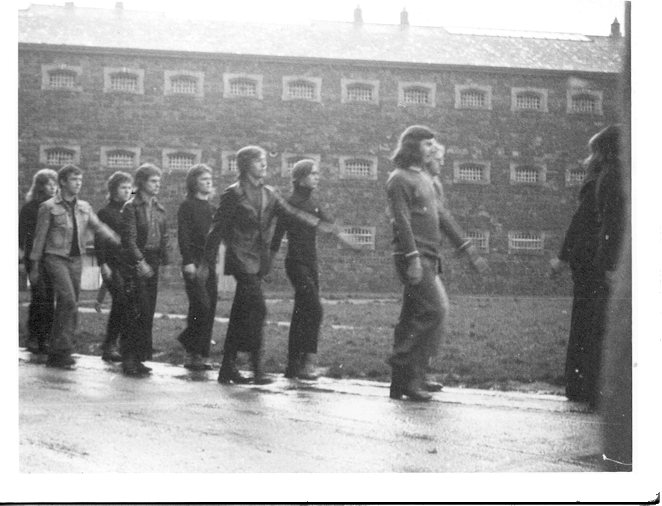
There was no Queens Park Strangers.  Certainly no Borrussia Munching Barnbrack.  And definitely no Real Madrid Street.  What we did have was Compound 21…or 16..or 18B…and the immortals—at least in their own minds– 19A.  In Magilligan, because compounds were given letters instead of numerals we had, on occasions AA playing against CB..or HB up against FA .  The Crumlin Road set-up was different again-less formalised football meant no leagues against other wings.  So it may have been landing against landing or just 2 teams made up from within whatever particular Wing being occupied at any one time.  In the early days football was a very haphazard affair.
You got it infrequently and there was little or no organisation involved.  Basically two teams were picked to play and it was more about getting out of the compound..sometimes in order to visit someone else at the wire.  There were always good players of course.  Some would have been known from outside before their incarceration.  As time moved on and football did become an important factor in jail life then of course it became more serious.  Too serious at times.
If someone was in remand who had a reputation of being a good footballer there was an effort from the different camps within the Kesh-or Magilligan-to get him in to a certain compound.  Now and again a mix would have been put in though and someone who was rumoured to be the next Charlie George and eagerly waited on turned out to be more like Charlie Drake when it came to football.  It was around 1976 that the soccer became a big thing in Long Kesh.  This was the year of the first inter-compound football tournament.
In Magilligan a similar venture had been in place from late 75.  Four Loyalist compounds-2 UDA and 2 UVF-formed 8 teams and played a league.  It was ultra competitive and had a record number of sending-offs.  The four elected sports reps-1 from each compound, myself included-took up the refereeing duties and this was a job in itself.  A bookie-in fact a number of them was in place in Magilligan-and this too made for some very combative and spirited encounters.  If I’m not mistaken the A team from Compound A-UVF-won that first tournament, finishing ahead of E compounds first team-UDA-and they had a number of good players in the team.
Some of those who spring to mind from the victorious A team were Bobby Rodgers-Victor Thompson-Rab McIntyre who had been for trials at Old Trafford and Davy Barr..who had been with a number of Irish League clubs including Portadown.  The other cages held other good players..Shane Hamilton (Chico ) and Guffer Liggett out of E–Danny Black and a couple of Rathcoole guys from Compound C and Jim Rossborough –a rumbustious and marauding centre forward out of H.  If this inaugural tournament was a success the initial one in the confines of Long Kesh was less so.

After many months of wrangling between the jail authorities and the representatives from the compounds the go ahead was given to commence.  Barely minutes into the first game in which the pre tournament favourites were playing each other-19 against 16—UVF against UDA—a deliberate tackle broke a players leg and the game was hastily abandoned—as was the league.  Although inter compound football continue in Magilligan until it’s closure in October 1977 it would be a long time before the idea was resurrected in Long Kesh.  In Magillgan in particular—perhaps because many of the matches were being bet on—there was a great interest from outsiders.  It wasn’t unusual to see the pitch ringed with a large number of screws—who of course would have had their own bets running—or indeed the IRA prisoners—lined along either D compound wire or along the fence of the other pitch-F.
Eventually it did kick off again and although there was the usual problems it never got out of control and by and large it was quite successful.  Spectator numbers were limited in an attempt to quell potential trouble and the notion that the next major incident could stop the mixed soccer for good seemed to work.


The truth is there was only a few inter compound leagues or cups in total and dwindling numbers—people getting out and the advent of the H Blocks which stopped others coming to the cages-meant that no longer could compounds field 2 teams.  By the time the mid eighties came around each compound was dependent on recruiting other players from different compounds to make the numbers up, otherwise the football would have ceased completely.
I played football behind many walls and wires in a “career” that stretched from 1973 until early 1990.  Many a professional would have been proud of that or the fact that conservatively those of us who served a heavy sentence and played an average of 2 games a week—EVERY week-would have racked up around 1500 appearances!!  Some going on all weather pitches—and many of us still have the scars and bumps-bruises and limps to show for it.  There was many hankie ball players but very few prima donnas in those days.  The stick would have been too much to take.  Magilligan led in many ways by supplying us with good quality kits and on occasions the proper balls.  For a long while Long Kesh trailed behind in this department and many of the kits were threadbare..hand me downs and distinctly second rate.  Boots were almost nonexistent for many years and unless you had your own sent in you were reduced to playing in trainers—old fashioned gutties—or at the start of proceedings just whatever you had.  Eventually, after many years the jail started supplying cheap Mitre boots and these became like gold dust.  They also went missing quite a bit so became much sought and looked after items. They also at one time supplied a brand of “trainer” that I believe were manufactured in D Wing in the Crum, and these were deadly.  They were the nearest thing you could get to a steel toe capped trainer and a hefty boot on the shin with one was sure to put you out of action for the next few matches.
Despite all these obvious drawbacks-manufactured or otherwise-many’s a good player graced the—well not turf—but the hard core of Long Kesh.  It is impossible to remember let alone mention them all but there are quite a few stick out in my mind.  Everyone will have a particular favourite and always with good reason.  There was the stylish players—the ball players—the Hardmen—the psycho’s who thought nothing of slide tackling on the gravel—or the goalkeepers who had to be mad to dive full length on basically concrete.  Then there was the dribblers—the selfish players—one’s it was rumoured you would need a Board paper to receive a pass from—the dry weather players—the ones who were legends—in their own mind.  There was huffers-and puffers and slabbers and wasters.  There was strokers and jokers and big girls blouses.  There was dead eye dicks and those who couldn’t hit a cow on the arse with a banjo.  But to all those who crossed the line thanks for all the memories.  I recently conducted a wee straw poll.  Contacted between thirty and forty ex prisoners—those fortunate enough to still be alive—and asked a simple question-“ Who was the best player you seen in prison”  To me the result wasn’t surprising.  I knew a lot of different names would crop up-and they did.  I knew a couple of names would appear near the top—and they did. Not surprisingly.  In the end only a vote or two separated two great footballers.  I was lucky enough to play with-and against-both.  One for far longer than I would have liked.. But-that’s Life.
The person who finished top of the pile in this particular poll was Geordie McKimm.  Geordie was only there for a couple of years but whilst he was he stood out-head and shoulders.  In modern day football he would be called a box to box man—he was a fantastic passer of the ball..great vision and could basically do what he wanted with the ball.  He was only a young man-20/21 and extremely fit.  A worthy winner I feel.  Only a vote or two behind was Jimbo Tipping.  Jim was a Shankill Road man and had passed through Magilligan before arriving in Compound 19.  It’s no exaggeration to say that Jimbo was one of the best strikers of the ball I have ever seen.  When he hit them they stayed hit.  In the end it was hard to get goalkeepers for the other team when Jimbo was playing!!  Jim was strong—six foot plus—and a great header of the ball.  He had a superb all round game and for want of a better word was extremely “competitive”.  These two were comfortably clear of the rest of the field in the poll.  There were many other mentions but I would prefer to do is pick the eleven players who I think would make up the best team..going by the many hundreds of players I played with or against during my time behind the wire.  It is a personal opinion and is not definitive–neither right or wrong.  I stand to be challenged and would welcome some debate on it.  So here goes.  11 men..no subs.

Eddie Martin. Former goalkeeping apprentice at Notts County and went on to play for 5 Irish League clubs…as a striker.

Rab. McCreery.  Glentoran legend.  His brother Paul was also a smashing player..but no room for him in this team.

Clifford Healey.  Powerful centre half..very aggressive and unbeatable in the air.

Victor Thompson.  Assured and steady..could play as stopper or sweeper.

Cliff Whiteside.  Classy full back-great left foot and impossible to get past.

Bobby Rodgers.  Two footed—Good in the air for a small man-and great goalcorer.

Jimbo Tipping.

Geordie McKimm.

Shane Hamilton.  Hard to get the ball of..good passer and fantastic ball skills.

Colin McCurdy.  Colin went on to play for Linfield-Fulham and Northern Ireland.  Great athlete and super finisher.

Sammy Frickleton.  Sammy was a Scotsman I remember from the Crum.. He had played for Ballymena before imprisonment and went on to play for East Fife and Sligo Rovers—despite having a large King Billy tattoo on his chest!!


*** The poll also included some ex Block men and the names put forward there included Noel Large and the aforementioned Guffer Liggett.


“Beano”


Share

Albums of Long Kesh: Beano

Albums of the Kesh.

Bad Co./Bad Company-1974


In a year that brought us such melodic masterpieces like Wear It’s At by The Rubettes and the master-ful eponymous Quatro, 1974 can be remembered as one of the halcyon times for outstanding albums.  Think Court and Spark/Joni Mitchell—461 Ocean Boulevard/Eric Clapton—Diamond Dogs/Bowie—Planet Waves/Dylan—On The Beach/Neil Young—or perhaps one of the greatest live albums of all time-It’s Too Late To Stop Now by Van Morrison.  We layabouts in Compound 11 were certainly spoiled for choice and rather cash strapped laying out all those £2:20’s.  In between all the boot bulling-drilling-lectures-cleaning-route marching-exercising and protesting sometimes we were lucky enough to book an hour on the Dansette in the study hut to spin out personal favourites.  It has been well documented before that many albums were synonymous with Long Kesh…and by this time those that were most favoured would have been Tubular Bells—Dark Side of the Moon—Band on the Run and for the older generation known as the Sad Sacks—Porter Wagoner’s Greatest Hit or the Worst of Charlie Pride.  Albums like these, when being played always drew moans of despair from the younger prisoners and remarks about receiving free packets of blades with every album bought.
Bad Company was of course a manufactured band.  Singer Paul Rodgers and drummer Simon Kirke from the wonderful Free plus Boz Burrell from King Crimson and Mick Ralphs late of Mott the Hoople.  If the new amalgamation wasn’t being lauded as a new Supergroup-a la-Cream or to a certain extent CSNY– much was expected of them —-and they didn’t disappoint.  Rodgers’s voice was a powerful fulcrum for the band.  He epitomised rock and roll with his raunchy  much imitated voice andwith the band signed to Swan Song records—Led Zeppelin’s label-they had truly arrived with a bang.  The album-Bad Co.-was released early in 1974 with the first single coming right away.  Can’t Get Enough of your Love remains the bands highest charting single.  Although the song was credited to Mick Ralphs it could have been lifted straight from a Free back catalogue and rivalled Alright Now for intensity and rockability—testimony to Rodgers wondrous voice.  Indeed, such esteem was he held in, that in between the breakup of Free and the formation of bad Company Rodgers was the number one choice to replace Jim Morrison as lead singer of the Doors after that talismans untimely death in July 1971.

Bad Company – Can’t Get Enough – YouTube

www.youtube.com/watch?v=uAPUxvjbdcU

Bad Co. Was much played in Eleven that summer and for many of us was a great antidote to the saccharin sweet drivel that plagued the charts.  By the following year the same line up would regale us with another masterpiece-Straight Shooter complete with my personal favourite Paul Rogers lyric—“Johnny was a schoolboy when he heard his first Beatle song—Love Me Do I think it was……… “.  In 1976 they released their third album—Running With the Pack.  This album was a particular favourite  for one of my closest friends—in Cage 21—who used it for the next 12 years as a writing pad when composing letters home.  The myriad of inscriptions on it over all of those years would have given a cryptographer a few nights overtime in Bletchley Park, attempting to decipher the modern day hieroglyphics.  Both were great albums with some exceptional tracks but the immediacy of Bad Co. ensured that this was the album we—of a certain age and disposition—would remember them by.  We watched in wonder when we seen them on television performing on of their classic tracks..we dreamed of the day when we could wear those tight fighting loons, and platform shoes—rather than the quasi paramilitary garb we were now used to—to be allowed to grow our hair to almost unmanageable lengths rather than the short back and sides that was now regulation fare.  The music alone was what made us semi-rebels—and that was as good as it got.


Beano

Share

Made for Life: A Belfast Boy

Made for Life.


The room is square and stuffy. The paint threatens to fall in big powdery blue flakes. The lino floor is scrubbed clean but still exudes a dirty look.  There are no windows. Only one steel door secured from the outside. There are 10 of us here.  There is a strange mix of despair and fanatical hope.  Me, I am resigned to my fate. Perversely we are all dressed well.  I wear a tie for the first time in years.  At least if Im going to be hammered I’ll look well.  My emotions flip flop. I don’t care, then I really do care. But I already know what is going to happen. A deal has been arranged. Plead guilty and you’ll get of lightly. Just ’ life’ my solicitor said. Sounds easy.  You wait your remand time until this day. Glad to get it over with yet afraid to get it over with.  The death of my free life. But then again I did kill someone, in fact a few people.  I joined the organisation to be a soldier.  To fight, kill and die if need be. It has led me here Court Number 1, Crumlin Road Courthouse.  Or Belfast City Commission if you want to be picky. People walk in and out of the room.  One man comes back from the reserve court crying. The man (I don’t know him) has got 2 years prison and he’s gurning.  I feel like going over and slapping him.  But he’s a crim.  Some of my friends have got 35 years minimum. Different standard.  Different people. I am one of the lucky ones. I have special category status. Many do not. All the talk at the minute is about the H-Blocks and protests. I will return to the cages in the Kesh. To talk and walk and study.

This is a Diplock court. Only one judge.  No jury.  Most times no evidence at all except a confession.  Freely given of course, not beaten or threatened out of people you understand.  I wonder at the logic of using a criminal system to deal with a political problem.

Soon it’s my turn. The screw barks out my name.  I exit the door and am surrounded by screws who will walk me up the stairs to the dock.  I enter into the bright light which hurts my eyes.  The colours are bright. Anything is bright after a while in ‘A’ wing of the Crum.  I feel the tension in the screws that stand beside me. And there he is. Sitting on his own, right in front of me. I’m not even told his name. The blood red robes give him away.  He does look silly.  But I think, this is what I am defending.  The court is huge. There loads of other people but it still feels empty. Barristers and hangers on.  Peelers.  The press.  No doubt the ‘Tele man’. More news to pass on. I have asked my family not to attend. Saves the pain on them and on me.  This is the loneliest place in the world. The people on my right I don’t recognise. Victims’ families? There is a curious expression on their faces.  Not hate nor hurt.  I did not know any of my victims nor do I know these people. I do feel sorry for their pain and misery. A loved one missing. I felt that way myself one time.  I expect some emotion, some outburst. But there is none.  I don’t want to stare. I catch one woman’s eye. It plain to see that she has been crying.

The clerk reads out the charges. There is a lot and it takes  a while.  At one point she takes a sneaky look at me.  ‘How do you plead’? I hear the word come out. It’s me but sounds like someone else.  ‘Guilty’.  The judge is saying something. I can barely hear him.  Can he not bloody speak up?  I lose interest.
I have a mix of feelings. Afraid yet calm. I did not do these things for myself but for my people,  my country.  Hundreds more will stand here like me,  young and idealistic.  Wanting to do their bit. Thousands will travel this path. Some will stay longer than others. I count myself lucky that Im here at all. I got winged by a .38 one night in an accidental discharge. It travelled through my shoulder without doing much damage.  We went to the back street doc who actually done a very good job.  I hurt for a while. Many of us have paid the full price for our beliefs and actions.  I wonder what,    “Dieu et mon droit”   means. Its written on the crest on the wall above his lordship.  God and my right?   It says ‘For God ‘on our badge.  I wonder who will get his backing.

Their voices drift off and I am suddenly back in primary school.  Its only 10 years ago.  Amazing.  I will be 20 years old in 3 days’ time. I’m sitting at my desk in school, looking at the window at the beautiful blue sky. I’m day dreaming of being outside kicking football or playing tig in the street.  I watch the fluffy clouds scud across the sky. I’m an ordinary boy interested in football, cheesers and going round to the sweetie shop.  ‘4 fruit salad for a penny please’.  I remember my Granny’s house. The smell of home baking, of fresh linen and  carbolic soap in the sink. My Granny spoilt all of us rotten. I loved her. What would she think today? I had never dreamed of killing people or belonging to one of the most violent organizations in Europe. But then again I never dreamed of the killing and carnage I would see as a child.  The bombs exploding.  My mother crying in fear.  I was a child but I put my arm round her shoulder. Walking behind a funeral with the anger and the sorrow.  We had played cowboys and Indians. In summer we ran and shot guns and arrows and laughed. We fell to the ground pretending to be dead. But we all got up at the end and went home for supper.  A thought comes to my mind that in my entire family not one person has been in trouble with the law. I’m about to make up for that.  Big time.

I suddenly realise my wigman is saying something. He’s much more clear. He says such nice things about me. This place reminds of a school trip to theatre.  Everyone knows their lines and the story and plot has already been set out. Maybe Dylan was right. We live in a land were justice is a game.  I have missed the first part of the sentencing.   I get snatches of what he’s prattling on about. ‘Shame’, ‘disgraceful’, ‘waste of life’.  I wish I could say ’are you finished yet’. But that’s not part of the script.  20 Years for possession, 20 years for  attempted, 20 years for that. The court is holding its breath.  What do they want from me.  Tears?  Pleading? Outburst?  I say nothing and look straight ahead.

Suddenly the screw pulls my arm.  At last, ‘let’s go joe’. And it’s down the steps. I hear one screw say to another, ‘Life sentence’. Sounds strange. Is that me? And I realise it is now.  Back down to the happy room. Faces look up at me. I feel nothing.  Just get back to the cell. I’m reading a good book at the moment. Wonder how it ends. Wonder how this will end?  Friends ask me what happened and I tell them. The room goes quiet. Another man is taken out. He too will get life.  When it is all over we are handcuffed together and walked back through the tunnel.  Instead of going back to A wing we am taken to another part, a virtual dungeon, to spend the first night.  No longer remand but sentenced. My big day has come and gone. A total anti-climax.  Tomorrow will be the first day of my new life.
The cell is dirty, damp and dark. A single bare bulb hangs from the high ceiling. The puke coloured paint is flaking off. I lie on my bed staring at the ceiling and thinking. Of empty chairs and tearful parents.


A Belfast Boy.

Share

’71: A Review by Beano Niblock

Director: Yann Demange

Writer: Gregory Burke


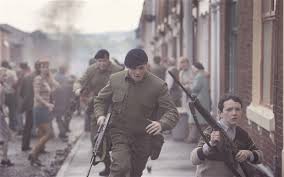
Not many “Troubles Films” stand out in one’s mind.  At least, not for the right reasons.  Ken Loach’s Hidden Agenda..Hunger..and perhaps Alan Clarke’s Contact.  In The Name of The Father, of course.  But you would be hard pushed to find too many more.  A Scots screenwriter and a first time French director—for a feature film at least—may not be the pairing to inspire great confidence in another.  But you would be wrong.  What they have given us is an exciting, taut and very intelligent thriller.  A behind enemy lines movie that will leave you thinking long after the end credits have rolled.   You could also throw the conspiracy label in there for good measure giving it another layer-a facet that gives the film an added attraction.
Gregory Burke’s dialogue is tight..he has encapsulated many of the Inner Belfast nuances—perhaps overdoes them in some parts.  It must be remembered that Burke also wrote the Black Watch play from a few years back and it has to be said he has a great handle on the military nuances as well.  It’s easy to be picky about home based drama’s and very often we fall into the trap of singling minor misdemeanours out—sometimes just for the sake of it.  There are a couple of iffy moments in’71-particularly early on-but certainly not enough to cloud your judgement of the rest of this brilliant film.  Jack O’Connor rightly receives the plaudits in the main role of a young soldier-Gary Hook, on his first tour of duty in Belfast, who gets left behind by his unit in the wake of a hair raising house search which goes tragically wrong.  The supporting cast are a mix of local and UK based actors.  Of these Richard Dormer stands out as Eamon, a former soldier himself who now lives with his daughter in Divis Flats.  Sean Harris plays an undercover MRF Captain with particular menace and an all encompassing disdain for everyone around him.  Friend and foe alike. Corey McKinley is a local teenager who makes an impact as a young Loyalist who attempts to help Hook in his short flight through the maze of West Belfast side streets and entry’s.
’71 was shot in Blackburn and Sheffield recreating an almost perfect reconstruction of the working class ghettoes of the early seventies.  The film is particularly strong on period detail and also succeeds in recreating a genuine claustrophobic feel especially in the Divis Flats sequences.  Demange manages quite adeptly not to take sides…criticism if any on this front, may be that he gives everyone an aura of underhandedness—of low morals—of dubious motivations and of nonexistent ethics.  Sums the situation up quite well then I hear you say.  There is a darkness about the film that recalls those long gone black days of the early seventies..almost apocalyptic in its showing.  The starkness of those little closed-in backstreets became a reminder of the narrow confines in which we all lived.  Both literally and metaphorically.  From a cinematic point of view no complaints can be levelled.  Indeed this film ticks most boxes.  It’s difficult to find any genuine downside.  On a personal level my one minor grievance would be that all of the well worn stereotypes and clichés from the “Troubles” are congested into a little more than ninety minutes but this would be a paltry criticism. ’71 is a must see film and well worthy of all the praise being heaped upon it.

Beano

Share

Studying in the Kesh: Primo

Another little example—if any more are needed–to de-bunk the seemingly widely held pre or mis conception that we Loyalist prisoners passed our time by swallowing steroids and watching pornographic movies.

Studying in the Kesh.


When I went to Compound 21 in 1977 I already had a head start I suppose by being a Full time student at the then Jordanstown Polytechnic undertaking an HND course. However I had already gained 2 A levels at grammar school and 7 O levels. As they were then.


I was surprised when I was in c. 21 of the focus on education.  But as I was somewhat good at art I had a choice to make between art and education It was people like Gusty Spence, David Ervine and Billy Mitchell that directed me towards education as I had a very long sentence and was going to be staying for a while.


This was the first time I had been told of some guy called Descartes I think therefore I am. Well I was thinking these guys had lost the plot. One man was studying philosophy and talking about existentialism. I’d never heard of it never mind what it meant. So my first dive into education was an art class. Pretty simple and a good interest. Because men were already studying the Open University I was pointed in that direction. At this time none of the Republicans were studying full time education through the prison, as it was against their policy. The H Blocks were just coming online with all the subsequent events that would take place there.


 As I wasn’t much into maths or computers I plumped for the Social Sciences Degree which would take in effect some 8 years to complete to an Honours level. However along the way I decided to make as much use of the education as I could. So along the way I gained A levels in Biology and Statistics. I’m not sure how I got the A level Statistics but it is amazing when you have the time and motivation what you can achieve. I gained the O levels in statistics, biology and art. I then also was able to gain qualifications in football coaching, boxing coaching and weightlifting. I had also had my first taste of yoga. I couldn’t stop studying. I undertook Irish history something blatantly missing from my secondary and grammar school education. I completed a short course on the structure of the European Union.


The education gave me a purpose and structure to my day. As well as completing my running, football and weights I was into writing letters,  reading anything (bar romance and westerns)  and watching TV. As the years rolled on and I gained my degree I could go no further so I took what I thought was a logical step and started the next degree. Science this time. However enough time has elapsed and I was seeing the start of the end game. On being released in 1990 I obviously thought I hadn’t enough of the education lark and I enrolled in two courses at Queens. Firstly a small Creative Writers course and then a MSc Course in Computer Science. Since then I have kept studying and have completed Diplomas and Certificates. At the grand age of 57  I hope to complete more education as long as I can.

Primo.


Share

The Long Kesh Fire: 40 Years On

THE LONG KESH FIRE-40 YEARS ON


Not long before lock up—9:00pm—on the fifteenth October 1974, we in Compound 11 became aware of a bit of a ruckus in Compound 13.  Less than two hundred yards away, we were able to see what looked like a number of Republican prisoners attacking a small number of screws.  The screws ran—for their lives—and managed to get out through the double gates to safety.  It transpired that there had been a minor misdemeanour and the screws were there to take an IRA prisoner out to the punishment cells. The screws who had been attacked passed 11—along with their fellow guards—en route to the Silver City—a purpose built prefabricated headquarters.  One of the screws—who hailed form Killyleagh—was bleeding from a head wound.  He told some of the guys in 11 he had been brutally attacked and that they-the screws-were getting offside and allowing the Army to take over their duties.  Rumours abounded about what might happen next.  What in fact did happen was that the estimated 1500 Republican prisoners ran amok—carrying through on a pre planned determination to burn Long Kesh to the ground.
As usual we were locked up just before nine and by then it was obvious that something “big” was going to happen.  As soon as the last padlock was fastened the screws on our compound made themselves scarce.  We in the middle hut-all UVF/RHC-convened immediately and under the tutelage and command of John McKeague made hasty plans.  We were thinking worst case scenario.  An attack from the Republican hordes where-throughout the jail-Loyalists at best numbered something short of 300-the outcome didn’t bear thinking about.  There were perhaps twenty odd of us in the middle hut at that time and we armed ourselves as best we could..bed ends..weight lifting bars—table legs and went as far as making sure the Burco was filled with boiling water.  The position of our hut in 11 meant we had a very limited view of anywhere so didn’t see the first glow of fires from the bottom phase.  However, it wasn’t long before the smell of burning reached us. Almost at the same time we had a visitor to one of our hut windows.  Fergie Robb was a Red Hand Commando serving an 8 year sentence.  He was a resident of Compound 19..Gusty’s compound..in effect-Headquarters.  Fergie was one of those who had been tasked with relaying the news to us Loyalists in Phase 5..apart from us in 11 there were remands in 9..other sentenced men in 12 and of course the internees/detainees in 14.  To reach Phase 5 from Phase 6 was a commendable feat on its own and required Fergie to scale many fences to reach us.  He appeared at the window and told us..”They’re burning the camp”.
Fergie disappeared again-back to Headquarters no doubt.  Almost immediately we made our own plans to break out of the hut.  Some of the bigger guys utilised a sit up bench and set to work on the inner doors.  No sooner had they started when we heard noises outside.  On looking out the window we discovered that a horde of republican prisoners had already broken into our compound by busting the locks on the gates and were now outside our hut.  I estimate there was around thirty to forty of them-all armed with weapons of some description.  To say that we were fearful of our lives at this stage is something of an understatement.  Amidst a commentary from one of the gang leaders about how the camp was about to be destroyed, they were also breaking open the outer sets of doors to our huts.  McKeague went to the window.  It transpired that the leader of the mob was the well known IRA man, Cleeky Clarke.  In an exchange McKeague informed Cleeky that if they tried to enter our hut we were waiting for them and would fight.  Cleeky replied that they intended us no harm but it was in our best interests to vacate the compound as the Army wouldn’t be asking question when they inevitable arrived.  He also gave assurances—presumably on behalf of the IRA that no Loyalist compounds would be touched.  They were only burning their own compounds he said.  At that the mob disappeared.  We came out of the hut to find absolute pandemonium.  The rest of the UVF/RHC personnel from the other huts grouped together out front.  Facing 11 was the visits and beside that was a section that housed welfare huts and the Tuck Shop.  We could clearly see that the shop had been broken into and was in the process of being looted but at that stage it wasn’t alight.  It was later to be burned but it later transpired that the looters were the Ordinary Prisoners who had broken out of Compound 15.  On McKeague’s orders we left the cage and moved to a spot in between there and the next compound-12.  Our colleagues who were still there were in the process of coming to join us.  So too were the remand prisoners who had made their way to us from 9—two compounds away.  As if by some form of telepathy the UDA prisoners all merged together, as did we.  McKeague assumed overall command of our grouping and the first orders were that we must all stick together..at this stage we were unsure of how things were going to pan out and as each moment passed more and more IRA men were arriving from the bottom phase.  Most carried weapons and a lot of them had blankets draped across their shoulders-poncho like.  Some were also masked up.  The tension was high.  Within our own ranks we had guys voicing the opinion that perhaps we should go on the attack against the Republicans before the inevitable happened to us.  The decision was taken for us all to move en bloc to the internee’s cage-14.  We gave no thoughts of trying to take belongings with us as we were under the apprehension that no Loyalist compounds would be ransacked or burned.  How naive would that turn out to be?  As we moved towards 14-only a couple of hundred yards away across one of the football pitches I was very aware of the groups of Republicans—huddled together-staring at us and looking menacing.  Whilst not in military formation we at least were grouped closely together and moved as one.  We negotiated our way to 14.  The gates were open and the cage was teeming with activity.  Already there were people on hand offering cups of tea and seats for the older volunteers.  In our ranks was one old gentleman-Mr. Thompson who had just been sentenced a couple of weeks previously.  He had received 8 years for manufacturing machine guns and was a “non-aligned prisoner”.  He was around 70 years old and quite frail.  In fact he transferred a short time after the fire and completed his sentence in Crumlin Road.  We were left to mingle with the internees and everyone else who turned up to 14-including YP’s.  I think the theory foremost in everyone’s mind was that safety in numbers was the best option.  Many of the Nationalist YP’s of course joined the ranks of IRA men.  An interesting note here is that quite a few of the YP’s were Loyalists—many in the organisations but who were serving short sentences for riotous or disorderly behaviour charges.  It was they who had ransacked the Tuck Shop and here they handed over their ill gotten gains—tobacco-papers-confectionery-and drinks etc:.
Rumours abounded and changed every few moments.  The atmosphere was electric and the general feeling was that it would all end in tears..for some.  It was obvious that the Republicans were intent on burning as much of the jail as possible.  We could see stores and outbuildings and by now unmanned watch towers leap into flames. A memory I will always recall from that evening is of a number of the watch towers glowing red-the corrugated iron sides-before explosions ripped through them blowing them apart—this was the Kosangas cylinders igniting—they were used in winter for Supersers.
After an hour or so number of us..mostly RHC prisoners were instructed to form a party to go back to Compound 11 with the instruction to salvage as much stuff as possible.  We aimed to put it into blankets and between us carry it back to 14.  By the time we got out on to the pitch which gave us access to the next phase we could already see smoke and some flames coming from 11.  We traversed the compound and entered through the broken front gates.  As soon as we entered it was obvious that there would be very little to salvage.  The huts had been totally vandalised-lockers and beds strewn all over the huts—piles of belongings in the middle of the floors—and they had also been set alight.  So the promises made by senior Republicans to spare the Loyalist compounds had been reneged on within an hour.
Fergie Robb


We trooped back to 14 to report.  There were a number of prisoners from 19 who had turned up.  There were senior staff officers who were there for a pow-wow but there was also a couple of “runners”—who flew about the jail most of the night relaying information back and forward.  The two I remember were Fergie Robb and Stevie McCrea.  Myself and three others were called to the side by a senior internee and John McKeague.  A Loyalist internee was a patient in the prison hospital –recuperating after experiencing a heart attack and the four of us had been tasked to go and bring him safely back to 14.  My memories of the night are, I suppose fuelled by the adrenaline and excitement.  Despite only having a checked shirt, Wrangler jacket, jeans and DM boots, I cannot recall feeling the cold.  The other 3 volunteers were dressed similarly.  Lenny Murphy, Basher Bates, Michael Hegan and myself made it to the hospital compound..about half a mile away.  Again the place was deserted—eerily so and once more we gained easy access as the padlocks on the gates had been smashed.  Once in the hospital itself we quickly found the ward.  There crouched on a bed with a pair of striped pyjamas and a house coat was Buster Wade-a UVF detainee.  We told him who we were although he neither knew us or us him.  He indicated to us that there was another prisoner—he was hiding down the side of an adjacent bed.  He was an Official IRA man and was frightened that the Provies might harm him.  I remember his first name—Jimmy—but cannot recall his second although my belief is that he had been in for quite a while after being arrested for a cache of guns found during the Falls curfew of 1970.  After assuring him he would be okay we escorted both prisoners back to 14.  Both had carrier bags with some personal belongings and we gathered as much stuff up as possible in pillow slips and carried those.  Tablets—bandages—plasters—methylated spirits –really anything we thought could be of use in case there were casualties later.  Once back in 14 both men were found a spare bed.  They had a cup of tea and a guard was placed on the cubicle Jimmy was assigned.
I don’t recall the reasoning but sometime after this a decision was made for all of the UVF/RHC prisoners who had arrived in 14 should now decamp and make their way to 19.  We made an attempt to form up in three’s and in a haphazard fashion we made our way to “Headquarters”  No fuss was made of us when we arrived—what I do remember on that walk from 14 to 19 was again more watch towers exploding—being completely surrounded by armed republicans and the constant noise.  As best we could a head count for our organisation was conducted and we were able to ascertain our strength in numbers.  This was done in the canteen and Gusty gave out whatever instructions were needed.  First and foremost we were to be alert-both from Republicans and latterly from the Army.  By this stage it was accepted that there was only going to be one outcome.  That, in time the Army would retake the jail.  And the thinking was that they weren’t going to be polite about things and ask if we were republicans or Loyalists.  Other than be on standby there wasn’t a hell of a lot more we could have done.  In a year-1974- when “Get Your Boots On “ became a catchphrase, we were well and truly “Laced up” this time.  As time ticked by the tension increased.  We stood about in groups.  All that year we had had many practice drills and we each knew what was expected off us.  As in the compound switch between 11 and 12 in July we knew who would be in the front ranks..who would have special duties to perform around the flanks—but in all honesty we always hoped that they were precautions only and hoped they were never realised.  Every so often the officers convened—usually to the canteen or half hut for another briefing.  And after each meeting we searched for answers—for clues.  But the reality was the officers and NCO’s knew little more than we did.  In a compound that was custom made to hold a maximum of 80 prisoners there must have been more than 200 in 19 at that stage.  We stood about in small groups..we circled the wire—in pairs—in groups…  The boilers worked overtime giving an endless supply of tea and coffee.  Cigarettes glowed like fireflies around the compound.  There was an apocalyptic feel to it all.  No one was certain what was to transpire which made it all the more worrying.
I suppose if we had thought about it seriously we could have worked out that the Army always attack at a time just approaching dawn..Isn’t that the way it was in all those old TV movies we knew so well?  And so..sometime in the very early morning the attack began.  Is it my imagination or did it go eerily quiet for a while before the first assault?  And then………….a tumultuous roar….battle cries..the warnings..the fear..the adrenaline let loose.  They knew it was coming and to a certain extent were prepared..but actuality is a different ball game.  The Republicans tactics seemed to be..we will fight them on the wide open expanses of the 2 football pitches….  The scene—if you picture it would look like some latter day battlefield.  Opposing forces at each end..advancing to a bloody skirmish..on the half way line.  But no.  As we stood..our own divorced masses..hoping the battle kept its distance..we could hear all..but see nothing.  Like an outdoor cinema with plenty of sound but missing the picture.  The noise was frightening…roars of encouragement—cries of despair..warnings shouted..defiance..and of pain.  Another noise.  That of helicopters..whump-whump-whump—flying low..barely above the wire.  And this was before the anti-copter wires were installed.  We at last..from our disadvantaged viewpoint—we could see something.  Cluster bombs being fires from the helicopters on to the hordes below.  CS gas we told one another.  Seemingly not we would find out later.  The Republicans had no answer..they were dispersed to the four corners..they choked on fumes..they spluttered and they could not see.  They fought but in the end they were easy pickings for the ground forces who picked them off.  A number of UDA men from 19 had been given the freedom to leave the compound-by jimmy Craig.  A few of them..dressed similarly in ponchos and with faces blackened arrived back on a number of occasions carrying wounded Provisional’s-some in worse shape than others.  Many had what looked like rubber bullet wounds and  I seen a couple who were in very poor condition.  They were taken to the back end of the half hut and given whatever treatment was available.  The battle continued—for how long I don’t know.  But at sometime in the morning—it was daylight anyway on a grey and grim mid  morning-activity ceased.  By this stage most of the Provisional prisoners had returned to their compounds-which of course by now had been razed to the ground.  The game was up.  The fight was knocked out of them.  If burning the jail was seen as some sort of victory for them towards the end of a year of endless protests, then this night’s bout was indisputably a rout of the highest order.  In many ways it was pitiful to see the stragglers trudge back to their cages..beaten and bowed.  But the overwhelming feelings amongst most of the Loyalist prisoners were definitely lacking in sympathy.  The deceitfulness of the Republican leadership to get us to vacate our compounds wouldn’t be forgotten…and rightly so.
During the day that followed we were subjected to countless head counts.  To establish who we were—where we had came from.  If the Army knew by now that were non aggressors in the previous night’s actions, at times they didn’t show it.  They came in with the attitude that everyone was the same and we would be treated as such.  In the days and weeks to come we would suffer many hardships—in overcrowded-under heated-filthy and damp and dirty conditions.  That story is for another day.  The Fire was a turning point in Long Kesh history..but it was far from a glorious chapter in the Provisional’s book of historical fables.

Beano Niblock

Share

It’s Too Late: William Millar

It’s too late.

Wranglers,  Ben Shermans  and Match of the day,

Reading the Dandy and watching your team play,

D.M.s and skinners,  homework on the bus

Collected the boney, what was the fuss.

We didn’t start the fight, we put no one down

Born to one  flag and told this is our ground

Told of taigs and rebels,  you’ll  fight nail and tooth

We didn’t know what coming, for the loyalist youth.

——————————————————————-

Seen the riots on TV,   the bodies on the ground

Had to grow up fast, for fear is all around

Parts of our country is lost to the other side

Our country is calling,  lets go for  a ride

Real rifles cracked,  bombs lit up the sky

Where are our young men, so we answered the cry.

Parents worried sick, while politicians twisted the truth

But its already too late for the loyalist youth

—————————————————

We marched and trained, and swore loyalty to the clan

Trained with real guns and took orders to a man

Our knowledge was poor but passion was great

We stood by each other and then met our fate

We stood in the court before our own crown

The judge looked puzzled but still sent us down

We had done our duty,  to fight off the  south

But it was too late for a loyalist youth.

—————————————————————————–

Sitting in the Kesh, the years roll by

We learn the reality as our mothers cry

Boys grow into men,  in a cage of wire

We seek our own truth and see who’s the liar

Our sentence is served and freedom arrives

But the world it has  changed, so what of our lives?

Go back to the family and fight the untruth

But it’s still too late for the loyalist youth.

————————————————————————-

Doors are locked and minds are not right

Jobs  are denied while the gutter dogs write

It’s a  different world and it’s not mine

We’re a generation born,  at the wrong time

Never forgiven and always remembered

Old men now;  but more even tempered.

Life’s moved on but the past is our truth

It was always too late for our loyalist youth.

William Millar

———————————————————-


Share

Book Review: Mad Mitch’s Tribal Law: Aden and the End of the Empire

Mad Mitch’s Tribal Law: Aden and the End of the Empire
Dr: Aaron Edwards


During the years of the conflict in Aden I was a schoolboy..moving from Primary  to Grammar education in 1966.  This was of course pre-conflict, as we in Northern Ireland know it,-although the fledgling UVF were making themselves known.  On a worldwide stage the Vietnam War dominated the news and

Dr: Aaron Edwards

was broadcast live into our living rooms.  No teatime was complete without the latest bulletin from Saigon or Hanoi.  By 1966 the little known colonial outpost in the Middle East-Aden-was starting to creep into our vocabulary.  Aden, an area of South Yemen had been a Crown Colony since 1937 when it became separated from British India and had always been occupied by British forces.  Aden had long been one of the most important trading ports in the Middle East and its situation meant that it was invaluable to trading between Britain and the Far East.  Since it’s inception in the late 30’s Aden had always had sporadic bouts of upheaval and violence-mainly due to the numerous factions co—habiting.  During the War Years there was an upsurge in violence directed at Jewish settlers who eventually would leave when the new state of Israel emerged from the British mandate of Palestine.
By the early sixties again there were rumblings from the myriad of factions in Aden.  There was by this time a growing number of anti-British guerrilla groups..all with varying political objectives.  Out of this quagmire there basically emerged two main organisations.  On the one hand you had the NLF—the national Liberation Front, and on the other FLOSY—Front for the Liberation of South Yemen.  Both of these fanatical organisations not only fought the British but more often than not each other.  Over the next couple of years both of these organisations waged a campaign of militancy ranging from street disorder and riots to shooting and grenade attacks against the British Forces.  In December 1963 an attack occurred at Aden airport where a grenade was launched at troops injuring a number of them.  This sparked the Aden Emergency..which would last until 1967.  During that time the targets for the guerrillas were mainly off duty soldiers and policemen.  Crater town was traditionally the old Arab quarter of Aden and it was here that most of the trouble and anti British activity occurred.  By July the trouble had escalated and tension rose further during the Six Day War between Israel and Arab States in early June.  In one incident 22 British soldiers were killed.  By this stage it is estimated that there were at least 400 NLF and FLOSY guerrillas within Crater City.  The escalating trouble became too much for the Police hence the introduction of British Troops to quell the unrest.  On the 5th July 1967 the Argyll and Sutherland Highlanders under the command of Lt. Colonel Colin Mitchell..who would later earn the sobriquet Mad Mitch because of his actions..marched into Crater..accompanied by fifteen regimental pipers, and took command of the area.  By the next morning Mitchell had regained control of Crater and amazingly without loss of life.  From then until the eventual withdrawal of British troops from Aden in November Mitchell managed to keep control.  There were many stories of his hard line tactics—some allegations of atrocities but during his tenure as a “peacekeeper” in Crater there was only one fatality.  After the withdrawal of British Forces from Aden the area was declared the Peoples Republic of South Yemen.  Mitchell remained as a soldier for a few more years before entering politics in the early seventies and latterly taking up a position of a security expert in later years.
The author has produced a wonderful book.  His research is overwhelming and he has managed to present a fantastic addition to the British Military tomes.  Edwards must have felt an affinity towards Mitchell such is the in-depth research and certainly at times we could be forgiven for thinking that they may have been close friends.  Again this is testimony to the extraordinary amount of investigative studies involved.  For the reader the book perfectly encapsulates an era of the rapidly diminishing British Empire…and the extent to which Britain would go to in clinging on to the last vestiges of times gone by.  Edwards doesn’t get bogged down in militaristic jargon—he sets the scene extremely competently and paints a picture of a man-Mitchell-who was a profoundly proficient soldier with an impeccable background.  Aden, of course—apart from casting him in some quarters as a ruthless tyrant-was the catalyst for his notoriety/fame.  If he hadn’t an ego, pre July 1967, Mitchell certainly developed one post Crater.  He revelled in his new found eminence and the publicity that followed.  It is interesting to find out that Mitchell was never decorated for his actions in quelling the situation in Crater.  The notion is that despite orders to the contrary, he devised his own plan and carried it out disregarding the Top Brass.  In normal circumstances he may have been awarded something like the OBE but an honourable mention is all he received.  Within a very short period of leaving Aden Mitchell resigned from his officership within the British army.  By mid 1968 he returned to civilian life.  Two years later he was elected as a  Conservative Member of Parliament for Aberdeenshire West.  He served that constituency for four years before leaving politics.
Aaron Edwards gives us a unique and fascinating insight into a controversial and grossly interesting character.  Mitchell was the epitome of the British attitude of those times.  He seen himself as the guardian—both morally and literally—for all that Britain stood for in those twilight years of a crumbling Empire.

Beano Niblock

Share