Category Archives: Current Affairs

Islamic Nutters Can Strike Here: Dirty Bomb Attack Possible: Dr. John Coulter

Islamic Nutters Can Strike Here.


Every responsible Irish Christian must throw their full support behind the Biblical state of Israel before Islamic radicals based in Iran manage to explode a nuke dirty bomb inside Israel’s borders.

Ireland should not dismiss this nuclear threat as Israel’s problem. In an ironic twist, it will soon become a major issue for the Emerald Isle.

The concept of a radical Islamic dirty bomb is not scaremongering. It was issued by one of Israel’s most senior UK diplomats, Mr Yiftah Curiel, who travelled to Ireland to give me this apocalyptic news.

Next to the gay rights and anti-abortion lobbies, the pro-Palestinian cause is one of the most vocal and active in Ireland.

The US State Department has already claimed up to six radical Islamic terror cells are based in Ireland.

Dissident republicans are known to be fostering terror links with Islamic militants in the same way the Provos and INLA built links with Palestinian terrorists during the Troubles.

Mr Curiel admitted his country had conducted research on the human cost if Iran used one of the militant Islamic groups to detonate a nuke dirty bomb inside Israel borders.

There is the very real possibility such a device would inflict death on the Jews on a scale not witnessed since the Holocaust in which six million were murdered.

Mr Curiel branded the concept of Iran making a dirty bomb as “mind boggling”, warning that “nuclear technology needs morality”.

Ireland is already high on militant Islam’s list of targets because of allegations Shannon Airport was used to allow US plans to refuel during the so-called rendition flights taking Islamic radical terror suspects to the US for interrogation.

But Ireland needs to be aware of how militant Islamic radicals think. These nutters are extremely homophobic and there is ample evidence of gay men being executed by beheading or being thrown off buildings.

The South has already voted comprehensively in support of gay marriage, and a pro-gay marriage march in Belfast attracted some 20,000 supporters.

Ireland may boast that it is a beacon for LGBT rights and gay marriage, but is it making itself a target for the violently homophobic radical Islamic terror groups.

The other danger which Mr Curiel warned about was that Iran could get its militant sympathisers in terror groups, such as Hamas in Gaza, Islamic State in Syria, and Hezbollah in Lebanon to carry the nuclear attack using suicide bombers.

“These organisations have no qualms about using civilians as cover. They are not interested in dialogue, but the destruction of Israel.

“In Gaza, the Hamas headquarters was under a hospital. Hamas used protected vehicles such as those for journalists and ambulances to launch attacks on our troops,” he added.

Bearing this in mind, Islamists would have little thought for civilian deaths, just as they did in the attacks on 9/11 in New York and 7/7 in London.

In Gaza, Hamas uses a network of tunnels to launch attacks on Israel, according to Mr Curiel.

This would be similar to how the Provos and INLA used the South to launch attacks on people and places in the North.

For the sake of all Irish citizens, include Ireland’s moderate Muslim community, the Irish Defence Forces and British Army must implement a joint operation to round up all Islamic militant suspects on the island and re-open the Maze prison site as an internment camp.

John Coulter.

Share

The Flying of Flags: A Celebration of Patriotism and a Defiant Determination to remain British: Jamie Bryson

The Flying of Flags

The flying of flags has been a matter of public debate in the past number of weeks. The question many people are asking is why do sections of the Unionist community fly flags and overtly express our Britishness by such methods?


The short answer is that in my personal opinion, the flying of flags etc. is an act of patriotism and an expression of pride in our Country- but at times it is also an act of defiance from a community which feels under siege- but it is important to set all this in context, and explain why our community feel the way we do and why this genuine and deeply held feeling translates itself into overt displays of patriotism.


The PUL community, or at least large sections of us- feel- with more than a little justification- that there is a cultural war being waged against every vestige of Protestant, Unionist and Loyalist culture and that this, campaign if you like, has many fronts- many Trojan horses.


We see the continuous oppression of Protestant culture and traditions through the outrageous decisions of the Parades commission, a body which is overtly hostile to the Unionist community.

We see the criminalisation of culture via the courts process. We see, what we believe to be, the one sided approach to policing and dealing with the past, and all of this feeds in to a growing isolation from the political process- a political process so distant from reality that we now agree fantasy budgets, just so as to keep the institutions on life support.


So with all that in mind, it is unsurprising that there is a feeling within sections of Unionism that we are a community under siege- and as has been evidenced ever since the days of 1912- when the Unionist community feel under siege the response is always one of defiance, so I am not in the least surprised that the flying of flags has increased and that old traditions, such as kerb painting etc., have once again come to the fore.


At its core the flying of flags is a show of patriotism, a celebration of our culture and a defiant signal of our determination to remain British. There is nothing wrong with patriotism. In America citizens are encouraged to flag their flags, to be proud of their patriotism, yet here in Northern Ireland we are branded as sectarian bigots for doing do.


Nationalists demand ‘equality’ and the right to fly two flags- I utterly reject that notion- there can be no equality between the sovereign flag of the United Kingdom and a foreign flag from a neighbouring, and separate, country.


Northern Ireland is a proud part of the United Kingdom, that is our constitutional status, and for all its faults and obvious failures, at least the Belfast Agreement did enshrine the principle of consent. Therefore the Union flag remains sovereign and Northern Ireland remains firmly British.


We are not neutral, and attempts to shift the debate into an arena whereby we submit to the notion that Northern Ireland is half Irish and half British, is a republican tactic which is seeking to pervert, and subvert, the constitutional position of our Country under the fatally flawed, Trojan horse (to quote Gerry Adams) notion of equality.


In North Down, Flag protocols had been a positive development in recent years; these protocols ensured that flags were not disrespected by being left up tattered and torn. There protocols were a good agreement, but as is always the case with statutory bodies, they bank whatever concessions they can and then push for more. They cannot accept an agreement and settle the issue, it always ends up as a process of eradication- every year they have to keep pushing for more, and then they act surprised when the community pushes back?


There has also been much debate around the return to the practice of painting kerbs in some areas. What I will say is that I can understand the anger within our community, I can understand the isolation and subsequently I can understand acts of defiance from a community with nowhere else to turn.

Jamie Bryson


Share

Get Masons To Save Stormont: Ancient Group Holds The Key: Dr. John Coulter

Get Masons To Save Stormont


It’s time for the ‘Funny Handshake Brigade’ of Irish Freemasons to get their gloves off and save Stormont.

The Masons may be branded suspicious because of their secretive oaths, and ridiculed by fundamentalist churches because of their use of Biblical Old Testament characters in their rituals, but Irish Freemasonry knows how to get the job done!

At its height, Irish Masons numbered some 40,000 across the island and while the Protestants-only Marching Orders have become tainted with contentious parade disputes, the Masonic has remained above the controversy.

Irish Freemasonry is interdenominational and allows both Catholics and Protestants to sit together in Masonic temples and refer to each other as ‘brother’.

Indeed, the real power base behind the Unionist-dominated original Stormont Parliament was the Masons, not the more public Orange Order.

The most senior of the Protestant Orders, the Royal Black Institution, was often dubbed ‘the poor man’s freemasonic’ because of the expense in being a Mason.

Many of the symbols used in Masonry are shared with the Orange and Black. While Masons hold church services, they very rarely – if ever – hold parades.

The Masons have a great reputation for charity fund-raising, looking after members’ widows and at one time, building schools in Ireland.

The Masonic was seen as a link between the upper and middle classes in Ireland and the working men in the same way as the Orange Order was once the cement between the Unionist aristocracy and the working class Protestants.

So bring in the Masons to sort out the Stormont debacle over welfare reform. For generations, it has been rumoured a Masonic Lodge existed at Stormont.

There has been a constant stream of politicians and organisations trying to mend Stormont’s woes, but all to no avail as the institutions edge steadily closer to the abyss and total collapse.

So why can’t Ireland’s Masons have some more secret meetings and see if they can unlock the deadlock?

The Masons created lodges for all kinds of people – coppers have their own lodge, as did Ireland’s Jewish community and even the journalists at one time. Even the Vatican was reputed to have had its own lodge!

In spite of eight centuries of sectarian conflict on the island, the Masonic temple was the one venue where Catholics, Protestants and other faiths could meet in harmony and reach agreement on matters.

Surely this can still be achieved in the 21st century?

In spite of the Bible holding a central position within each Masonic temple during a meeting, the order still has faced criticism from the fundamentalists in both Protestantism and Catholicism who branded Freemasonry as a rival religion to Christianity.

Supporters of Masonic rituals maintain they tell the tales of Biblical characters; opponents claim the rituals resemble Satanism or something from a horror slasher movie!

While Catholics can become Masons, many in the Catholic Church hierarchy have frowned on membership of the Brotherhood. Perhaps this is because Freemasonry would take away from Catholic holy orders or secret societies, such as Opus Dei.

But the principal reason for Catholic opposition was that many Protestants held dual membership of the Orange and the Masonic, giving the false impression Freemasonry was part of the Loyal Orders.

Rather than lock the politicians into intensive talks, get them into the Masonic, get trouser legs rolled up, chests bared, and get the business done of making Stormont work for the sake of all the people of Ireland.

Share

Two Flags and No Clue: Sophie Long

Two Flags and No Clue: Is Post-Agreement Republicanism Politically Bankrupt?


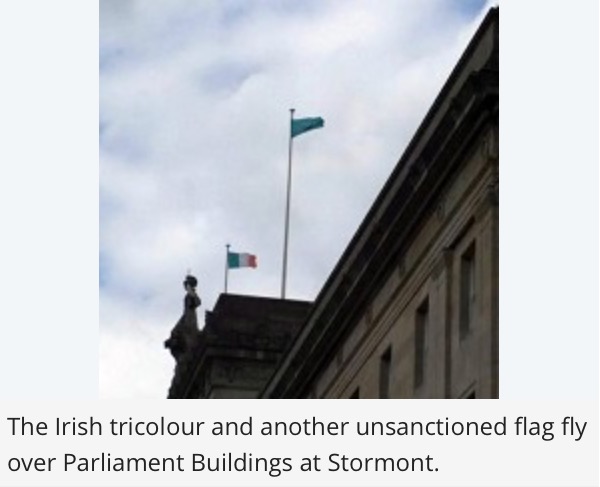
On Wednesday the 5th May, I emerged from conducting a series of interviews, and checked my phone for news and emails. I had been occupied for around five hours, which is a long time in Northern Irish politics. However, I was unprepared for the image of two, Irish flags flying from Stormont buildings, and the nuclear fallout which resulted.

‘Someone’, possibly contractors, had hung the Irish Tricolour, and a United Irishmen flag, from the flagpoles at Stormont buildings on Wednesday. Both flags flew for around ten minutes before being spotted and subsequently removed. As with many things on this island, the act itself was relatively banal, but what it symbolizes, and how it is interpreted, is important for understanding where we are at as a post-Agreement, yet deeply divided, society.

Firstly, the divergent reactions to the flying of these flags reveal much about the attitudes of political elites and indeed, the divisions within Northern Irish society. After the Belfast Telegraph ran the story, the majority of commentators derided Unionism for calling for an investigation, and stated that there were other, more important problems to consider.

The politicians can be demarcated in this analysis, as they are in Stormont itself, along sectarian lines. Unionists, united it seemed, for the first time in months, took great offence at the act, decried it as criminal and provocative, and demanded an inquiry.

Nationalists, contrastingly, shrugged off the flag issue as inconsequential and Gerry Kelly, that well-known moderate and mediator, accused Unionism of “hysteria” and as having an irrational focus on the “wrong issues”, given the salience of Welfare Reform, and resultant existential crisis, which the Executive is currently facing.

Two points are implicit in Kelly’s comments. The first is that flags do not matter, therefore anyone who does see value in respecting a flag, or experiences positive or negative emotions when faced with particular flags, is operating under misplaced, nationalistic delusions, and really ought to consider more pressing, economic matters, should they wish to be taken seriously. Linked to this is the belief that Unionists should not, therefore, be taken seriously.

The second is that Unionism as a whole is reactionary, and by extension of this, less politically mature and adept than Republicanism. Both of these things tell us a lot about Sinn Fein’s attitude towards Unionism as a political ideology, in that they see it as an unfortunate obstacle to the ‘Irish awakening’, which we will all, of course, undergo eventually, prior to our willing incorporation into a United Ireland.

This patronizing and demeaning disposition, whilst morally repugnant,  goes some way toward explaining Sinn Fein’s ungenerous treatment of Unionists, in the December 2012 Union flag debacle, in Wednesday’s provocative comments, and more broadly, since 2007, when the ‘new ascendancy’ of Sinn Fein and the DUP, clumsily took the reins of power. Not only do Sinn Fein dislike Unionism, they also fail to understand it, and consequently fail to recognize it as a legitimate, political position.

What is ironic however, is that for the Shinners, who have honed and crafted their own nationalist mythology, flags probably do matter. No doubt, if a vote supported flying the Tricolour at Belfast City Hall, we would see Gerry et al celebrating the symbolic victory of further ‘greening’ the former bastion of Unionist political and economic power, and consolidating Republicanism’s place in the new Northern Ireland.

Therefore, Kelly is being deliberately disingenuous, in order to present himself and his party as serious politicians, and Unionists as flag-waving imbeciles. I’m not sure if claiming you are better at politics than the DUP is anything to boast about, but the Shinners clearly need to take their victories where they can find them.

Indeed, there is some truth in what Kelly said. Viewing Unionist as reactionary is not an unreasonable position to take, given the lack of proactive and independent policy ideas emerging from the Unionist camp. Robinson refusing to sign the Haass Agreement because “McGuinness seemed very eager to sign it, therefore something must be up”, is a depressingly accurate example of how we do politics here. If ‘they’ want something, it must be bad for ‘us’.

Further, these perspectives on Unionist short-sightedness are voiced by the Unionist people, and fairly regularly. Much of the complaints which emanate from the electorate are that Unionism has no strategy, and tends to be pushed and pulled by the various crises which we manufacture for ourselves here in Northern Ireland. However, that should not distract us from the fact that a substantial number of those crises are engineered by Republicanism, and for reasons which I will now outline.

Sinn Fein willingly entered into government with the DUP, on the understanding that power-sharing was a pragmatic solution to the ethno-sectarian divide. Since then, there has been little evidence of the development of a respectful, healthy politics between the two.

The question I have for Republicans is: why the small-scale, amateur attempts at winding Unionists up? Is it, perhaps because, you have found yourselves in power, ten months away from the hundredth centenary of the Easter Rising, with no idea where to go from here?

I have heard much reference to a ‘New Ireland’, an ‘Agreed Ireland’, and an ‘Ireland of Equals’. These abstractions, with their implicit benefits, are regularly doled out to Republican voters, to reassure them that this is not it. McGuinness sitting alongside Robinson is not where the Shinner train stops. A United Ireland will come.

But how? And when? Who will vote for it? And what will it look like? Because, despite the demographic changes, which the esteemed and benevolent Gerry Kelly so graciously displayed in his electoral leaflets, support for the Union has increased steadily since 2007, when 48% of Catholics wanted unification, compared to 2013’s figure of just 28%.

Professor Peter Shirlow refers to this attitudinal change as down to the “settlement”, which gave Catholics the rights and opportunities which they desired, and so removing the need to alter the constitutional position of Northern Ireland. However, that figure of just over a quarter looks positive when compared with the Protestant support for a united Ireland, which was sitting at 2% as of 2013 (Northern Ireland Life and Times online).

How do Sinn Fein plan to persuade the reluctant, or downright opposed, 98% of Protestants, and 72% of Catholics? By continuing to pursue a schizophrenic, inconsistent approach to policymaking across the island of Ireland? Anti-austerity in the Republic, and, for the most part, implementing Tory austerity in NI? By taunting and insulting Unionists as a grouping, criticizing their attachment to the Union flag, and working, where possible, to block parades from progressing?

As a Unionist voter, I can only assume that life in a united Ireland, with Sinn Fein in power, would be very unpleasant indeed. Given their silence on what shape this Ireland would take, and how we, the irrational, but nonetheless resident, minority, would be welcomed, all we have to go on is their conduct towards Unionists to date.

In addition to this inconvenient survey data, the recent Westminster elections brought bad news for Republicans. Sinn Fein’s vote share dropped for the first time since 1987, with the Ulster Unionist Party emerging as the victors of the election. Furthermore, the votes for ‘other’ parties, that is, Alliance, the Greens, and People Before Profit, and UKIP, increased. These parties sit outside of the ‘Orange and Green’, and they too, would have to be persuaded of the merits of Irish unification.

Finally, there have been some symbolic blows to the Republican psyche in the past year, which have perhaps derailed their grand plans for 2016, and all it promised to bring. Firstly, Gerry Carroll took a West Belfast seat in 2014, no mean feat in Gerry Adam’s former fiefdom. The people of West Belfast, it appears, are disillusioned with what the Shinners have to offer the working classes, and would prefer to lend their support to a new, genuinely socialist, candidate.

Looking east, toward the mainland, it might also be worrying Sinn Fein, that for all their supposed political capital, their tight party discipline, and their elastic approach to “talking to the Brits”, the SNP brought the Union closer to dissolution through democratic argument and persuasion, than the Shinners ever did through force.

Switching from the Armalite to the ballot box has brought Sinn Fein into Stormont. But that appears to be the upper limit of political Republicanism’s reach. This might be why, then, such attention is paid to the ‘small victories’ of irritating Unionists, given that they have failed to achieve their objectives, and are now “the Establishment”, which they once criticized so fiercely.

Sophie Long


Share

Marriage Under Attack: Athiests Try To Police Faith: Dr. John Coulter

Marriage under attack: Atheists try to police faith


Churches across Ireland better shift their defence of the religious marriage ceremony into top gear otherwise this traditional Christian institution is well and truly scuppered.

Catholic Archbishop of Dublin Diarmuid Martin, one of the most senior clerics on the island, really understated the crisis which faces Irish Christianity when he said the gay marriage referendum victory in the Republic was a “reality check”.

While the gay and lesbian community is one of the best organised and most vocal in Ireland, would the Catholic Church faced a similar 64 per cent defeat if the referendum had been about abortion, divorce, assisted suicide, or designer babies?

The referendum result was not so much a victory for the gay community – it was an ‘up your’s’ to the Catholic hierarchy for its alleged cover-ups of sexual and physical abuse by clerics and nuns over the generations.

The gay marriage defeat for Christianity in Southern Ireland represents a treble whammy which the faith has suffered in recent weeks.

Firstly, devout Baptist and DUP MLA Jim Wells was forced to quit as Stormont health minister as a result of remarks he made about homosexuality during the North’s general election campaign.

Then Ashers bakery – owned by devout Christians – lost the gay cake row. Now the Republic has joined the ever-growing league of nations to formally support gay marriage.

Christian Churches will react in a number of ways. Firstly, they could ask the question – what would Jesus do? How would Christ Himself treat the gay and lesbian community?

The ‘reality check’ is for Christians to find a theological answer to the sensitive question – is homosexuality a sin as defined by the Bible, or are people born gay? Whatever the answer, it is bound to split many churches as clerics line up on both sides of the debate.

This will also spark further rows over the issues of gay adoption and gay men donating blood – and the ordination of openly gay clerics.

The LGBT lobby now has its sights set on getting gay marriage legalised in the North. But its campaign could become hijacked by militant atheists hell-bent on being ‘offended’ by anything Christian.

Could churches now be forced to conduct religious weddings for gay and lesbian couples? Will we see the creation of a ‘preaching police’ who tour evangelical and fundamentalist churches seeking out clerics who preach ‘offensive’ sermons?

Unfortunately this will create a situation where genuine clerics who hold devout Biblical beliefs will find themselves in court, being fined, or even jailed.

But there is also the real danger that some on the fundamentalist lunatic fringe of Christendom will deliberately preach provocative sermons to get themselves jailed.

These hell-fire preachers will want to become the modern-day equivalents of the Biblical martyr Stephen.

After all, the political career of former First Minster and DUP founder the late Ian Paisley senior did not take off until he was jailed in Crumlin Road goal.

Stand by too for a range of fundamentalist sermons warning of God’s Judgement on the South for supporting gay marriage.

Ironically, could the referendum victory spark a new wave of homophobic crime as militant fundamentalists target gay bars, clubs and activists?

Already rumours are rife that some even more looney militants have formed the so-called Anti Sodomite Army (ASA) as the LGBT lobby scores victory after victory.

There’s nothing Christian about the ASA – its leaders are the Ku Klux Klan under another name! That’s my opinion of the ones I’ve talked to.

Share

A View From the South: Jacob

A VIEW FROM THE SOUTH

Some observations of the past week.

I’m wondering if Barra McGrory is a football fan? If he is, he obviously has some sympathy for dear old Sepp Blatter. Mr. Blatter has been at the helm of FIFA for God knows how many years and just this week was successfully re-elected for the fifth time – unprecedented. Blatter’s obvious joy has been spoiled by the vitriol of the opposition with regard to the FBI arrests and raids in the USA. Opponents of his re-election listened with ever-increasing dread to the pledging of support from around the football world for Blatter – Europe and isolated parts of the rest of the footballing world apart. They wondered how someone could survive the allegations heaped upon individuals, FIFA and Blatter himself with regard to the awarding of the 2018 and 2022 World Cup venues. Calls for Blatter to resign were many fold and multi-lingual and tempered with the right amount of righteous indignation. Enter young Barra.

The Maria Cahill saga is also refusing to go away, despite Gerry Adams continuing denial of IRA interference and his own brand of spin. The role of the PPS and Barra’s stewardship has also been scrutinised at all levels over this, and other affairs. Let’s remember that  McGrory was Adams’s legal representative at the time of these allegations and when Liam Adams was confessing to his brother Gerry about the disgusting abuse of his daughter. It has been acknowledged that Maria Cahill and other rape victims have been let down by the PPS, resulting in the allegations being withdrawn. The stink surrounding Blatter and McGrory is overwhelming, though, seemingly, non-transferable.

An article in the Independent.ie recently reports that Police in the UK make a request to monitor e-mails, txt’s or internet searches every two minutes and that fewer than 1 in 10 requests is refused! How many people are required to monitor these requests? That’s a lot of snooping – it must be an interesting interview for that job, though we all know someone who would be great at it.

The legacy of ‘the troubles’ continues to haunt the people of West Belfast – according to Paul Maskey. Figures just released show people receiving DLA in West Belfast sits at 19.9 % compared to 11% for the country as a whole. North Belfast comes second with 15.5%.

This compares with a 5.23% rate for ‘across the water’. Is it no wonder Sinn Fein are opposing the welfare cuts?  ‘If you don’t eat your vegetables you won’t get your pudding’ Paul.

The Panorama programme ‘Secret Terror Force’ and some of the allegations made has resulted in a financial windfall for some sharp operators around the country.

When Lord Stevens stated that ‘ of the 210 people arrested during the ‘Stevens Inquiry’, 207 were informers or agents’. ‘I’m one of the Stevens 3’ t-shirts are available online now.

Jacob


Share

Labour Needs To Follow DUP Lead: Dr. John Coulter

John Coulter

Written By: John Coulter
Published: June 1, 2015 Last modified: May 28, 2015

After its calamitous general election defeat, Labour should take a leaf out of the Democratic Unionists’ tactics book and rebrand itself as a slightly left-leaning social democratic party – and go hunting in traditional Liberal Democrat territory.

For almost a generation since its inception in 1971, the DUP was invariably branded as a hard-line, right-wing, working-class loyalist movement, fusing together an unholy political marriage of working class Protestants and Christian fundamentalists.

For decades, both these factions had been the voiceless minorities of the Unionist family in Northern Ireland, which was dominated by the religiously liberal, upper-middle-class landed families from The Unionist Party.

But at the start of the new millennium, the DUP embarked on a new strategy – selling its policies to middle-class Protestants who formed the bedrock of the rival Ulster Unionist Party’s voter base.

By 2003, the UUP had lost control of Stormont; by 2005, the DUP had more MPs’ and by 2010, the UUP had no Westminster MPs.

Ironically, Sinn Fein implemented a similar strategy against the moderate nationalist SDLP, snatching its European parliamentary seat, Westminster constituencies and eventually becoming the latest nationalist party in the Northern Ireland Assembly.

Labour can get back into Downing Street by adopting the Irish model – electorally plundering the centre ground which was once the bastions of the Liberals.

Granted, this is a high-risk strategy and sceptics may say that what works in Ireland may not work in Britain.

But the DUP and Sinn Fein strategies were not simply about canvassing raids into their opponents’ bases – in these cases, the middle classes. This was about capturing and holding those voters.

Indeed, it was about more than this. It was not just a protest vote – it was about seeking out a whole generation of new voters.

Just as Tony Blair conceived of New Labour to undo the years of Thatcherism and develop a new brand of Labour voter that was almost right-wing, so Labour now will only defeat David Cameron and rampant Scottish nationalism by developing the concept of Patriotic Labour.

Both the DUP and Sinn Fein had past links to paramilitary groups in the Irish conflict and were viewed globally as representing the extremes in their respective communities.

Patriotic Labour – like the DUP and Sinn Fein – must come to dominate the centre ground. By capturing and holding the Unionist centre ground, the DUP has gone from an ultra-fundamentalist movement to a party which operates a power-sharing Executive with Sinn Fein.

Similarly, Sinn Fein has gone from a group which gloated over the IRA bomb blast that killed Lord Louis Mountbatten in 1979 to a modern party whose president, Gerry Adams, shook hands with Prince Charles, a direct blood relative to the murdered Mountbatten.

Sinn Fein is currently expected to make substantial gains at next year’s Stormont and Dail elections using this centre-ground strategy.

The DUP has become such a liberal unionist movement that even the man the party was set up to oppose, the liberal Unionist Prime Minister Terence O’Neill, would be very happy to lead it

This is forcing the revamped Ulster Unionists to have to make a stark choice – does do they fight the middle of the road Alliance for the centre ground, or do they reposition themselves as the voice of the new right in Unionism?

Regarding Scotland, Labour’s strategy should be to rebrand itself as a patriotic Scottish party. That doesn’t mean you have to abandon the Union.

In Britain, the Lib Dems have been left with the same number of MPs as the DUP in Northern Ireland. Just as the DUP embarked on a charm offensive in the middle classes, so should Patriotic Labour target middle-class Liberal families.

The time has come for Labour to develop its own unique appeal to undermine the Lib Dems, SNP, UKIP and even Tory wets.

What it must not do is fall into the same trap it did after Margaret Thatcher’s victory in 1979 and become a party of the hard left. To defeat the Tories, Patriotic Labour must box clever. Stage one: win over traditional Liberals to its cause.

Share

Assembly on the Brink: Scheme could stop Meltdown: Dr. John Coulter

Assembly on the Brink


Get the Scottish and Welsh Assemblies along with the Dail to foot the welfare reform bill at Stormont – and save the Northern Assembly from meltdown tomorrow.
And in return, Brit Prime Minister Dandy Dave Cameron gives more tax-raising powers to Scotland and Wales, and increases the clout of the cross-border bodies in Ireland.
Ever since the 1998 Good Friday Agreement, the people of Ireland – and especially the North – have been subjected to constant brinkmanship from the Stormont parties.
The prophets of doom take us to the very edge of chaos and collapse, only for a last-minute magic solution.
None of the Stormont parties want to implement the austerity which approving welfare reform will unleash.
At the same time, refusal will spark a Stormont election, which neither the DUP or Shinners want, and possibly even the total shutting of the Assembly with all powers going back to London.
The Shinners don’t want another Northern poll this year as their primary focus is getting into power in Leinster House.
Robbo’s DUP equally don’t want a poll given the resurgence in the rival UUP under Mickey Nesbitt.
With all the sabre-rattling, no one seems to have picked up on a wee announcement by the new DUP health boss at Stormont, Simon Hamilton.


He quietly unveiled that his new health department has reached a deal in principle with the nationalist-run Scottish Parliament that payments to the Independent Living Fund (ILF) in the North will be administered through the Scottish ILF infrastructure it is setting up.
While this will only affect about 600 Northern citizens, Unionists sources are hinting this will be a dry run for the Scottish National Party to have a bigger say in helping Stormont pay its way.
Nicola Sturgeon, the SNP boss, the Welsh nationalists of Plaid Cymru and a few folks On The Hill may have been listening to my solution of a Celtic Alliance involving Ireland, Scotland and Wales.
There will also be a pay-off from the English royal heir, the new bonnie Prince Charlie and his missus, touring Ireland last week.
The historic handshake between Prince Charles and Shinner boss Gerry Adams could well have been the grip which sealed the deal on another era of Anglo-Irish relations.
It’s a trial run for bigger things to come. If the SNP can make a good job of running the North’s ILP, the nationalist reward for Scotland will be increased tax-raising powers.
If the Scots get these, so will the Welsh. It could also prove to be a tempting carrot for any future English regional assemblies.
The deal is simple – you help the Irish out of their cash crisis at Stormont, and you get more control over you own finances. This means Scottish and Welsh Home Rule as well as English regional devolution by the back door.
It also prevents a dangerous political vacuum emerging in Ireland which could be filled either by dissident republicans or militant loyalists.
So what does the Dail get out of this? Okay, Leinster House doesn’t have the dosh to pump into the Stormont welfare reform rescue plan.
But the Brits could squeeze a few million quid here and there to increase funding to the cross-border bodies.
Dave may even be able to screw some extra cash out of the European Union before the crunch 2017 In/Out referendum to boost the powers of the British Irish institutions.
If the ILF works, I wonder what other schemes the Tories have to keep Stormont in business? Watch this space!

John Coulter

Share

The Ashers Verdict: Becoming “Generous Minorities”: Sophie Long

The Ashers Verdict: Becoming “Generous Minorities”


I am offering my comments on the recent Ashers legal case, and subsequent “guilty” verdict, because I believe that both have consequences for community relations here in Northern Ireland, and also because I have a broader interest in what a diverse, tolerant society might look like.

The events which preceded the court hearing, and yesterday’s decision, have already begun to polarize opinion, with some heaping blame upon those with an “aggressive gay rights agenda” and other, socially conservative Christians, framing themselves as victims of “political correctness gone mad”, and perpetuating the idea that modernity, secularism and liberalism are incompatible with religious tolerance.

Such perceptions, whether misplaced or otherwise, should give us little cause for celebration. If the aims of the LGBT ’community/communities’ are respect and equal rights, the Ashers verdict might appear to be an all-out victory, but in the broader scheme of building an inclusive society, I believe it might represent a long-term, strategic failure.

Of course, as is often the case in Northern Ireland, the loudest voices aren’t the only voices. Some others, who may describe themselves as fairly liberal, and who support equal marriage, are troubled by the verdict, and its implications for religious tolerance, and are quietly questioning the logical limits of the legal decision.

Whichever side you fall on, I believe that the 19th May 2015 may have been a short-term victory for equality, but one which simultaneously created a long-term obstacle to tolerance and understanding. The case has been dissected multiple times, and my own analysis adds little to what has already been said.

However, it is worth considering how an order for a cake has caused such deep, social and political tremors. Tremors which might become fault lines if they are not critically addressed.

From what I can gather from their official website, Asher’s market themselves as a bakery, with the only discernible evidence of any religious leanings being found in the ‘About Us’ section of the site. They state this:

“Why Ashers? Well, contrary to popular opinion we are not called Mr. & Mrs. Asher. Our name comes from the Bible. Asher was a tribe of Israel who had many skilled bakers and created bread fit for a king.”(Ashers online).

I see no issue with this; it is not uncommon for businesses to explain their branding and provide some insight into their heritage. It personalizes the company, providing a Unique Selling Point in a competitive marketplace. However, nowhere on the website do Ashers suggest that this short, Biblical reference has any implications for the products which they are willing to offer.

Therefore, it is reasonable to assume, when visiting the website, that Ashers are a professional bakery, keen to solicit custom, as all for-profit organisations are, and who make only scant reference to the private values which might lie behind the branding. The same ‘About Us’ section ends with:

“It just so happens we love to bake. On any given morning, you’ll find our home kitchen filled with the aroma of freshly baked scones or cinnamon swirls as we try out new recipes or experiment with new flavour combinations.

So why not pop in for a visit, we’d love to see you.” (Ashers online).

Based on this information, placing an order for a cake, with the now infamous, pro-gay marriage “Bert and Ernie” decoration, from Ashers, should not necessarily have resulted in a legal battle. Ashers appear to specialize in hand-decorated cakes, and encourage would-be customers to get in touch:

“Looking for something more personal, why not order a custom-made cake in store with our friendly folk behind the counter or build your own at our online shop Build-a-cake.

However, as has been outlined in various media discussions on the case, Ashers accepted the order, before contacting the customer to explain that they would be unable to fulfil the request. Following this, and, it appears, due to the connections and/or political persuasion of the customer, a lengthy dispute took place, with all of the associated claims around discrimination and tolerance which this sort of issue inevitably raises.

These are important, social and moral topics, and deserve our consideration. We are no longer a society with a clear majority, whose wishes could, under democratic, majoritarian voting systems, secure such wishes, and in doing so, perhaps oppress a range of minority groups.

Instead, Northern Ireland is a society of minorities. We all want different things, and have different, but equally firm, ideas about how best to organize society. Ashers was a small, tangible example of the new, Northern Irish pluralism, and all of the issues which that pluralism raises.  I’d like to offer a suggestion for how all sides, the “victors”, “victims” and concerned onlookers might move forward.

The verdict was met first with glee from some areas (DUP and TUV), who quickly re-adjusted their response once they realized that the “not guilty” rumours were unsubstantiated. It was then met with triumphant statements from others (LGBT groups for the most part), who celebrated the “common sense” approach of Judge Brownlie in recognizing discrimination when she saw it. This series of divergent, but equally passionate reactions, are what caused me to reflect on what the Asher’s debate might mean for Northern Ireland.

Ashers are a for-profit, professional business, operating in the centre of a capital city. Unless you know the family personally, it is nearly impossible to glean their religiosity from the company website. It is therefore, as I have said above, not unreasonable to expect that they would fulfil an order for a product which contains a pro-equal marriage message.

However, and this is a contingent statement, there have been murmurings that the customer in question was keenly aware of the family’s religious beliefs, and deliberately chose Ashers as a bakery, in order to provoke a reaction. There is nothing inherently wrong with this, as they are, as I have outlined, operating in a public space, as business. Indeed, provocation can often be necessary for encouraging uncomfortable conversations.

Yet I can’t help but feel there are more respectful, and less overtly combative, ways to progress LGBT causes. We now have a legal decision which prevents businesses discriminating against customers, and this itself is a positive step. Yet we also have a substantial number of Christians, and others, who feel threatened by the ways in which this dispute was conducted.

These Christians, and those ‘others’ who are uncomfortable with the Ashers case, do not, of course, have the right to prescribe how others live their lives, and this extends to the debate over equal marriage. Yet they do have the right to feel part of our society, and it seems that we are rapidly alienating many of our fellow citizens.

It is not for me to advise LGBT groups on how to secure rights and protections, nor do I wish to belittle the very real and ongoing cases of discrimination which many LGBT citizens unjustly suffer, but there is a general piece of advice which we all might take on board, as we adjust to the new, increasingly secular Northern Ireland.

Yesterday’s ruling means that pro-gay rights groups can order similar products from Ashers, and reasonably expect the order be fulfilled, lest another fine be levied. However, and this is my argument: just because you can, doesn’t mean you should.

Ashers, as far as I am aware, are not engaged in any actions which harm or threaten the rights of the LGBT community. They should obey the law, and obligated to comply with equality legislation. Yet the temptation to exploit yesterday’s ruling should be avoided. We would like to be respected as equal citizens in Northern Ireland.  We should extend the same respect to others.

“Just because you can, doesn’t mean you should” can be applied to a number of contentious areas of life in Northern Ireland. Just because you can parade up a road, doesn’t mean you should. Just because you can stop a parade, doesn’t mean you should. Just because you can vote to change a flag policy, doesn’t mean you should.

If we are to live together, in a genuine spirit of tolerance, we must transform the zero-sum attitude of “defeating” the other, in order to progress our own agendas. Justice matters, and the struggle should not end, but we should think in terms of twenty, fifty, one hundred years ahead, and build relationships, not future battles.

In short, to paraphrase a local Green politician, to move beyond such fraught, short-term battles, and create a tolerant, respectful society, we must all become “generous minorities” and consider the rights of all, not just the few, when we engage in these debates.

Sophie Long


Share

You Can’t Have Your Cake and Eat It: Jamie Bryson

You can’t have your cake and eat it- Critique of ruling in Gareth Lee v Ashers


Today’s ruling in the Gareth Lee V Ashers bakery case sets a dangerous precedent and it feeds those activists pursuing an aggressive gay agenda with more ammunition with which to persecute their war on freedom of conscience and also upon religious and moral principles and beliefs. The gay rights activists do not seek equality; they seek to pervert the true meaning of equality to use it as a weapon to enable their ‘rights’ to trump the rights of those who object to their practices or sexual preferences on religious or moral grounds. The ruling, in my mind, is a flawed one which is open to appeal on many levels. The Judge has allowed the rights of the “gay activists”, who purposefully and maliciously targeted a Christian run bakery, to trump the rights of those who hold deep religious and moral convictions. In delivering her judgement the judge made reference to a disputed ‘fact’- that she believed the bakery knew or had reason to suspect that the plaintiff was gay, this is a flawed and illogical assumption because the greater number of those who describe themselves as “LGBT activists” are not actually themselves gay. Therefore the judge has based a key issue, which she drew heavily upon as part of a balancing exercise between competing rights-which the judge herself acknowledged existed- upon a flawed and misinformed assumption that because a person is a gay rights supporter or activist that it would be ‘reasonable’ to believe that the person was gay. This reasoning stretches the boundaries of the law and goes far and beyond the protections that are offered, it effectively means that you can discriminate against not only a person but an idea or a belief- that is dangerous territory for any society to enter and it could quite realistically open the floodgates for not only an assault on Christianity but also upon a whole range of political, religious and moral beliefs and convictions. It creates a de facto right not to be offended by the back door. Ashers bakery did not refuse to bake a cake for the plaintiff because they suspected he was gay, they refused to bake the cake because they disagreed with the idea or belief the slogan on it espoused. As a matter of fact they disagreed, based on deep moral and religious convictions, with the gay rights propaganda message that the cake was to carry. It is also worth pointing out that gay marriage is unlawful in Northern Ireland, so it is also an issue that Ashers have been punished for refusing to produce propaganda supporting an illegal act. How bizarre that the Courts, at the behest of the publicly funded equality commission, would persecute a Christian family run business for refusing to provide propaganda promoting illegal activity. Some may say that is an unrealistic stretch of the law, well given the stretch in the law that Judge Brownlie made today I believe that the law is now open to be stretched in a whole manner of bizarre and illogical directions. Equality has no logical trajectory, boundaries or parameters. It provides for an anything goes society, as long as it makes anyone happy. It will corrode and destroy every moral fibre of society because society will be expected to accommodate every immoral act based upon the fatally flawed notion of equality.

What if a man decides he wants to have three wives? Should marriage be re-defined again to allow for three consenting women to be married to one man? If we following the trajectory of equality then most certainly a man should be allowed three wives so the question I then pose is where does ‘equality’ stop? What does ‘equality’ actually mean? It appears to me that equality is a weapon to be used to coerce and force people to promote or accept practices, causes or beliefs that they oppose for religious, moral or general conscientious reasons. Let’s look at just one example of the logic of todays ‘equality’ ruling in relation to businesses. Sean Kelly, the IRA Shankill bomber, could walk into a bakery on the Shankill Road and ask for a cake to be made commemorating fellow Shankill bomber Thomas Begley. Providing the message on the cake did not breach the prevention of terrorism act by encouraging future acts of terrorism and only ‘glorified’ terrorism in a historical/past tense then the bakery would be duty bound to make this cake or face being brought before the courts for discrimination on political grounds. Freedom from discrimination on political grounds is offered the same protections within the law as discrimination on sexual orientation. Now in my mind, and in the mind of any right thinking person, the Shankill bomb was not a political act but it was an act of pure terrorism but Sean Kelly was afforded, by the perverse Belfast Agreement, political status by being released as a ‘political prisoner’ on the basis of an internationally backed political agreement, therefore following the precedent set today a Republican could ask for a cake glorifying the Shankill bomb or any other act of republican terrorism and hide under the cloak of freedom from discrimination on political grounds to force the business into complying or face a discrimination case. That is the reality of the bizarre and outrageous possibilities opened up by this outrageous ruling. There is also an illogical and bizarre argument put forward, quite often by those who support the devolved Stormont institutions, that gay marriage should be allowed because it is allowed in the rest of the UK and therefore it would be anti-unionist to oppose it here in Northern Ireland. This nonsensical argument once again tries to ride two horses- firstly those who are devout supporters of Northern Irelands ‘special circumstances’ and devolved powers, which allows the assembly to make their own mind up on gay marriage and other issues, want to override the ‘special circumstances’ and slavishly follow the ‘mother parliament’ to force through gay marriage legislation. Secondly most Unionists would trace our heritage back to the signing of the Ulster Covenant and the formation of the Ulster Volunteer Force, which later became the 36th Ulster Division fighting as part of the British Army, yet those who perpetuate the argument that we should follow the mother parliament wish to cling to the legacy of our forefathers that framed and signed the convent whilst conveniently ignoring the fact that the Ulster Volunteer Force/36th Ulster Division was formed to resist the mother parliament, by all means necessary, in relation to the Home Rule bill. What is clear is that those celebrating today’s ruling cannot ignore the possibilities for an opening of the floodgates for all sorts of bizarre cases and indeed whilst it is the right of freedom of conscience that has been trumped on this occasion, there is a flip side to that coin which means that gay businesses could quite reasonably be forced to produce merchandise, cakes etc. which condemn gay marriage and which may carry slogans that while being totally lawful, a gay person may find deeply offensive, such is the can of worms that has been opened. You can’t have your cake and eat it!

Jamie Bryson

Share