Loyalists Trying To Avoid History’s Traditional Route: Steven McCaffery

Loyalists trying to avoid history’s traditional route

17 MAY 2013

THIS ARTICLE FIRST APPEARED ON “THE DETAIL”

THE Detail’s Steven McCaffery attended two debates on Northern Ireland’s future this week – one involving politicians at Stormont, the other featuring loyalists at a resource centre for the unemployed.

You probably already know how one of these meetings went.

When the First Minister Peter Robinson addressed the Assembly on his plans for a shared future, it soon deteriorated into a bitter row replete with biblical-sounding insults.

The second event was held behind closed doors but saw a discussion on loyalism that was not afraid to be warts and all. Whatever about Stormont, there were no “whited sepulchres” in the function room of the Belfast Unemployed Resource Centre.

The problem with the two debates, however, was that while the Assembly quarrel ended with the publication of a blueprint on the way forward, the arguably more constructive discussion on loyalism ended with uncertainty about where to go from here.

The organisers – the Political Studies Association and the Fellowship of Messines cross-community peace project – have at least started a debate.

But 15 years after the Good Friday Agreement, it feels very late in the day for loyalism to still be finding its way.

Outsiders might have expected to have heard the perhaps predictable criticisms of republicanism and mainstream unionism, but they may have been surprised by the self-critical descriptions of Orangeism as at times being `supremacist’, the most extreme flag protestors characterised by one speaker as `fascist’, and to hear sympathy for not just Protestant but also Catholic communities hit by poverty and educational under-achievement.

The resource centre’s room was filled with a rectangular arrangement of tables, with around 40 participants discussing events under the privacy of Chatham House rules.

There were community workers, trade unionists, loyalist politicians, ex-prisoners, a republican known now for campaigning on social issues, researchers and a number of academics specialising in the study of loyalism and Protestantism.

The event, by the way, wasn’t as dry as it might sound – there were even some laughs, particularly when a debate on uniting Protestant and Catholic workers was interrupted by a mobile phone ringtone playing the old Soviet national anthem.

But if representatives of the mainstream political parties were present, they may not have found the day-long discussion a comfortable experience.

The city centre event began with a myth-busting history lesson, recalling much of what unites Protestant, Catholic and Dissenter, but which did not reflect well on today’s `political elites’.

“It appears to me that history has kind of played a three-card-trick on people here,” said Joe Bowers, chairman of the Fellowship of Messines, who helped open the event.

“What has happened to us? Why are we not all united celebrating this progressive history? Why are we left with this in-your-face, `youse ‘uns and them ‘uns’ type of politics?

“All of this is encapsulated with what we are faced with today.”

The recent crisis over the restrictions placed on flying the Union flag at Belfast City Hall which, as reported here convulsed unionism, was never far from the debate.

A speaker asked why NHS cuts had not brought more people onto the street, or sparked common cause between communities.

“The National Health Service – is that not the most important part of our British history? Is it not more important than the Union flag?

“Why are we not mobilising people around the defence of the National Health Service with the same type of determination? It is much more threatened than the Union flag.”

Focusing on the question of whether the `Protestant working class had lost out on the peace process’, some asked what the Protestant working class was?

Others recalled the withering of industries that had once been a way of life for the Protestant community in Belfast – a loss that had ended the sense of shared experience with industrial heartlands in Britain.

Uncertainties about the future were also fuelled by urban planning decisions which were  seen to have led to population movements and the decline of traditional loyalist communities such as the Shankill.

This led to references to educational under-achievement in loyalist districts and a complaint that mainstream unionists had promised to champion the issue, only to continue to support academic selection despite evidence of its negative impact.

Speakers also cited the impact of political changes brought about by a peace process described as being “designed for republicans”, with the loyalist experience of life under the power-sharing government also said to be eroding identity.

“But how,” asked another contributor, “do you respond to an identity crisis?”

The current disconnect with mainstream unionist parties was traced back to the Troubles.

Former UVF and PUP figure Gusty Spence was quoted as being encouraged towards violence by unionist political rhetoric, but was among those who from inside prison came to the belief that: “We’re in here and they’re out there, still mixing it.”

While that disaffection remains up to the present day, there was some limited hope expressed that the Unionist Forum, formed by Peter Robinson to allow discussions between all strands of unionism and loyalism, could yet bear fruit.

There were also claims, however, that Sinn Féin is engaged in a `cultural war’, bent on eroding British emblems.

There was no detailed explanation of what this meant, though nationalists have claimed it is they who struggle to see their identity reflected in public life.

And there was little mention of parades, though this is obviously a key battle ground, as was previously examined in The Detail here.

A contributor at the event later said that republicans had `lost the war’, but wanted to appear to be making gains on issues such as restricting the flying of the Union flag.

This was then linked to the familiar analysis that the Good Friday Agreement was a `victory for unionists, if only they’d realise it’.

It was a phrase that had currency in the years immediately after the 1998 peace deal, but which today, when set against the background of ongoing political change, seems to fall short of explaining the present, or framing future possibilities.

A question as to how unionism might cope with any future political change in Northern Ireland was misconstrued as a prediction that major constitutional reform was imminent.

The subsequent observation that the 1998 Agreement guaranteed Northern Ireland’s place in the UK, until a majority desired otherwise, was an accurate one.

But perhaps it underestimates the potential for loyalist disquiet over the inevitable process of continuing internal reform within Northern Ireland that is still flowing from the Good Friday Agreement.

There are further factors that could promote change, including Sinn Féin’s leading role in government at Stormont, the party’s growth in the Irish Republic (as previously reported here), plus factors such as demographic shifts placing Protestant and Catholic communities on an equal footing (as reported here).

A speaker asked if perhaps the real issue currently concerning unionists was not in fact the border, but rather the process of reform in Northern Ireland that was delivering greater political and cultural equality for nationalists.

And this prompted the suggestion that sections of unionism are undergoing an inevitable period of adjustment, which will eventually settle and stabilise.

Two others recalled growing up unaware of Irish history, including the history of Northern Ireland, neither of which was taught in the state schools they attended.

A separate contributor said discussions on how loyalists might begin to show a greater acceptance of Irish culture and identity could perhaps be developed in the Unionist Forum.

He added: “There is a supremacist attitude within Orangeism that states that we’re better, that `we’re the people’.

“And that, I think, is one of the characters that needs to be seriously addressed by ourselves.

“We are all equal.”

He added: “The flags issue raised serious concerns for me because of how it was focused around something that, let’s face it, most of us wouldn’t have even noticed, ie the flag flying over the city hall.

“I think the rallying around that flag … the conduct of it was wrong.

“It came across as supremacist, it came across as fascist … moderates [were] pushed aside.

“The `flagsters’, for want of a description or a word to call them, certainly within the wider unionist family became, quite frankly, viewed as fascists and supremacists in that their association was with members of the British National Party.”

His comments on “supremacist” views in Orangeism were echoed by others from a unionist background, though there was also agreement around the table that sectarianism was equally a problem within both the Catholic and Protestant communities, with “Protestants no more sectarian than Catholics”.

The speaker also acknowledged there were varying views within loyalism on the flag demonstrations, with others at the event known to have publicly defended the right to protest.

But he was critical of mainstream unionists he said had reacted to flag protestors with an attitude of “ignore those people, and let’s move on”.

“How does an audience like this change the political thinking in modern day Ulster Unionism and the Democratic Unionist Party, when we’re all outside of that?”

The same speaker also underlined the impact of IRA violence in the area of Belfast he had grown-up in, where he said hundreds were killed during the decades of conflict.

“The fear of republicanism is very, very real. It’s a pumping heart, certainly in that working class community that I grew-up in.”

The former loyalist paramilitaries present underlined their commitment to the peace process, but cited concerns over continuing violence by dissident republicans.

On the wider political front, it is generally held that nationalists feel more comfortable with the changes that have flowed from the peace process, but the new census figures also showed Catholics remain more likely than Protestants to be unemployed.

This reality was not lost in the loyalist discussion, where a regular theme was the clear acceptance that there were both Protestant and Catholic communities trapped in poverty, who had never enjoyed the economic benefits of the peace process.

One delegate said: “I think that the challenge that has arisen from the flags protest is, how do we tap in to that disaffection that is out there that was being suppressed by political elites saying everything was wonderful?

“And anyone that asked `why are things not changing?’, they were always criticised as being dissidents or anti-peace, or being loyalist fascists.

“I think a lot of the energy that has emerged out of the flag protests can begin to help us hold events like this and begin to question how do we move the peace process on?

“How do we begin to address those issues around the marginalised, the disadvantaged, and the poor who have not experienced the benefits of the peace process?”

As the debate drew to a close, it was noted that while they had been prepared to challenge others, and to challenge themselves, the same kind of frank discussions had to be held in wider society, where problems were too often politely ignored.

The loyalist intimidation and violence surrounding the flag crisis frightened and unnerved many people, but some of those at the discussion said that they had predicted unrest was in the pipeline and wanted to work now to deal with the underlying issues. This included dealing with the legacy of the Troubles by building a reconciliation process.

The debate recalled how Belfast’s past is littered with failed attempts to put the fight against poverty above sectarian rivalries.

No one was glossing over the challenges facing the divided city, but there also seemed to be a willingness to try to avoid history’s traditional route.

Share

When Did Protestants Lose Out?: Gareth Mulvenna

PSA Paper – 15May 2013

Intro

Has the Protestant working class lost out in the Peace Process? This is a question that many people have been asking since April 1998. The issue has, however, come into sharp relief in the past ten years or so and over the past five years it has been magnified. Have we reached the crisis point? Or did we reach it in 2012, 2011, 2005 or 2000? Arguably we have to go back to before the ‘peace process’ even existed. If we want an accurate picture, we have to revisit the start of the Troubles: arguably that is when the Protestant working class truly lost out.


I: Tartan Letter

I have recently been carrying out research into the loyalist ‘Tartan’ gangs of the early 1970s. During my research I came across an ‘open letter’ in the Belfast Telegraph by the political commentator Barry White. The letter, from May 1972 was written in response to a recent upsurge in Tartan violence. Here are a few excerpts –

I don’t suppose you give a damn, but I think I know why you did what you did in East Belfast last week-end. You are young, it is spring, there is nowhere to go, nothing better to do, so you go looking for trouble. I’ve done it myself.

It’s not the pleasantest place to live, East Belfast. The houses are small, overdue for demolition, and the only playing fields are the streets. Youth clubs are fine, but they’re dull when there’s some excitement to be had outside.

It’s the people who make the place. They’re tough on the outside, but couldn’t be kinder to their own sort. They’re proud to come from the wee streets, and most of all they’re proud to be Protestant.

Since those civil rights people started marching you’ve seen your little world crumbling. First they got their way by marching and rioting, and then – when the Protestants hit back – by getting their houses burned down. They couldn’t lose, and since the IRA took over, they’ve done even better. Nothing even slowed them down – certainly not internment – and by murdering, maiming and destroying they have succeeded in toppling your Protestant Parliament.

It was enough to make any Protestant blood boil, and it isn’t really surprising that you hit the top last week-end. Those two bombs in Castlereagh Street softened you up, and those pictures of the IRA in the Bogside and the internees getting out were the last straw, even if you don’t count the Vanguard rally in Templemore Avenue.


Substitute ‘Tartans’ in that letter for the phrase ‘some flag protestors’; or ‘IRA’ for Sinn Fein; or indeed ‘Vanguard’ for DUP and you have a letter describing a situation which is still familiar to some working class Protestants 41 years on. Indeed it is a situation that was played out on a few occasions in east Belfast during the weeks that followed the initial vote to limit the number of days on which the Union flag would fly over Belfast City Hall.


II: The Early 1970s & Community Fragmentation: A very British concept?

If things are so similar in that respect, perhaps it is worth revisiting that era briefly to try and figure out the possible roots of some of the problems that the Protestant working class in Belfast are currently enduring.

McAuley and McCormack have rescinded the notion that the Protestant working class constituted a ‘labour aristocracy’ in Northern Ireland and have noted that ‘By the mid-1950s…it had become clear that the traditional industrial base of shipbuilding, textiles and engineering could not guarantee a viable and prosperous economy.’

In this environment a lack of education could have proved fatal to the aspirations of the Protestant working class.  For many it was precisely this fissure that made Protestant working class males prone to a social and economic disparity with their Catholic counterparts who by the late 1960s had begun to see the progression of a first generation of adults who had benefited from the Education (Northern Ireland) Act of 1947.  The fact that the Troubles were on the horizon meant that any misery endured by the Protestant working class through the process of industrial decline would only be compounded by the problems which civil unrest brought.

While deindustrialisation occurred in other parts of the UK after the 1960s, and the shipyards of the Clydeside, Tyneside and Merseyside suffered, these working-class communities did not have the added pressure of political violence to contend with. The essence of understanding the Protestant working class and their sense of angst I feel is to understand them as part of a wider British working class community: an ‘East-West’ perspective is needed. The early 1970s was certainly a shock to the system for both sides of the community in Northern Ireland. Catholics suffered indiscriminately at the hands of roaming loyalist murder gangs, while both Catholics and Protestants had to endure the IRA’s reckless bombing campaigns that destroyed the commercial vitality and viability of Belfast city centre. This combination of violence and deindustrialisation affected the Protestant working class in a unique manner which is perhaps best understood by referring at least in part to Paul Willis’ 1978 work which was entitled Learning to Labour.

In Willis’ study he noted that the ‘lads’ (a group terminology used by Willis to describe his working-class research subjects) formed an ‘oppositional culture’ to education, feeling that they were pre-destined to an unskilled job in the industrial workplace. I don’t think that the perceived indifference of the Protestant working class to education prior to the Troubles is a completely satisfactory reason for the current malaise. One need only look at Orangefield, Carolan, Grosvenor and Annadale to see good schools with a strong reputation which were filled with Protestant working class children. The general consensus however is that the Protestant working class attitude to education was similar to the lads in Willis’ study. Due to the process of deindustrialisation the jobs that would have been available to Willis’ ‘lads’ and Protestant working class males in Northern Ireland from the 1970s onwards became redundant. Linda McDowell (the sociologist, not the journalist), in her 2003 study Redundant Masculinities, picked up on this phenomenon and its negative effects. She states ‘In the UK, today still a predominantly white country, male manual workers are, of course, the group currently most threatened by deindustrialisation, economic change and the growing dominance of the service sector. Rates of unemployment are consistently higher for men in old manufacturing districts…’

Speaking to a community worker in East Belfast six years ago, he was of the opinion that to be a Protestant working class male was to be at the bottom of the pile. The exclusion of young men from the so-called ‘feminised’ labour market is best summed up when the community worker in question stated that he had young Protestant men come to him and state that they wouldn’t go for a job in Tesco as a ‘replenishment officer’ as it was too ‘high-powered’ for them; above their station. Here, the language of the labour market is a stumbling block.

In the early years of the conflict, many Protestant working-class communities were decimated as people fled the threat of the Provisional IRA at interfaces and intracommunally the dreadnoughts of their local loyalist paramilitaries. The grip of civic guardians such as those involved with the Protestant churches and consequently the Boys’ Brigade and other uniformed organisations was dissipating; indeed many of these so-called community leaders fled Protestant working-class areas as the temperature rose, seemingly content to leave the emerging problems of violence and high unemployment behind. Trade unionists who would have provided reasonable voices and strong leadership qualities in Protestant neighbourhoods were overtaken or subsumed by the emergence of more militant workers groups, notably the Loyalist Association of Workers.

Of course there was another important process at work during the early 1970s and that was the redevelopment of the Shankill due to the Belfast Urban Motorway project which gave rise to the Westlink. As Ron Wiener demonstrated in his seminal work The Rape & Plunder of the Shankill the strong sense of community which had been present in the Shankill prior to the Troubles was decimated by fanciful city planning which pushed working class people further out into the suburbs and thereby breaking up solid community and family networks. The Shankill, with an ageing population, has never truly recovered from this. Divorced from the violent context what happened to the Shankill is more or less the same as what had happened to another proud working-class community in London’s East End during the late 1950s. As Phil Cohen has noted, plans to ‘‘modernize’ the pattern of East End life’ were a disaster and did not allow for ‘any effective participation by a local working-class community in the decision-making process at any stage or level of planning.’ While housing in places such as Dagenham and Greenleigh were substantially better than the slums that people had inhabited, the kinship network which had sustained community morale was destroyed. Add the violence of the early 1970s to the redevelopment of an area such as the Shankill and the population movements happening across Belfast and you can envisage a disorientated component part of British working class life struggling to adapt to a place apart.


III: Conclusion

I purposefully avoided dwelling too much on the conflict in this brief and informal paper. I wanted to demonstrate how many of the losses suffered by the Protestant working class at the start of the Troubles led to a sense of frustration owing to the disaggregating effects of social forces and political violence on their sense of Britishness. That is not to say that the Protestant working class felt or feel any less British themselves, but an opportunity was perhaps lost for the Protestant working class to keep in tune with the ongoing refashioning of contemporary British identity. While the white working class of the East End have adapted to this refashioning or withdrawn into a familiar sense of British identity by moving away, the Protestant working class in parts of Belfast are arguably still coming to terms with the breakdown of community and civic structures which occurred in the early 1970s. The Tartans who rioted in 1972 and the flag protestors who rioted in 2013 share the same core issues of unemployment and a lack of a vision for the future; problems which young people across the UK faced then and now. However with a peace process that is perceived to be designed for the benefit of republicans and a perception of being cut adrift from the rest of the British working class which once reflected their hopes, dreams and ambitions it is little wonder that the Protestant working class feel marginalised and without direction.


Share

Has The Protestant Working Class Lost Out In The Peace Protest?: Gareth Mulvenna

Has the Protestant working class lost out in the Peace Process? – An overview of a one day workshop

Dr Gareth Mulvenna, Queen’s University Belfast School of Politics, International Studies and Philosophy


On Wednesday 15 May I had the pleasure of attending a workshop focused on the question ‘Has the Protestant working class lost out in the Peace Process?’ This short article is a very brief summary of some of the key issues which emerged on the day. I believe the proceedings were recorded so a better appreciation of the day will emerge when these are uploaded.

The workshop was held in the Belfast Unemployed Resource Centre and was jointly organised by the Political Studies Association Irish Politics Specialist Group and the Fellowship of Messines Association. Around forty people sat around the room, forum style, to discuss this very important issue. After opening remarks by Dr Aaron Edwards and the BURC Director and Chair for the day, Brendan Mackin, the first panel commenced and sought to address the history, culture and politics of the Protestant working class.

Dr Tony Novosel, who needs no introductions round these parts, gave an historical overview of the manner in which the Protestant working class had been betrayed by ‘big house’ unionism and linked this experience with the emergence of progressive loyalism as espoused by Gusty Spence, Billy Mitchell and David Ervine. I was given the unenviable task of following Tony and spoke briefly about the sense of loss and community fragmentation which the Protestant working class in Belfast specifically had experienced during the early years of the conflict.

I felt it important to mention the negative effects of poor city planning and redevelopment on kinship networks in the Shankill Road during the early 1970s. By calling upon Ron Wiener’s seminal work The Rape and Plunder of the Shankill I spoke about the comparisons to be found with similar processes in the 1950s in London’s East End. Plans to modernise the pattern of East End life were, as Phil Cohen has noted, a disaster, and crucially the planners did not allow for any effective participation by a local working class community in the decision-making at any stage or level of planning. The misery endured by the Protestant working class in Belfast through the Belfast Urban Motorway development was compounded by deindustrialisation and violence.

Joe Bowers, Chairman of the Fellowship of Messines Association, needs no introduction. Joe rounded this session off by providing a fair and even-handed mini ‘history lesson’ invoking a range of references from the Levellers to the contemporary ‘croppies lie down’ criticism of the seminal United Irishmen. Joe crucially reminded the audience of how the welfare state and the NHS are integral parts of British working class history and bemoaned the fact that fewer working class Protestants came out to protest about cuts facing the NHS than assembled at Belfast City Hall to protest at the removal of the Union flag. Perhaps a change of focus is required?

The next session sought to investigate the challenges for Protestants in dealing with the past. Reverend Chris Hudson and Dr Graham Spencer from the University of Portsmouth delivered informed perspectives, however I felt that an opportunity to discuss issues such as HET in depth was missed. This has become a vexing issue for loyalists in particular and the state of perennially existing with a Sword of Damocles dangling above the heads of many ex-combatants has created an extremely uneasy atmosphere. Jackie McDonald made the point that in the coverage of Bobby Rogers’ arrest and conviction for a 1973 murder a picture of the youthful victim was juxtaposed with a recent photo of Bobby which Jackie balefully said ‘made him look like a paedophile’.

This led to an interesting debate about negative media representations of loyalism. The past is all about competing perspectives and I just wish more of this session had been about attitudes within Protestant working class toward the HET and dealing with the past in practical terms. That is by no means a criticism of the two speakers whose contributions were extremely important.

The panel which followed lunch was designed to investigate the feelings of the ‘Protestant/Unionist/Loyalist’ community about the Peace Process. Billy Hutchinson, Jackie McDonald and Dr Aaron Edwards debated issues which were core to the overall narrative. One metaphor that Billy used which I found useful was that if you tell a child to be scared of the dark they will find it difficult to then come to terms with the fact that there is actually nothing about the dark to be afraid of. The same process has been used by the DUP and others over the years to utilise the Protestant working class in opposition to Republicanism. Now that the DUP are in government with Sinn Fein how can they justify using the old politics of fear? It didn’t stop them at the end of last year with their pamphleteering.

The last topic discussed was that of the place of ‘Protestant/Unionist/Loyalist’ community in a ‘shared future’. Joe Law of Trademark and Prof. Jim McAuley spoke around this theme and McAuley addressed an important issue – how memory can be vital in shaping the future. Instead of celebrating a revanchist vision of the past, the Protestant working class need to bring out other enriching aspects of their culture which translate to the wider British community. British identity is an amorphous thing and the Protestant working class have much to contribute in this respect to both a ‘Great’ Britain and a better Northern Ireland.

The whole day was energetic and encouraging. A remedy was not found but by brining so many contributors from different backgrounds together a step in the right direction was taken. It was agreed afterwards that a follow-up is needed. And a follow-up to the follow-up. Perhaps, as Jackie McDonald said, we should get some of the young and disenchanted flag protestors in to listen and contribute. There is no point congratulating ourselves about a great day until those who are really on the margins are brought in from the cold.


Share

From The Shipyard To The Somme.

From the Shipyard to the Somme


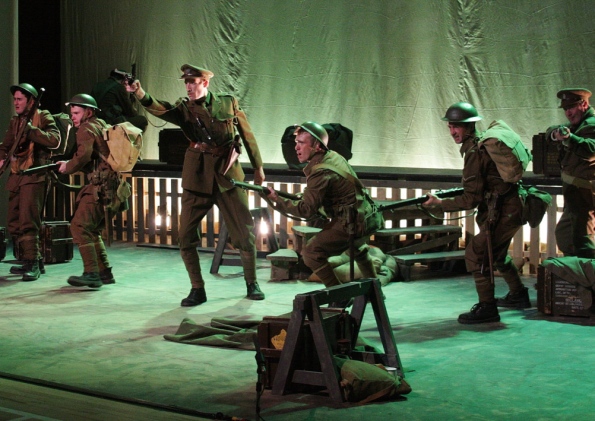
Officials from the Irish Department of Foreign Affairs were among a packed audience in the heart of east Belfast on Wednesday night to watch a new play about Ulster men who fought in the First World War.


From The Shipyard To The Somme will continue to run on until Saturday at the Connswater Community Centre off the Newtownards Road.

It was put together by the 36th (Ulster) Division Memorial Association in partnership with the Arts Council of Northern Ireland, and follows a group of Belfast men from the Home Rule crisis to the trenches of the Somme.

The two act play tells the story of a group of young men from the same streets in east Belfast, tracing their differing involvements with the fast moving and tumultuous events surrounding resistance to the Third Home Rule Bill and following them through the transformation of the UVF/YCV into the 36th (Ulster) Division and their deployment at the Somme in 1916.

Opening in a tent at “World’s End Camp” Ballykinler, on the May 6, 1915 as the 107th (Belfast) Brigade prepare to depart for the Divisional Review in Belfast before embarkation for France, to the long day and night of July 1-2 1916, as they push through the hell of mud and high explosives that lie between Thiepval Wood and the German fifth line.

Fintan Brady of Partisan Productions was the Artistic Director of the production.

Stephen Gough from the 36th (Ulster) Division Memorial Association said this was the organisation’s first step into the arts world and is a “major financial and cultural investment in east Belfast by the 36th (Ulster) Division Memorial Association at a time when the area has been making the headlines for all the wrong reasons”.

He said he felt Unionist history is largely ignored by the arts world.

It is hoped that the production will be able to be taken on tour across Northern Ireland, to the Republic of Ireland, as well as the mainland UK.

*From The Shipyard To The Somme will run at Connswater Community Centre on Severn Street until Saturday May 18, starting at 7.30pm with a matinee at 2.30pm. Admission is £5, with a reduction to £3 for pensioners while under 12’s are free.

Share

Connal Parr’s Response to Richard Reed

I was interested to read my review of The End of Ulster Loyalism? ‘demonstrates an inability to self-reflect’. When reviewing a book you tend not to reflect on yourself, but it is a shame Richard Reed found it ‘disappointing’. As it originally appeared in the Dublin Review of Books back in March, I hope Reed hasn’t been living with this ‘disappointment’ in storage for too long.

The historian Marc Mulholland once said in an introduction to a symposium at Queen’s University Belfast that those who thinks they are working through something new on Northern Irish Loyalism always declare, at almost every opportunity: ‘No-one has looked at or written about Loyalism’. I understand Reed places himself very much in this regrettable mould. It gives rise to an unfortunate condition where a – usually insecure – mind believes they ‘own’ a subject. This emerges more than a little in the way Reed sees my opinions as ‘dangerous’, which ‘must be resisted in the strongest terms if damage is not to accrue to the profession and to our understanding of loyalism’. Not only are these views part of any healthy debate, I suggest someone like Reed does not represent ‘the profession’ and that he is no guardian whatsoever for ‘our understanding of loyalism’ (if he was, I fear things would be in an even worse state than they are already). Aside from being an incredibly pompous thing to say of oneself, part of the problem of the mindset which takes hold is that people consider a subject ‘their territory’, leading invariably to a mediocrity which does real damage to ‘the profession’ and an ‘understanding of loyalism’. In terms of the recent study of Loyalism such a person is of course a plastic Columbus, walking the well-worn path Sarah Nelson, Jim McAuley and others did back in the 1980s and early-1990s.

In this sense Reed is correct to see himself as the slight tangent in my original review’s criticism of ‘younger academics’ who have failed to name their interviewees. Now, if no less an historian than Richard English can write a history of the IRA (2003’s Armed Struggle) and manage to name all those he talks to (including some who would have been involved in the military operations of the organization), why can this not occur in a study of Loyalism? Were Loyalists less dangerous than the Provisional, Real or Continuity IRA? Writers like Carolyn Gallagher and Martyn Frampton have completed studies of Loyalist paramilitaries and dissident republicanism respectively, managing to name almost all their interviewees.

It is not a question of ethics. As Reed seems so interested in what I have been writing, at least since March, I have a memory of an entirely connected deficiency in his own research. Reed gave the game away when he referred in his imaginatively-titled journal article ‘Blood, thunder and Rosettes’ to an interviewee as a ‘trade unionist’ who had mediated between the UVF and the Dublin Government in the early 1990s. This person was not – as Reed protests – a member of the UVF or UDA he needed to ‘protect’ (though the latter are also alluded to and bizarrely never named either). To those with any knowledge of the subject, we all know it to be the Reverend Chris Hudson who very happily talks openly to people about this experience (in Henry McDonald and Jim Cusack’s UVF book, as in several others, he was named from the start). This proves that Reed does not make the decision ethically but as part of a debilitating practice set down, copying examples from journals because he thought he should and demonstrating the regurgitation of bad habits worth confronting. He mentions Tony Novosel – and knows him ‘well’, though what this has to do with anything I’m not sure – who makes the correct choice in distinguishing between necessarily protecting those who need to conceal their identities out of ethics, with those – including Dawn Purvis and Billy Hutchinson – who are individually acknowledged in Novosel’s recent book as interviewees. Part of my objection to The End of Ulster Loyalism? was that the insights of ‘UVF Respondent’ et al were interesting and, making a mockery of the ethics argument Reed has parroted, were not related to their paramilitary activities and careers. There were political and intelligent comments from people talking about their everyday lives, and we never discover their names.

Reed sloppily misquotes the review as saying Irish Republicanism ‘is much less fragmented’ than Loyalism. My original review quite specifically stated that ‘mainstream Irish nationalism’, i.e. Sinn Féin, is much less fragmented than Loyalism. If Reed believes the Workers’ Party and dissident groups are ‘mainstream’ Irish nationalists then he is at least being consistent with his lack of knowledge thus far. Indeed, Anthony McIntyre and Ricky O’Rawe, as former members of the Provisional IRA (they’ve been named, look), have proven that it is impossible to remain a part of the mainstream party once they dissent and have suffered attacks for it as a consequence. Almost as careless is the conflation of the UVF circa 1965 with Carson and Craig’s UVF. The broader, mass movement (100,000 strong) of 1913 does not stand up to comparison with the reactivated UVF, which was structurally more exclusive in membership as well as being drawn from a primarily working-class base.

Reed has a problem with my review’s original claim that ‘Loyalist paramilitaries are not, and have never been, an authentic mouthpiece of the Protestant working class’. Doubtless Loyalist paramilitaries are authentic to their own experience and comrades. But the self-appointed ‘community leaders’ who appear on TV or radio to speak on behalf of ‘the Protestant working-class’ from a paramilitary background – who several Loyalists have assured me are often motivated financially to do so – have been rejected by no less a process than parliamentary democracy. The PUP made a breakthrough in 1998 and Hughie Smyth’s dedication to his constituency has been rewarded with a council seat for decades, but it is quite offensive and ludicrous – as my original review stated – to claim UDA men and their immediate spokesmen as oracles of the Protestant working class, as Reed has it. Many consider paramilitarism a blight on their community and the vast majority of working class Protestants have voted with their feet by not backing in large numbers candidates associated with paramilitary groups (despite the encouraging efforts of the likes of Ken Gibson and John McMichael). There may be ‘unease’ about dissident republicanism from the Protestant working class, but they do not turn round to members of Loyalist paramilitaries and request a military response. A long-established theme is that many in such communities regard the Police and security forces as adequate in a response to the dissident threat.

I would like to distance myself from the theory Reed values, which has the same shortcomings already alluded to concerning jargon. I’m fascinated to hear that Orwell has been cited so frequently in journals as an ‘arbiter of academic standards’ – I’ve read a fair few recently and have yet to see much reference at all. Commendably however, Reed talks of how we should ‘stop seeing loyalists as objects in a zoo to be stared at, and rather to see them as fellow humans’. That he thinks theory and jargon – or bad writing – is the way to transcend this is where it all collapses for him. At the moment it is Loyalists, among other disillusioned groups, who see the academic world as a zoo; its inhabitants spouting jargon which has no resonance whatsoever to their daily lives, political understanding or existence. This is one of the reasons, I suggest, why Loyalists do feel alienated – because of a world where people are writing about them in abstract language they don’t recognize or appreciate, who are so dislocated from their subject that they do not even use the real names of people. Loyalism, when written about academically, is not understood by Loyalists themselves. I am asked, who are ‘the people’ who are prevented from understanding this work because of ‘obfuscatory’ language? Personally speaking, they are every Loyalist interviewee I have ever met as well as those I speak to off the cuff at events, launches, meetings. Fascinatingly, Reed argues that when someone tries to look at the subject differently, through the eyes of ‘angry playwrights’ or ‘literary references’, that they are in fact peddling jargon – not the stuff Reed and those he has felt compelled to defend have been writing for a while now!

Those Loyalists are right to feel separate from the academic world. Who can blame them for feeling alienated given the misunderstanding, poor practice and jargon on display from those who contribute to it, and block them from entering in?

Share

Richard Reed: A Response to Connal Parr:

In Response To Connal Parr

I was rather disappointed to read Connal Parr’s recent review of Pete Shirlow’s End of Loyalism and his subsequent response to Shirlow’s defence, which I felt painted neither the author, nor the profession, in a particularly good light. His critique was full of holes and one gets the sense reading it that Parr was trying to be controversial for the sake of it, rather than offering a genuine academic critique. Shirlow is certainly right to recognise and lament the tendency to bicker within academia, which often comes across as wounded alpha males slogging it out. Take it to extremes and you get this rather odd response to a response that is, to my eyes at least, rather demeaning to the profession. Perhaps that is understandable given the energy and soul many of us put into our work, but it has its downsides. Not least because the social division in Northern Ireland is partly a consequence of unquestioned conviction; a problem that academia does little to solve when it fails to offer its own explanations with a little humility and self-reflection. Unfortunately there’s not a lot of either on show in Parr’s tone or critical approach; whether one agrees with the writing or not, there are probably better ways to make your point than accusing an experienced professional of ‘bad writing’.

I have some thoughts of course on Shirlow’s book, and he himself recognises there is room for development. But Parr’s response cannot be allowed to pass without comment, not least because there are some dangerous claims that must be resisted in the strongest terms if damage is not to accrue to the profession and to our understanding of loyalism.

Top of my list of worries is Parr’s persistence with his criticism of Shirlow for not naming his sources, because ‘other writers have managed it’. His original response also managed to critique the younger academics who have followed this practice (I include myself among them). In theory, the worry that we obscure the complexity of our subject matter by refusing to name our respondents is, generally speaking, fair. But this is a matter of research ethics, not editorial preference. Academics, like journalists, regularly conceal the identity of their sources, and rightly so. It is utterly wrong to suggest we should be diverted from a true regard for research ethics by the need to understand. We, as researchers, have a duty of care to protect our respondents who wish to remain anonymous. Both the UDA and UVF are illegal organisations, and so admitting to membership in print is a risk that the respondent themselves should take voluntarily, not be forced to by the researcher (who after all, owes their research, their career and their reputation to the co-operation of their respondents). If further comment were needed on just how wrong-headed this critique is, witness Parr’s failure to contemplate that whether authors are given permission or not to use interviewees names rather varies from author to author, and from project to project. In my experience interviewees with existing media profiles are more likely to give their names than those without any profile. While Parr applauded Novosel’s use of names in his latest book, knowing the author well I can assure Parr that he shares a similar commitment to protecting the identity of interviewees should they request that any author do so. I can only hope no-one reads Parr’s comments and takes his suggestions remotely seriously.

I also find Parr’s critique shot through with pure hypocrisy that, once again, demonstrates an inability to self-reflect and belies the arrogance of the tone. For instance, he criticises Shirlow for presenting a rather simplistic thesis of the black and the white (regressive and progressive forms of loyalism). In general, that is a very important criticism, no doubt, and one that should be aimed not just at academics but all those who establish public narratives of these issues. Yet Parr simultaneously claims that ‘Loyalist paramilitaries are not, and have never been, an authentic mouthpiece of the Protestant working class’. Certainly one gets that impression if one considers the media coverage of Bobby Moffett’s funeral in 2010, for example, or if one spends a long time with certain angry playwrights (who often have good cause to be angry). But the picture about support for the paramilitaries in the Protestant working-class is as complex, and the voices in support and condemnation as ‘fissile’ as anything else, at least if one looks under the cover. Yes, there are plenty within Protestant working-class communities that utterly reject paramilitarism. Yet there is continuing unease about dissident republicanism, and continuing unease about isolation and a lack of political representation that feeds a quiet, understated support for paramilitary groups. Even many of those now who reject paramilitarism might concede there have been times – and might be again – when they wouldn’t feel that way.

And there are other problems. Why, if they are totally ‘inauthentic’ parasites with no support in the ‘real’ Protestant working class are the paramilitaries still with us? If paramilitaries have never been an authentic mouthpiece of the Protestant working class, doesn’t it seem odd that so many joined the UDA and UVF at the beginning of the Troubles? Or so many supported Carson’s first UVF, or the militant organisations of the 1920s and 1930s (or did the pogroms never happen?), or the paramilitary support for the UWC? Damningly, in rushing to critique Shirlow for failing to consider historical context it seems Parr has fallen into the same trap himself, while doing much the same in simultaneously slamming Shirlow for diminishing and simplifying a varied and complex phenomenon by denying the paramilitaries any authenticity.

Let’s not even go there with Parr’s claim that republicanism is much less fragmented. That might reflect commonly held narratives, but I’m pretty sure that serious scholars of republicanism would wish to argue exactly the opposite.

Finally, I find Parr off the mark with his criticism of Shirlow’s book for its use of ‘jargon’. Again, there is the germ of a fair critique here, albeit one a little thoughtlessly deployed. I can almost overlook the rather worn use of Orwell’s much cited comment on the matter (where haven’t I seen this used? And what makes Orwell the greatest arbiter of academic standards?) and Parr’s tendency to himself sound intelligent but actually say nothing of any substance (what exactly is a jargon-loaded way of speaking by the way? Or was it meant simply as an insult?). But even so it’s a flawed critique. After all, isn’t jargon in the eye of the beholder? Doesn’t it depend on your level of initiation with a subject? Who are the ‘people’ Parr refers to who are prevented from understanding Shirlow’s thesis by its obfuscatory language? It made sense to me and would, I dare say, speak to a wide range of other academics (to whom the book was ultimately directed). And besides, isn’t Parr’s tendency to drop in literary references and cloak himself in Northern Ireland speak equally jargon-laden to the uninitiated?

I’m grateful that Parr does at least recognise that theory can be fascinating, but let’s be fair, theory does tend to be rather abstract and, at times, esoteric. And it’s very difficult – if not impossible – to write good theory that translates easily and smoothly to a general-level audience. But then isn’t lots of other academic research – including historiographies of the Troubles – rather esoteric? The beauty of theory is that it helps us make sense of very complex data by providing (warning: jargon ahead) systems, frameworks and logics, ultimately helping us to rationalize and develop a greater understanding of the complex mechanisms and processes that underpin empirical phenomenon. It also helps us to escape from these sort of circular critiques that get hung up on minor details by encouraging us to see the wider picture – i.e. how analyses of Northern Ireland speak to broader narratives of the human condition. That’s critical to seeing loyalism as a human story, which is, in turn, critical to seeing loyalists as humans. After all, as Novosel reminds us, quoting Billy Mitchell, no one came over and suddenly dropped crazy gas over Northern Ireland. Using theory that might speak to any number of contexts allows us to describe loyalism in terms of the trends and tendencies to which every human is vulnerable. Whatever else one might say about Shirlow’s offering, he should be applauded for the turn to theory; the conversation needs to be opened up to this sort of expansive analysis if we are to stop seeing loyalists as objects in a zoo to be stared at, and rather to see them as fellow humans. That, surely, is the most immediate task of the academic.

Share

What We Can Learn From Belfast: Former Combatants And Shades Of Grey: Richard Reed

THIS ARTICLE FIRST APPEARED ON www.extremisproject.org

Richard is currently a Research Fellow in the Social Inclusion Unit at Macquarie University in Sydney. Prior to taking up the post in Sydney, Richard held a position as an Honorary Research Fellow at Queen’s University, Belfast, following doctoral studies on the nature of identity narratives among the major loyalist paramilitary organisations in Northern Ireland. Richard has also worked on a number of knowledge exchange and community transformation and coherence initiatives with former loyalist combatants and prisoners in Northern Ireland, and has published a number of articles related to the history of the loyalist paramilitaries, current transition efforts, and methodologies for working in sensitive and politically divisive contexts.

What we can learn from Belfast: former combatants and shades of grey

By | October 17, 2012

At the beginning of September I wrote about the violence following a parading dispute in North Belfast, in the aftermath of which police and community leaders raised fears of a repeat during the centennial commemorations of the signing of the Ulster Covenant at the end of September. In the event, however, these fears were not realised: with the exception of the disagreements about whether the bands held to Parade Commission rulings on the march past St Matthew’s Church, the day passed off without disorder.

Nonetheless, the event drew a predictable deluge of commentary. Some saw the marches as an unsavoury commemoration of law-breaking. Unionists and loyalists used the occasion to re-articulate a defence of the Union in the shadow of the impending referendum on Scottish independence. The sheer scale of the commemoration – 30,000 marchers, many tens of thousands more spectators in a city of a quarter of a million, half of whom are Catholics – was also a reminder of the salience of history in a country that seems stubbornly wedded to its past.

For this author, above all the celebrations re-highlighted the complex contractual ‘Britishness’ of many unionists whose affection for British institutions and legal codes seems at times rather dependent on how well they correspond to unionist interests. The British nationalism of Ulster Unionists is underpinned by an affinity with the ‘constitution’ that was born at the moment of Protestant Ascendency in Great Britain in the seventeenth century. This identity has crept through history, re-energised at key moments such as the signing of the covenant and the blood sacrifice at the Somme. For the British left-wing, of course, looking outwards through the guilt-hazed lens of its colonial apologia, Ulster Unionism’s unapologetic attachment to British imperialism (and all its violence) is disturbingly anachronistic and alien. It was perhaps therefore rather unfortunate that none other than Nick Griffin, accompanied by the usual furore, should turn up to offer his own brand of support.

Casting politics and history aside for a minute, however, there is another, less visible story here that is worth some serious reflection. While the police praised organisers for ensuring the day ended peacefully, no commentator considered why, despite the anticipation, there was no disorder or violence at these parades. Here lies a truth that remains largely unrecognised in Northern Ireland, that despite the social divisions enduring in the long shadows of the ‘peace walls’ the violence is kept largely in check. What we don’t remember often enough is that the parades that result in violent confrontations are exceptions and not rules. Of the nearly 4000 parades a year, an ever-decreasing number are contentious (195 in 2011), with less than a quarter of these resulting in disorder.

There are a number of reasons why this is so, including the skilled, experienced and professional conduct of the Police Service in Northern Ireland, the tireless work of stewards and community representatives appointed by the marching organisations themselves, the routing of the parades to avoid contentious areas and the restraint shown by nationalists (who, given the central message of the parade, are perfectly entitled to feel rather excluded).

But scant recognition is accorded to one other important group that is routinely involved in making sure parades pass off peacefully – former combatants. To see how this is so, it is necessary to understand a little of the social geography of division in Northern Ireland. Much of the conflict played out in working class areas, often heavily segregated and in many cases still divided by peace walls. The vast majority of those who became involved in paramilitary organisations, went to prison, or otherwise felt the brunt of the conflict lived – and live today still – in these communities. It is the parades through these heavily segregated areas that are the most contentious.

Former combatants often wield significant influence in these trouble spots and operate as informal peacekeepers and peacebuilders. Their knowledge of local conditions, a commitment to improve the lot of the community and a long, painful experience of the privations and miseries of conflict, are a valuable resource for the police and other statutory authorities. Former combatants are often deployed as stewards at the front lines of contentious parades, diffusing tensions and preventing outbreaks of violence. Elsewhere they are the first to arrive at the scene of interface violence, committing themselves to the fray, sometimes at considerable personal risk. Many have become full time community activists or are involved in local politics, undertaking to address the social legacies of the conflict. Or they have enabled symbolic peacebuilding measures such as decommissioning and the ‘re-imaging’ of militant murals. This all regularly involves working alongside former combatants from the ‘other’ side; while not always replicated at the grassroots, this nevertheless sets an important example.

Of course, any positive appraisal of the paramilitaries should be tempered by a recognition of the human destruction and suffering of forty years of conflict. Outside the white noise of raging debates about victimhood and guilt lie lingering pockets of quiet grief that scar the country. The weight of this misery lies heavy on the collective conscience of all those who were involved in the conflict, and heaviest of all on the paramilitaries whose tit-for-tat violence frequently left mothers without sons, children orphaned and sometimes set sibling against sibling, often in the most horrific and unexpected ways.

We should not forget too that while former combatants are often at the fore of efforts to re-image militant murals, it was these organisations that painted the murals in the first place, often as territorial markers and warnings. And for the kids causing trouble at interfaces it is the paramilitaries themselves, and their activities during the bloody years of conflict, that they seek to emulate. For all the brave work of some former combatants to tackle criminality, we might remember too that the paramilitary organisations provided an entire generation of young men with the very skills and contacts which now make organised crime a viable option for those unable, or unwilling, to ‘reintegrate’.

Ultimately, both these portrayals of paramiltarism are true at the same time. It is this complexity which contextualises the ongoing events in Northern Ireland, explaining the moments of peace as much as the moments of disorder. The apparent contradiction inheres in our tendency to stereotype and simplify, to forget that even paramilitary organisations represent a wide spectrum of political opinions, capacities and personalities. Sometimes, too, there are reminders of the contradictions that conflict provokes even within individuals. Almost every former combatant I have met in Northern Ireland who is steadfastly committed to peace argues in the same breath they would do the same again, were the same conditions to arise. John McMichael, who was killed by an IRA car-bomb in 1987 (and in whose honour a debate is shortly to take place involving former IRA combatants), became both the face of the Ulster Defence Association’s startlingly conciliatory political overtures in the 1980s, and a well-known mover and shaker among the organisation’s militant ‘assassination’ wing, the Ulster Freedom Fighters.

These nuances are routinely occluded by those in the media who cast stories in black and white for an audience without the time or interest (or occasionally the emotional capacity) to witness the confused and messy reality. Dangerously, all too often these ingloriously simplified narratives reverberate in the debating chambers and the ballot boxes of a country still divided by opposing political and cultural visions of itself.

Herein, it seems, lies a salutary lesson for students and researchers of extremist violence, the best analysis of which includes an account of these subtleties and oppositions. The reality of conflict – and indeed similar manifestations of the extreme behaviours of which humans are capable – resides in the shades of grey that populate the expanses between the blacks and the whites. The student of extremism must avoid the highly-charged moral mien of many debates about extremism, and instead walk a (sometimes lonely) middle path that challenges popular narratives with dispassionate, nuanced reflection. Nowhere evidences this more clearly than Northern Ireland, where long nights and cold winds are once more descending to bring closure to a summer marked both by communal violence – but also by restraint, moderation and negotiation.

Share

A Timely Alliance to Beat Shinners: John Coulter


A timely Alliance to beat Shinners: Unionist fact will have major PUL if steered right


(John Coulter, Irish Daily Star)


The Shinners need to box clever and back off from loyalists as we get deeper into the Marching Season.

Many Protestants firmly believe Sinn Féin is waging a cultural war on their Britishness, but republicans should not take heart from the political splits in Unionism.

Known as the ‘PULs’ (Protestant, Unionist, Loyalist), the Union flag protest has merely awakened a giant and many loyalist leaders believe the PULs should stamp their feet in the same way Catholics did in the Sixties over civil rights.

The Shinners’ cultural war against the PULs is simply to deflect attention away from them not achieving their united Ireland by 2016, the centenary of the failed Easter Rising.

Sinn Féin and its pals in the Stoops and Alliance need to realise that while the PULs may not speak with one voice, they are now thinking with one mind.

The PULs now see themselves as the Sixties Southern American Blacks. They have concluded that politics is war without bloodshed and the message is going out via the Unionist Forum meetings that it’s time to take this passive resistance to the Shinners and Stoops.

The PULs now have a new target in their sights because of the Belfast City Hall flag debacle, and their strategy is simple – register to vote, go out to vote and get rid of Alliance.

Maybe that’s why former UUP MLAs Basil McCrea and John McCallister didn’t jump ship to Alliance. Maybe they knew the restless PUL giant will stomp Alliance out of existence at the next elections, and their new pluralist liberal party could steal Alliance’s thunder?

There is a perception among PULs that whatever Sinn Féin wants, Sinn Féin gets. The PSNI are rounding up dozens of PULs over the flag protests, but the police attitude to republicans is one of appeasement and concession, with the IRA enjoying an amnesty about its terrorist past.

Many PULs who voted Yes in the 1998 Good Friday Agreement referendum, would vote No if such a poll was held today.

The PULs have reached the conclusion that the Belfast Agreement was to stop the Provos bombing mainland Britain. In signing the Agreement, the Provos effectively tore up their Green Book, the republican movement’s Bible of commands.

Numerous PULs have had the political confidence sucked out of them since the DUP sucked up to Sinn Féin during the 2006 St Andrews Agreement.

At many Unionist Forum shindigs, it is the DUP enduring the verbal wrath of ordinary PULs in a re-run of how the No camp slabbered at Trimble and his Yes camp UUP in the early 2000s.

Given the collapse of the Celtic Tiger in the South, the Union may be safe in a border poll, but is the Union safe within the UK?

Could ‘Loyal Ulster’ become a mini republic within an increasingly fragmented UK, especially if the Scots plump for independence?

There is no doubt the PULs have become demoralised because of republicans’ cultural war on British heritage in the North.

The PUL leadership has a moral duty to ensure loyalists re-engage with the ballot box. But before the PULs can take on the Shinners and Stoops at the polls, they must get rid of Alliance.

Many Alliance politicians rely on Unionist transfers for their seats. If PULs snub Alliance, the party is over for the middle of the road, fur coat, wine and cheese movement.

May 14, 2013________________


This article appeared in the May 13, 2013 edition of the Irish Daily Star.

Share

A Response from Connal Parr to Pete Shirlow.

I was intrigued to read what appears to be Professor Pete Shirlow’s review of my review. I do not want to go into all the points raised as I think I would be providing oxygen to something I do not wish to entertain. All my objections are contained in my actually rather generous original piece, such as highlighting the inadequacy of not revealing the names of interviewees (why for instance, in the study of Loyalism and other subjects, have other writers managed to name who they’ve been talking to?). So I will be brief in this rejoinder. Something I can start by helping with is the phrase ‘a bit of a mouse’.

Before complaining about this at length Pete professes not to know what it means. Figuratively, a mouse is something minor and insignificant. This is how I view the book’s overarching thesis that Loyalism has both ‘regressive’, i.e. ‘bad’, and ‘progressive’, i.e. ‘good’ elements. I consider this a truism and the nature of almost every ideology, political movement and individual that has ever existed in the world. It further diminishes and simplifies something which is varied and complex.

Revealingly, Peter confuses ‘intellectual’ with jargon. There are many natural intellectuals in all walks of life – I have found a number of Loyalist interviewees to be highly intellectual in their sophistication and world view – and this is not the same as jargon, which is a style of writing (or speaking). It does not mean being intelligent or clever. Similarly jargon is not a particular ‘big’ word but a way of writing (for some people it is perhaps a way of life), and has nothing to do with theory which can be fascinating. And this is where I must stick my neck out. This jargon – aside from being dreadful to read for both a scholarly and general readership – prevents people from understanding and is therefore damaging. I feel this is worth confronting because although Pete’s work suffers from it, the problem is a common one and exists in much, though by no means all, academic writing.

In his 1946 essay ‘Politics and the English Language’, George Orwell argued that sloppy jargon had potentially dangerous political consequences. Targeting in particular two theorists from the British Left – Harold Laski and G.D.H. Cole – Orwell believed bad writing could, at an extreme, lead to the late-night visitations where people are ‘shot in the back of the neck or sent to die of scurvy in arctic lumber camps’. Through the elimination of ‘meaningless words’ and ‘pretentious diction’, Orwell believed, writers and society as a whole make the ‘first step towards political regeneration’. His analysis has particular resonance in Northern Ireland where repetition and a special kind of jargon have been used to retrospectively justify some very dark moments of the recent past, and – not much better – skew our understanding and recognition of a subject or issue. Of course, Pete’s The End of Ulster Loyalism? never justifies anything heinous, but the nonsensical, convoluted phraseology (an intellectual word here) Orwell complained of is prevalent throughout. This jargon, a sort of verbal waste, even makes its way into Pete’s response to my review of his book. At the end of the point-by-point rebuttal, which has an oddly rehearsed quality, he complains that I did not refer to ‘the context of idea building’ his work so prizes. Stand back for a moment and unpack that phrase. What on earth constitutes ‘idea building’? What has ‘context’ to do with it? What human concept or mental process does not involve an ‘idea’, and when are ideas ever ‘built’?

While ideologues and writers from all the major parties and traditions in Northern Ireland practice the jargon – ‘designed to make lies sound truthful and murder respectable, and to give an appearance of solidity to pure wind’, in Orwell’s assessment – the weakest academic writing demeans and prevents people from finding out what they need to find out about. I am with Orwell on this. Each sector of the society has its part to play: the kind of jargon and pure wind found in The End of Ulster Loyalism? should be avoided in the future. Given the problems facing Loyalism and – distinctly – the Protestant working class at the moment, the times are too serious for this bad writing to continue.

Share

Billy Hutchinson on Orange Hall Attack.

Progressive Unionist Party Leader Billy Hutchinson has condemned the attack on a war memorial stone at an Orange hall in Coleraine as cowardly and sectarian.

He said, “This is a disgraceful attack designed to intimidate the protestant community and stir up trouble.  Here we are 15 years after the Good Friday Agreement and yet people continue to undertake attacks that show nothing more than a hatred for the protestant community.”

He continued, “Where is the shared future in all this?  I would ask those with influence in the Nationalist and Republican community to show leadership and to encourage people who carry out attacks like this regularly to stop doing so. It damages relationships.”

He concluded, “I would ask the PSNI to step up patrols at vulnerable Orange halls across Northern Ireland, particularly as we enter the marching season.  Tolerance and respect should be at the heart of a shared society and sectarianism should have no place.”


Share