Lessons To Be Learned From Feile: Billy Joe

Anyone who can claim to be reader of the Irish News and in particular the Thursday edition each week will be aware that Jimmy Gibney is a regular columnist.  Jimmy is an old Provisional IRA man and currently spouts the Sinn Fein party line–when required.  The Irish News with it’s predominately Nationalist readership is the perfect forum, therefore for The History of The Troubles According to Jimmy.
On many previous occasions I have taken exception to his articles and on more than one occasion have actually penned letters to the paper in reponse–but have yet to have any printed.  But, as they say–everyone is entitled to their opinion and this includes Mr. Gibney.  It isnt very often I have to proclaim that I would concur with Jimmy on his musings but I have to hold my hands up and admit that I have at last found a reason to do so!
In yesterday column Gibney was enthusing about the West Belfast Festival–Feile An Phobail which is celebrating it’s 25th birthday.  This wonderful festival can arguably lay claim to be being the biggest of it’s kind in Western Europe and you only have to look at the line up each year to understand how it is held in such high esteem.  At the etecetra theatre launch in the Linen Hall library last week Danny Morrison told the audience of the reasons for starting the festival in the first place and of the difficulties in trying to establish it.  He said that one of the main reasons was to give West Belfast a voice and to counter the widely held claims that that community were 100% terrorists.  It wasnt always easy according to Morrison but with detrmination and perserverence they are now reaping the rewards.  Jimmy Gibney echoes these sentiments.  He says-“It was about providing a platform for the marginalised and powerless within and beyond West Belfast”.  He goes onn to say that the Feile ” was rooted deeo in it’s comunity. It’s organisers had a keen understanding of the community’s needs: it’s hopes and dreams”.
There is a very simple message here.  If a community feel marginalised–alienated–disenfranchised–powerless-then it must strive to combat these negatives.  If we feel “someone” isnt “doing” it for us then we must endeavour to do it ourselves.  Whatever “it” is.  The recent launch of etcetera is only a small cog in a huge PUL community based wheel.  This community has so much more to offer–so much more to give.  We need to stop relying on others to sort our own mess out.  We need to regain that power–to overturn those feelings of powerlessness or alienation–we need to take control of our own destiny.  In two weeks time the East Belfast Arts Festival takes place for only the second time.  It is in it’s infancy compared to Feile An Phobail but is heading in the right direction.  It is incumbent of those who feel marginalised within Protestant working class communities to throw their collective weight behind such innovative and worthwhile ventures.  Within that context there will be many ways to get the stories told–and listened to.  It is here we can express our feelings as individuals and as a community.  By song-dance-lectures-exhibitions-debates-forums-cultural expressions. If we feel our culture is being eroded or that history is being written FOR us then what better way to respond. And as Jimmy Gibney might say–Is e todchai linne.

Share

Next In The Series of Marching Bands: The Whiterock


Next Time:  One of the most popular of Ulster’s traditional flute bands– The Whiterock –have a long and illustrious history.  Longkeshinsideout will cover that–since their inception in 1962 up until the present day–complete with rarely seen photographs.

Share

SHANKILL PROTESTANT BOYS FLUTE BAND

The Shankill Protestant Boys Flute Band—or as they are more famously known now—The SPB—were formed in the Shankill area in 1980.  The reasons for forming the band were much more than simply establishing another flute band—the Shankill had many at that time.  The men behind the formation had other ideas.  They wanted to promote and express their Protestant culture and also remember the brave Volunteers and Servicemen who had fought and died during two World Wars—in particular during the Somme offensive—and to remember those in more recent times who perished during the conflict in the war against violent Republicanism. 
Sadly many of those who served the band since their beginnings 33 years ago are no longer with us—either passed away or in many instances murdered.  However of the original founders around ten remain.  Some, remarkably are still marching while others retain honorary membership.  Gary Lenaghan—The Hunters—Harold Reynolds-The Young’s—The Freel’s—John McQuade—Derek Mawhinney—The Finlay’s were all there at the start and remain heavily involved today.
The SPB were the first flute band to receive and carry the colours of the 1st Battalion of the Ulster Volunteer Force—in 1982—and to this day carry those colours with pride and dignity.  It is a commonly known fact that these colours are carried on ALL occasions—at no time are they excluded—and in the past this has caused some difficulties—with both the Police and indeed with certain sections of the Loyal Orders.  At one stage during the Eighties the band came into conflict with the Scottish Orange Institution which forced the band off the road because of their refusal to parade without their beloved colours.  Since then the SPB have not walked in Scotland with the Orange.
Around the same time and with the concept of the Supergrass system being implemented the band became heavily involved with Families For Legal Rights.  For many weeks the band paraded every might to and from Crumlin Road jail supporting FFLR in their quest to have those spuriously incarcerated released.  This eventually happened.  Some years later the band were also conspicuous in their full support for the Portadown District during the Drumcree dispute and continued to support that particular battle long after many others had given up the fight.
To see the SPB now with the massed ranks and uniforms that cost in excess of £50,000 is to look at aristocrats on the marching band scene.  They are held in extremely high esteem when Blood and Thunder bands are mentioned but that respect has grown and been nurtured over the years and it shouldn’t be forgotten that the band had very humble beginnings.  Long before the classy uniforms of today they had to make do with plain purple jumpers, black trousers, badges that were manufactured in Harland and Wolff and a selection of homemade hats!!
It is with some satisfaction and great pride that the band see themselves as a “family band” and this is reflected in the membership.  Currently there is an age range from 2-60 years old—there are fathers and sons—grandfathers and grandsons and one particular family can boast ten members in the band!!  In today’s climate and with the perception of what Loyalist marching bands stand for, it is worth recounting the generous nature of the SPB.  Not only to current or former bandsmen—for whom they have helped out in times of need—paying mortgages—helping at Christmas and indeed paying funeral costs—but in a wider capacity.  Many detractors would fail to be aware that in the course of their history the band have raised and donated in excess of £100,000 to charitable causes.  How many other bands can make this proud claim? No wonder the band consider themselves to be one big family.
Another consideration that goes unnoticed about the marching band fraternity is the level of musicianship involved.  Over the years the SPB—both collectively and individually—have gained many musical awards and can also lay claim to playing for Queen Elizabeth!!
To be a member of the Shankill Protestant Boys is very special.  And to march through your own area nad in front of your own community with massed crowds cheering and clapping your every note and step, certainly makes the hairs stand on end and the heart beat faster.  Currently band membership stands at 125—a figure that most bands can only dream of.  To attend functions the hire of a double deck bus isn’t unusual.  On Orange parades we do our best to help the Loyal Orders out by not charging the usual marching or transport fee’s although many would make a donation to the band.  A greater emphasis is now being directed towards historical and cultural education within the band.  In recent times many of the members, both young and old, have taken part in educational packages which has included trips to the Boyne Heritage Centre and the Battlefields and Cemeteries of the Somme.  To join the SPB now is to take part in much more than playing in a band—it is as much about learning discipline, culture and history and also about education.
Thirty three years on the Shankill Protestant Boys are a well established flute band and greatly received throughout that particular culture.  We also see ourselves at the forefront in upholding our proud history and culture.  We are a very community orientated group and we will continue to serve that community in the best way possible.  The band will go from strength to strength in the coming years and as a premier band we welcome those future challenges.

TILL WE DIE.

Share

The Brave Mairtin: Robert Allen

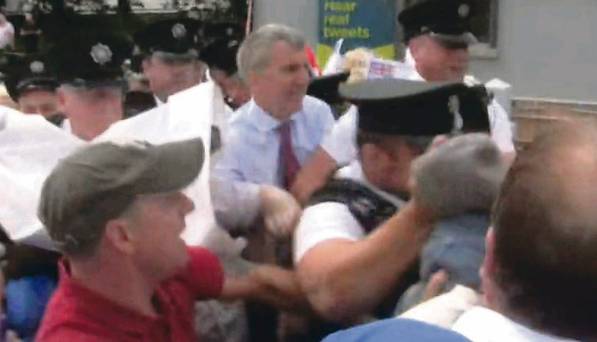
The headline in the Belfast Telegraph today, (07.08.13) reads, ‘Lord Mayor defiant after ambush by Loyalist mob’.

Made me think he was attacked in the jungles of Borneo rather than heckled and ‘jostled’ as was reported by other media groups.

Sure, once again, Loyalism will receive negative press due to the actions of some people who have just had enough of the double standards and hypocrisy shown by Sinn Fein.

But I think people should just keep an eye out to see how Mairtin genuinely reaches out to the PUL community. He has stated, ‘I want to be the first citizen for all the people’. Remember wee Niall, his first outing was also to the Shankill to show how he was reaching out the hand of friendship. That was of course before he was asked to present a Duke of Edinburgh award to a child.

Allow me to point out some statements made by Mairtin after yesterday’s incident. He has stated, ‘I was invited to go to the Shankill…therefore I was discharging my obligations as Lord Mayor’. ‘…I’m determined I will discharge my duties as first citizen fairly…’

He has also said, ‘If violent protest and thugs were to decide where the first citizen goes and where he doesn’t it wouldn’t be a city worth living in’. These are all very commendable statements by Mairtin. But after hearing the statements from the DUP it made me wonder just what are Mairtin’s intentions?

Was he really reaching out to discharge his duties as first citizen? Or, as some suspect is he just playing another card for Sinn Fein in the show all Loyalists as thugs and Republicans as peace loving victim’s game?

The DUP have stated, ‘we were aware that having him participate in any official capacity would be an affront to many within our community and recommended that this duty be deputised to another council representative…clearly the Lord Mayor chose not to listen to that advice’.

They went on, ‘we expressed the view that it would be totally inappropriate for the Lord Mayor, as a member of Sinn Fein, a party which talks of a shared future but by their actions has shown nothing but contempt for the culture, history and traditions of our community to officiate at the public reopening of Woodvale Park’.

I would ask the readers of LongKeshinsideout to keep this in mind over the coming months.

This whole situation made me think of another possible scenario in the near future; Remembrance Sunday.

On this occasion Mairtin was told by the DUP he would not be welcome. I think he would be welcome to remember the sacrifice made by the British army and other armies on Remembrance Sunday and to wear a poppy to demonstrate this.

On this occasion, Mairtin was determined to do his duty as first citizen, he wasn’t going to be put off by ‘violent protest and thugs’, he wants to be the first citizen of ‘all the people’ because a city where ‘thugs’ and ‘violent protest’ determine where the first citizen goes ‘wouldn’t be a city worth living in’. On Remembrance Sunday will Mairtin be put off by the threats from Sinn Fein supporters and armed republican groups or will he be at the Cenotaph to remember the fallen?

On this occasion Mairtin ignored the advice from the DUP to have this duty ‘deputised to another council representative’. On Remembrance Sunday will Mairtin step up to the mark and attend the solemn ceremony to remember the dead and wounded or will he bottle it and send another council representative?

Yesterday Mairtin went to Woodvale Park, he had been told he wouldn’t be welcome, he was told it could cause trouble, he was asked to send a deputy but because he is so determined to be first citizen for everyone, to ensure Belfast is a city worth living in, he went ahead.

I for one will watch with interest to see what he will do and say come Remembrance Sunday.

Or, come November 12th will Mairtin be scouring propertynews to relocate to another city which is worth living in…look out Lisburn!!

Robert Allen


Share

The (Not So) Lost World: The Culture Of Rangers Fans

This Article First Appeared on www.therangersstandard.co.uk

The (Not So) Lost World: The Culture of Rangers Fans

By Dr Gareth Mulvenna

‘I’m an Ulsterman, of planter stock. I was born in the island of Ireland, so secondarily I’m an Irishman. I was born in the British archipelago and English is my native tongue, so I am British. The British archipelago consists of offshore islands to the continent of Europe, so I’m European. This is my hierarchy of values and so far as I am concerned, anyone who omits one step in that sequence of values is falsifying the situation.’

John Hewitt

Disagreement among the broad church of football clubs’ supporters isn’t in itself out of the ordinary; as a diehard follower of Nottingham Forest I count myself as one of the tribe that find the constant moaning among large swathes of our fans about us being a ‘big club’ that ‘should be in the Premiership’ hard to bear. I also personally think the uncritical veneration of Brian Clough is something that needs to be reassessed. That’s one opinion though that I have kept hidden from about 99.9% of my close Reds friends. No matter how fiercely we disagree with each other, myself and my fellow Trickys have never encountered the kind of frictions that exist between sets of supporters at a club such as Rangers. This is because these frictions often go above and beyond football and focus on the very essence of social, cultural and political identity.

Two recent Internet articles on Rangers which analysed the issues of identity and fan culture demonstrated the diametrically opposed forces that exist within the stands at Ibrox. D’Artangan’s piece on Rangers and Protestant/Unionist identity[1] was swiftly followed by a response article by Andy Steel.[2] I think both articles raised important and valid points but some of these need elaboration and further investigation in a historical context. The issue of Rangers’ relationship with Scottishness, Britishness and Northern Ireland in particular is so interesting and complex that it is hard to do the debate and history of it justice in an article or even a book chapter. An entire study could be dedicated to these issues alone and could comprise a mixture of sociological theory, social and oral history and archival and newspaper research. What I hope to do in this article is to touch upon issues highlighted by D’Artagnan and Steel and hopefully push the debate forward.

In a poem entitled ‘On Dunmore’s Waste’, written about his childhood in North Belfast during the 1920s, the esteemed Northern Irish poet John Hewitt recalled,

We had our cricket team, our football team;

Our jerseys blue, our heroes, I should say,

were Glasgow Rangers, Linfield. Like a dream,

McCandless passed once, home on holiday.[3]


Hewitt was born in Cliftonpark Avenue – a street which in its day was grand and lined with Victorian townhouses. During the Troubles the avenue became a no man’s land which acted as an interface between Catholics and Protestants. About a mile away, on the Shankill Road, a staunch loyalist called Robert ‘Basher’ Bates was jailed for life in 1979 for his part in a bloody orgy of sectarian violence with a UVF gang known as the Shankill Butchers. In jail Bates twice converted to Christianity. During his second and permanent conversion in 1989 he penned a testimony for The Burning Bush, a Free Presbyterian publication in which he lamented the effect that ‘the UVF and Glasgow Rangers’ had had on his violent life up until that point.[4] He described Rangers as a ‘God’ which had played its own part in the complex network of reference-points and experiences that contributed to the ‘Basher’ who thought nothing of acting on his violent urges. I never had the opportunity to ask Robert Bates about this reference to Rangers, but it would have been interesting to hear his reasoning for including the club in the tapestry of his negative personality. Having committed himself to peace building and working with young people on his release, he was eventually shot in revenge for an intra-loyalist killing he had committed in the mid-Seventies.
What can usefully be extrapolated from these two vastly different references to Rangers from Northern Ireland is that they perhaps represent two of the extremes which are discussed in the recent articles by D’Artagnan and Steel. Hewitt and Bates were both Rangers men and their respective support of the club was equally valid with Bates in particular being a regular attendee at Ibrox as a young man. I find the lived experiences of these two men germane to the two articles I have referred to as their juxtaposition is representative of the distorting effect that the Northern Ireland ‘Troubles’ had on the club’s image and fanfare. Hewitt’s reminiscences are reflective of a more civic and innocent time generally when in the early twentieth-century shipyard workers travelled between Queen’s Island in Belfast and the new Harland and Wolff shipyard in Govan and a strong relationship began to ferment based on the mainly Protestant Belfast workers’ admiration for the team at Ibrox. Just as Millwall adopted navy jerseys out of respect for the Scottish dockers, who were among many British workers to converge on the Isle of Dogs looking for work in the late nineteenth-century, Rangers became inextricably entwined with a strong Ulster Protestant working-class support base whose social experiences were not very different to the yard workers from Glasgow.[5] It was perhaps inevitable then that any major social or political impacts on the lives of the supporters from Ulster would find their way onto the terraces of Ibrox. Rangers had its own problems in the 1960s, before the Northern Ireland conflict properly emerged and the ultraloyalism espoused by men like Bates became more popular. Graham Walker has noted how Rangers perhaps sleepwalked somewhat aloofly into the countercultural era of protest songs and free love:
The disjunctive effect of the sixties has probably been exaggerated, but nonetheless there has seldom been a time in which young people have felt so emboldened, for better or worse, to reject the values and standards of their elders. In short, in relation to Rangers, it stopped being fashionable around the mid1960s to support a club with its associations. Of course, many young people continued or started to support the team; however in the new hyper-critical time Rangers’ Protestant image was more vulnerable to attack and those imbued with the liberal or even anarchic spirit of the youth culture of the period were, generally, not attracted to the club.[6]
While this remained true in to an extent in Scotland where the sectarian enmities of daily life have often been overplayed,[7] and it was perhaps easier to reject parent values, the effects of the countercultural times described by Walker were less strong in the loyalist strongholds of Ulster. The permissive society existed in Northern Ireland, but behind closed doors and in the edgy, heaving blues venues such as the Maritime where Van Morrison’s band Them played their early classics to transfixed audiences. In Northern Ireland the 1960s may have borne witness to an easing of community relations, but that did not translate to an abandoning of tradition. This led to what an outsider might have viewed as a paradoxical youth culture for many young working class Protestants in particular. While the popular music of the time, with its often liberal messages, would have been consumed voraciously by young Protestants there was never a sense of contradiction in travelling to Ibrox every other Saturday to watch the ‘unfashionable’ Rangers or attending the home games of Linfield, the staunchly unionist Belfast side from south-west Belfast. While enjoying the Beatles, Rolling Stones and The Faces among many others, young loyalists were equally as passionate about playing in their local bands which celebrated martial, loyalist and Protestant culture in working class communities of Northern Ireland. Inevitably this communicated admiration for the Siege of Derry, King William of Orange and, when the Troubles emerged, a further amplified and aggressive version of loyalism.

This was hardly an unreciprocated gesture during the Seventies – indeed one need only look at Peter McDougall’s classic ‘Play for Today’ Just Another Saturday which was first broadcast by the BBC in November 1975. John, the main protagonist, is the drum major in Muirhill Flute Band and while on the bus to his band hall on the Twelfth morning he encounters an old man who on watching a passing band from the top deck of the bus says, ‘Eh-heh, an Irish band, eh? They look too smart to be any of our boys. Aye…they’re strict in Ireland. Just off the boat and no a drink among them.’ Having interviewed a number of loyalists in Belfast who were young men in the early 1970s there is constant reference to the Scottish-Ulster connection and most have fond memories of travelling to Scotland whether it be for the July 1 celebrations or to watch Rangers play at Ibrox. Relationships which had been forged by the movement of workers between the Belfast and Govan shipyards many years before were unsurprisingly changed by the emergence of conflict in Northern Ireland. Indeed having spoken at length to loyalists who are now in their mid-late fifties the one thing that struck many them when they started travelling to Ibrox as the Troubles bubbled and then boiled over was the geniality that existed between supporters of Rangers and Celtic in Glasgow when compared with what was going on at home. The Troubles emerged on the terraces of Ibrox due to the close relationships between sets of supporters across the Irish Sea. One evening a few years ago I was having a pint with Graham Walker when he recalled how as a young Rangers fanatic in the early 1970s with an interest in Northern Ireland he remembers that for a brief period around 1972 Vanguard[8] flags were almost de rigueur at Ibrox. The Vanguard flag appears in footage of the Orange walk in McDougall’s play and also made its way, some 35 years later, to Manchester in 2008. In the current climate the Vanguard Bears moniker should need no explanation.
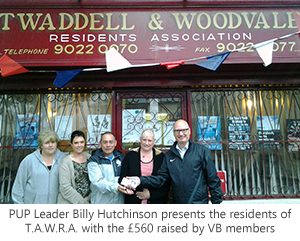
Which brings me to Vanguard Bears. I’m not entirely convinced by the movement, particularly in relation to its attitude to the Scottish Independence debate, but I think D’Artagnan’s article is a fair and even-handed expression of how thousands of Bluenoses in Ulster must feel about the club that they hold so close to their sense of self. Their motto, ‘Defending Our Traditions’, sets out their stall pretty explicitly and their involvement with the loyalist cause over marching and other issues in Northern Ireland in recent months has been quite active. Indeed it is no surprise that in the past week Vanguard Bears donated £560 to the Twaddell and Woodvale Residents Association; the sum of money being passed over to TWRA by Progressive Unionist Party leader Billy Hutchinson. Vanguard Bears raised the money in empathy with loyalist protestors who have stood defiantly on a daily basis to make their displeasure at the Parades Commission refusal to allow an Orange walk to pass the Ardoyne area of north Belfast. The money is intended to ‘go towards much-needed hot and cold drinks, sandwiches, biscuits, chocolate etc. for the resilient and impervious protesters.’[9] D’Artagnan’s piece dovetails with the defiant attitude of the TWRA members and the discontentment demonstrated by the flag protestors in Northern Ireland who protested during the winter months (and continue to do so) at the limiting of the flying of the Union flag at Belfast’s City Hall.[10] Many Rangers fans, particularly from Northern Ireland, would view Andy Steel’s article as an attempt to acquiesce to the wishes of Rangers’ critics. D’Artagnan’s would speak more closely to their fears over the erosion of their British identity. In the piece D’Artagnan states that
On Wednesday 24th July, 2013, that celebration of a football club intertwined with the beliefs of its people erupted in spectacular fashion in Sheffield. The people of Sheffield heard what we are, saw what we believed in, and the things we considered important, those worth celebrating, defending and, perhaps most importantly, in the case of Lee Rigby, were most worthy of our utmost respect.
They watched, they tweeted and they stood in awe and admiration at the Rangers support. Remarkable how an audience how (sic) are not motivated by a hatred of the things many of us cherish, can be so complimentary rather than derogatory. It makes one wonder where the problem really lies?[11]
These comments in particular would resonate with those in the loyalist community in Northern Ireland, not all Rangers supporters, who were dismayed by Sinn Féin’s vehement opposition to a homecoming parade in Belfast in late 2008 for soldiers returning to Northern Ireland from Iraq and Afghanistan. The display of camaraderie between Rangers and Sheffield Wednesday supporters at Hillsborough last month which D’Artagnan mentions is representative of two things: the first being the current sense of displacement within the refashioning of contemporary British identity that the white working class in England and Scotland are currently experiencing where even the murder of Lee Rigby turned into a debate about racism; and the second being that people like Andy Steel underestimate the strong undercurrents of a pro-martial and pro-establishment sense of British identity that has long existed in the face of criticism. The same displays that were acted out in Sheffield were also on show in 2006 when Rangers visited Derby County for Ted McMinn’s benefit match, and the pro-British fanfare was reciprocated by the Derby fans whose team walk out to the strains of the Dambusters theme.
When Andy Steel talks of the ‘Troubles’ period being horrible for anyone in Northern Ireland to live through he somewhat understates things slightly. He also seems to underestimate the deep-rooted societal issues which still exist here. A barometer where peace is measured by bombs not going off daily ignores the complex issues of dissident republicanism, perceived cultural inequality and high unemployment. Steel also states that ‘There are many avenues open to someone wishing to express Loyalist tendencies, both in Ulster and in Scotland, such as print articles or marches; there’s nothing I can see to be gained by doing it at a football match. By being linked to us, it will only increase hostility toward the people you are trying to support since we are not (this may surprise you) not universally loved.’ Would he be so quick to make the same point about fan culture and the amplified demonstration of Catalan identity demonstrated by Barcelona fans in the cavernous Camp Nou in the post-Franco era? What about the displays of nationalism at games played by the Britanny national team? Steel shouldn’t be criticised for soul-searching, but his arguments are too simplistic and are derived of any historical perspective. Yes of course there are many other avenues available to Rangers fans through which to express their social, political and cultural identity but the club itself has, like it or not, become an integral part of that very identity to many working class Protestants from Northern Ireland – and the west of Scotland. I get the impression that Steel is wishing away a fundamental (no pun intended) component of Rangers’ support base. In respect of this it is useful to once again return to Graham Walker and leave the last word to a long-term Rangers supporter. He states,
Rangers might, before long, have to decide between the types of supporter they wish to attract. If they opt for the moneyed kind with business or professional clout they will have to accept that such people do not, in general, ‘follow follow’ everywhere…If the ordinary fan is not driven away by commercialism, Rangers will in all probability remain the Protestant club in Scotland just as Celtic have remained the Catholic club for all their past and present Protestant employees. The significance of religious labels – however nominal – shows no sign of waning in large parts of Scotland. The roots of people’s need for such an identification lie deeper than football, although, such is the game still a national obsession and such is the Old Firm’s cultural domination of it, that the fusion of religion and football is a remarkable social force, both divisive and cohesive, in itself. Rangers and Celtic will probably never just be football teams, but in Scotland football will never just be a game, unless that is, it is totally hijacked by business tycoons or politicians.[12]


Gareth Mulvenna is a Visiting Research Fellow at Queen’s University Belfast. In 2009 he completed a P.h.D on the Protestant working class experience in Belfast and is currently co-editing a book with Dr Paul Burgess a collection entitled ‘No One Likes Us, We Don’t Care? Journeys Into the Abyss of Ulster Protestant Culture (Cork University Press, forthcoming 2014). He occasionally blogs at gmulvenna.wordpress.com

 
Share

Dark Dawn: A Book Review

Dark Dawn: by Matt Maguire

I seen this book while waiting in an airport lobby, seen the blurb mention Belfast, and so just bought it without any prior knowledge. As a novel and fiction it is a good read. Exciting, good characters, a move away from the old stories and bringing in the reality of life in Belfast in this era.  For a debut novel it is pretty good. However there are things I don’t understand. The main murder victim of the book is found in the new docks waterfront area. Why is there a picture of a lower Shankill road estate on the front cover? Having said that I enjoy the accuracy of the book as opposed to the book ‘Cathedral’, an IRA story based in New York which talked about an IRA safe house in the Shankill area of Belfast (needed a bit more research.)

The book is based around D.S. O Neill of the new PSNI. A character under pressure from the start.  A hero.  Quite an insight into a modern day detective in N. Ireland.  A body is found on a building site and it is his job to solve the case but with pressure coming from the top. There are a number of story lines in the book including the 2 young hoodies from west Belfast which I admit I enjoyed. Many aspects of the characters are very true to life. Another character that stands out is Joe Lynch. Ex-republican prisoner with unresolved issues.  Old school and not happy with new school. Has decency but with a violent streak when he needs it.  The baddie of the tale is ‘Spender’ who McGuire paints as a real character that you would love to smack if you met him in real life. Are property developers a bit like this?

I always try and guess out an ending when reading a book and sometimes it is obvious where a story will end. That did not happen here. I was surprised by the turn of events at the end. And I’m not giving away the twist.  What I want to comment on is the reflection that the book gives, or will give someone, someday, on the reality of today.

I have read hundreds of books on the troubles both past and present including fact and fiction.  This is interesting for the introduction of new elements into our society. The rise of the gangster, the role and plight of the political ex-prisoner,  workers from eastern Europe, the hooding culture along with punishments. (I thought Mc Guire could go a bit deeper into the brutality of such attacks.)

All events sit inside a context. For years Belfast was riding high on peace,  expansion,’ loadsa’ money and the good times.  Then came the crash of the recent years.  A sobering up of where we want to be and where we actually are. The book captures a small part of the financial backdrop to life and the developing N.Ireland.

There is a cameo appearance for loyalists from the Shankill. Still a violent threat, which the police use, to intimidate a young catholic man. A bit stereotypical and clichéd.

One of the storylines that I would like to see developed was Joe (the ex- prisoner) seeing a shrink. Was this a metaphor for the republican movement being psychoanalysed?  I would love to see the loyalist paramilitary family being assessed.  Can you imagine the questions. Was your father violent? Were you not loved as a child? Have you feelings of rejection?

Overall a good read and I would look out for his next book.

G.Igitur

Share

Time To Re-write Parades Script-Political Theatre Could Help Us Finally Hear Loyalist Voice: Dr. John Coulter

Make a drama out of a crisis – literally! That’s the way to bring a workable solution to the present parading debacle in the North.

   Political theatre could well be the way forward to lasting peace in Ireland, as long as the situation does not deteriorate into a political circus where the clowns control the arena!

I was highly impressed with the ‘in your face, no punches pulled’ work of a new professional theatre company formed to create a voice for Protestant communities, especially the loyalist working class.

The challenge now becomes – could loyalists and republicans sort out their political differences on the stage rather than on the streets?

The Etcetera Theatre Company – recently launched in Belfast’s prestigious Linenhall Library – is the brainchild of former loyalist prisoners who met in the Maze – William Mitchell and Robert Niblock.

Such drama does not sit easily in the Unionist community. Rather than telling their stories, Unionists like to bathe in the swimming pool of self-pity, or else keep a British stiff upper lip by keeping their feelings bottled up.

The Union flag dispute has sparked claims that republicans are indulging in a cultural war against Protestantism, loyalism and Orangeism.

But the real truth is the inability of the Unionist community – especially the Protestant working class – to talk about their experiences through the medium of drama.

Mention drama to Protestants, and it immediately conjures up images ‘La-de-dah’ comedy performances by Young Farmers’ Clubs, or wine and cheese evenings by middle class dominated amateur dramatic societies.

There is a loyalist culture in the North. It is not under siege. It’s just that Prods lack the ability to tell their stories.

The People’s Forum and Unionist Forum meetings have clearly diagnosed the new social cancer in loyalism – a substantial section of Prod opinion feels alienated, marginalised and disenfranchised.

Unionists literally need to learn to act, not complain. Drama can provide a terrific morale boost for the Protestant working class community. There is enough energy and commitment in that community to displace the conflict and replace street violence with stage theatre.

But for projects like Etcetera to succeed will also require the Protestant churches and community groups to weigh in behind such drama groups.

The Fur Coat and No Knickers Brigade along with the snooty Blue Rinse Brigade in Unionism need to take their heads out of their trendy wine glasses, get off their BBQ patios and get a dose of loyalist working class reality.

Etcetera’s launch was personally uncomfortable listening, hitting me like a historical kick in the balls.

Actors performed a couple of scenes from the company’s first production, Tartan, by Niblock, about the hardline 1970s Protestant Tartan gangs which roamed loyalist working class estates seeking Catholic victims.

As a teen, I was a member of our village’s local Tartan gang – except there were no Catholics to burn out. We wore Wrangler jackets and I donned a Bay City Rollers tartan scarf bought at a Boys’ Brigade summer camp.

We didn’t curse and we were good little Sunday School boys trying to impress the local lasses.

But Niblock’s scenes showed the real Tartans – hard-cursing hoods preparing for a life in the paramilitaries. It was a very painful reality check!

Maybe I should pen a play about being a Black Sabbath-loving, Presbyterian preacher’s kid trying to survive in the ultra-conservative Co Antrim rural Bible belt?

Respond to John Coulter at    john.coulter@thestar.ie


Share

Dissidents Or Dissenters?-The Future Of The Orange Order: Dr. John Coulter

DISSIDENTS OR DISSENTERS? – THE FUTURE OF THE ORANGE ORDER

To survive, the Orange Order must go political and stop pussy footing at being an Ulster Scots cultural fan club. That’s the view of former Orangeman and Radical Unionist commentator, Dr John Coulter. The former Blanket columnist outlines this contentious political route in his latest exclusive article for Long Kesh Inside Out.

The Orange Order must return to politics as a pressure group and stop messing around trying to be a cultural movement.

With daft suggestions such as Diamond Dan the cartoon character and flagship parades, a faction in the Order’s leadership has tried to convert the movement into an organisation which puts culture before the Christian faith and Unionist politics.

All this has done is back the Order into a cul de sac with republicans, nationalists, liberal Protestants, as well as the British and Irish governments all laughing at what was once the most influential political movement on the island of Ireland.

The Ardoyne Shops saga has pushed the Order into another Drumcree-style parade debacle. If the Order is not careful, it will play into the hands of those in the London and Dublin administrations who want all Orange and Loyal Order parades banned – even traditional annual divine services in overwhelmingly Protestant areas.

Will the Order find itself in the same scenario at the start of the Troubles when parades were banned and it was reduced to so-called pavement parades – walking along the pavements to get to churches, or meeting in church carparks and walking into churches.

If this becomes a reality, the Orange Order will be nothing more than an exclusively Protestant version of Irish Freemasonry, limited only to church services and charity fund-raising. Worse still, the inevitable outcome of the present parades crisis is that all the Loyal Orders are declared proscribed organisations.

The problem is not with the direction of Orangeism as an ideology, but with the direction of the Orange Order as an organisation. Mobilisation is the way forward for Orangeism. It must mobilise the Protestant people to return to their churches, and it must mobilise as many Protestants as possible to both register to vote and come out to vote on polling days.

The biggest mistake the Order made in the present conflict was to sever its connections with the Ulster Unionist Party. The Order urgently needs to develop a political direction – in this case Unionist unity.

The political value of the Order over the generations was that it acted as an effective communications vehicle between the various classes and factions within the pro-Union community. In practice, the worker and business manager could sit in the same Orange hall on lodge night and refer equally to each other as ‘brother’.

Cynics might say that the one-time ruling Unionist aristocracy used the Order as a controlling mechanism to keep the Protestant working class in check. But in many circumstances, the lodge room functions as a centre of communication where the thoughts and policies of the Unionist ruling classes were passed discreetly to the working movement.

Following the signing of the Good Friday Agreement, Unionism became more divided over the agreement than republicanism. The Unionist No camp was more vocal within the Unionist community than dissident republicanism against Sinn Fein in the nationalist community.

Dissenting Protestant movements, such as the Spirit of Drumcree group within the Order, became highly organised and publicly challenged many pro-Agreement Orange leaders at Twelfth demonstrations in 1998.

Rather than a tool of smooth-running communication, the lodge room became an ideological battle ground as the Yes and No camps of Unionism locked horns. As the DUP became the increasingly dominant political voice within Unionism at the expense of the UUP, so too, came the calls for the Order to formally split from the UUP.

On the UUP’s ruling body, the Ulster Unionist Council, the Order had specified delegates. This resulted in the ironic situation of DUP-supporting Orange delegates having an influence over UUP policy at UUC meetings!

It could also be suggested that those within the Order who campaigned for a formal split from the UUP recognised that the UUP was eventually going to be overtaken as the leading party in Unionism as the rival DUP steadily stole the UUP’s political clothes, policies, votes and ultimately, seats.

Essentially, the DUP was doing to the UUP what Sinn Fein was doing within the republican community. To become the leading nationalist party, Sinn Fein had to eat into the electorally lucrative Catholic middle class which was the traditional polling hunting ground of the more moderate SDLP. Sinn Fein took over the Catholic middle class while at the same time holding onto its own traditional working class republican heartlands.

But what has happened in Unionism is the opposite for the DUP. Yes, it had become the leading Unionist party and has substantially eaten into the UUP’s traditional middle class Protestant heartlands.

But slowly, but surely, to maintain its position within the Unionist middle class, the DUP since becoming the leading Unionist party in the 2003 Assembly poll has left the loyalist working class behind. The DUP was unable to use the fundamentalist Free Presbyterian Church and much-smaller Independent Orange Order as effective communication tools with the Protestant working class.

Both the Free Church and Independents had been crucial in developing the DUP as a well-oiled working class Unionist movement. They also acted as a good springboard into the UUP’s middle class strongholds.

The political value of the Orange Order had been best demonstrated in 1974 during the two Westminster General Elections of that year. The United Ulster Unionist Council – also known as the Unionist Coalition – comprised several strands of political opinion, including the UUP, DUP, UUUP and Vanguard Unionists.

In the smooth running of the UUUC, the Order played a significant role. The collapse of the UUUC by the 1979 Westminster General Election could be in large part blamed on the inability of Grand Lodge to hold Unionist unity intact.

Decades later, there is much talk about Unionist unity and Unionist co-operation. Initiatives such as the People’s Forum and Unionist Forum have tried to address this unity problem as well as how the loyalist working class can again be mobilised as it was in 1974 to defeat the Sunningdale Executive and in 1985 to combat the Anglo-Irish Agreement.

In both 1974 and 1985, the Orange Order played a central role. But since severing its UUP links and developing its cultural initiative, the Order has effectively side-lined itself in political Unionism.

Essentially, the challenge facing the Order is how it re-captures the spirit of ’74? In terms of the cultural battle, the Order lags far behind the republican movement which has had centuries of organisations such as the GAA and Gaelic League developing nationalism’s cultural identity.

Put bluntly, Orangeism cannot compete competently with republicanism on the cultural front. Even in terms of the Irish language, republicans have largely claimed that tongue as their own, seemingly airbrushing out of history that it was Irish Presbyterianism who kept the language alive.

While the Ulster Scots heritage and culture has been a significant return of the serve from the pro-Union community to the republican movement’s cultural roller coaster, the marketing of the Ulster Scots language as a Unionist rival to the Gaelic language has been a laughable disaster.

It has been suggested that Ulster Scots is nothing more than a North Antrim accent written phonetically. While it would largely take a Northerner around five years to become a fluent speaker in Irish, a Southerner could take about five minutes to become a fluent speaker in Ulster Scots!

As someone who grew up in North Antrim and spoke virtually fluent Ulster Scots from primary school age, what killed off the ‘language’ for me was not the terror campaign by the IRA, but a few years of elocution lessons.

Just as the Orange Order is valiantly making a significant attempt to reclaim St Patrick from nationalism, if the Order urged its members to learn Irish, it would be interesting to see what the reaction from republicans would be?

The cultural drive by the Order has seen an even greater fragmentation of the Unionist political family with 2013 already witnessing a rejuvenation of the Progressive Unionist Party in urban loyalist working class areas, the launch of two new parties – the moderate and pluralist NI21 under the leadership of former UUP men Basil McCrea and John McCallister, as well as the hardline loyalist movement, the Protestant Coalition – and a surge in interest in the staunchly euroskeptic party, the United Kingdom Independence Party.

Could the Orange Order act in its traditional role as a political conduit and help not only to get Protestants into the polling booths, but also act as a forum to decide which parties run in which constituencies as was successfully achieved in February 1974 when UUUC candidates won all but one of Northern Ireland’s Commons seats?

With such fragmentation in Unionist parties coupled with voter apathy in the Protestant community, there is the real danger traditionally safe seats in Unionist areas could fall to nationalist or centre parties by default.

The best way to maximise the Unionist vote is for the Orange Order to act as a political forum to negotiate agreed candidates for each constituency. The real first test will be next year’s European poll. Sinn Fein seems certain to hold its seat, so the big battle will be for who takes the two remaining Northern Ireland seats.

With the increasing collapse in the UUP vote and the breakdown of the UUP/Tory pact, is veteran MEP Jim Nicholson’s seat in jeopardy? Likewise, with the DUP now suffering the same backlash as the UUP suffered under David Trimble, could DUP MEP Diane Dodds’ seat be the one at risk?

During a recent visit to Northern Ireland by Nigel Farage MEP, the leader of UKIP, a meeting at the Stormont Hotel in Belfast heard how the main target seat was Mrs Dodds’, not Mr Nicholson’s. Could UKIP be the dark horse in Northern Ireland as it is expected to be in mainland Britain?

The Orange Order has some bitter medicine to swallow. If it continues on its present course, it will become the parades whipping boy and will see either all parades banned, or the organisation prescribed itself. The Order has only one choice – it must go political to have a relevance in Northern Ireland.

All it will take will be another few Drumcrees or Ardoyne Shops debacles and the Unionist middle class will abandon the Order in much bigger numbers than at present. It will deteriorate into nothing more than a Protestant version of the Ancient Order of Hibernians. The AOH has virtually no influence within republicanism and is little more than an ‘old man’s club’ for retired nationalists.

Structurally, the Order must become a political pressure group like the old Vanguard Movement or the UUP’s former influential Right-wing Ulster Monday Club. But what the Orange Order must not do is to launch its own political party. That move spelled the eventual death knell for Vanguard.

The People’s Forum and Unionist Forum have both largely run out of political steam. Let’s hope the Orange Order Forum fairs better at achieving Unionist unity as a first step to the eventual creation once again of a single Unionist Party.

In urging the Order to go political, water down its cultural-seeking initiatives and focus on building an Orange Forum, I speak from the experience of almost two decades in the Order. I covered many events as a reporter, and only decided to leave the Order to care for my severely autistic son. I still maintain that the Qualifications of an Orangeman represent an exceptionally challenging evangelical ‘born again’ Christian way of life.

There is a niche in the Unionist family for an umbrella pressure group to mobilise the pro-Union vote. Let’s hope the Order’s leadership has the courage to take the political bull by the horns and occupy this gap.


Share

Gerry Adams:Calls For A Debate on a United Ireland

Gerry Adams: The institutions of the State have their backs to the border

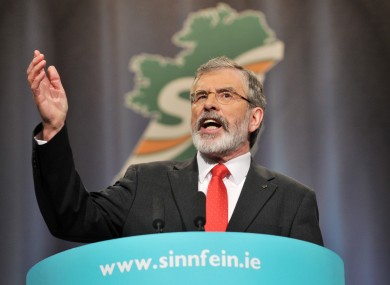
“The prevailing sense among the policy makers is to perpetuate the status quo,” the Sinn Féin President has told the MacGill Summer School in the Glenties this evening.

Image: Laura Hutton/Photocall Ireland

GERRY ADAMS HAS hit out at the institutions of the current Irish State accusing them of having “their backs to border” and has called for debate on a united Ireland, saying the status quo will only be changed when this happens.

“The prevailing sense among the policy makers is to perpetuate the status quo,”the Sinn Féin President has told the MacGill Summer School in the Glenties this evening .

“This will only be changed when a genuine national spirit is recreated to replace the nonsense, popular in some circles, that this State is the nation and that Ireland stops at Dundalk or Lifford.”

In his speech Adams said that the current Irish State is the product of the aftermath of the Easter Rising of 1916 and the Civil War four years later.

He claimed that the outcome of the Civil War and partition led to the “native conservative elite” replacing “the old English elite with little real change in the organisation of Irish society”.

He said of the post-Civil War, early Irish State: “Religion was hijacked by mean men who used the gospel not to empower but to control, and narrow moral codes were enforced to subvert the instinctive generosity of our people.

“Women were discriminated against; gay and lesbian citizens were denied equality under the law and all the while scandals like the abuse in the industrial schools, the Magdalene laundries, Bethany Home and the barbaric practice of symphysiotomy were tolerated and encouraged. 

“Those who suffered were mostly poor. The arts were censored. Our language undermined. Our culture corroded.  Millions fled to England, the USA and Australia. A lesser people would not have survived.

“The system of economic and political apartheid in the north and the scandals of backhanders and brown envelopes, and of the banking and financial institutions and developers in this part of the island, exemplify how the elites held sway.”

He accused the media, academia and “political elites” of being “partitionist”.  ”They have their backs to the border,” he said.

“While they are generally benign, policy makers know little about the north and care even less. Their concern is to protect the interests of the establishment as they understand it,” he added.

Adams also accused the government of shying away from the debate over a united Ireland and implementing the measures contained in the Good Friday Agreement.

He hit out at the government over its failure to more radically reform the Dáil but he did say his party would support the abolition of the Seanad in the forthcoming referendum.

Explaining the rationale for this, Adams said: “Only one per cent of citizens have a vote in Seanad elections while others have multiple votes. That is why Sinn Féin will not support a proposal to retain the present Seanad. We will campaign for its abolition.”

The Louth TD also called for equal rights for people in same sex relationships and for ethnic minorities like Travellers and “those of all creeds and none”.

This article first appeared on www.thejournal.ie

Share

Vanguard Bears Show Support for Ardoyne Protesters

Vanguard Bears, like many other Rangers supporters groups, has strong links to Ulster and as such we are fully aware of the ongoing daily protest at Ardoyne, where loyal people are being denied their human right to walk past Ardoyne shops to their homes as they have done so for decades as part of The Twelfth celebrations.

Protesters have been there every day since this past 12th of July and there appears to be no sign of it ending soon.  With that in mind, Vanguard Bears members agreed to offer some financial aid, assisting our friends and comrades in their time of need.

In the space of just a few days the magnificent sum of £560 was raised.

This money was handed over to the Twaddell And Woodvale Residents Association (TAWRA) by Progressive Unionist Party leader Billy Hutchinson – representing Vanguard Bears – this evening, and will go towards much-needed hot and cold drinks, sandwiches, biscuits, chocolate etc. for the resilient and impervious protesters.

As well as the above, Vanguard Bears has also supplied 1,000 Rangers rosettes to TAWRA to assist in future fundraising.

Our friendship with Ulster’s loyal people is one that will never wane.

Hands Across The Water.

Share