Category Archives: History

Strike Up The Band:Albertbridge Accordion

This is the first article in the planned series looking at many of the well known bands from Northern Ireland and further afield.  Here we begin with a look at one of the Premier bands in Ulster–not just in the realm of accordion I may add.  Albertbridge have a history that dates back to the late 1950’s and have led from the front on many seperate occasions–colour party–foreign parades.  Many thanks are due to the late Robert “Bobby” Duncan who related much of this history from far away Canada before his untimely death almost a decade ago.  Robert was, of course a member of the band who blazed a trail for Ulster Bands by taking part in the Toronto 12th July Parade in 1968.

ALBERTBRIDGE ACCORDION BAND
EAST BELFAST

Albertbridge Congregational Church was actually situated in the Short Strand–at the corner of Thompson Street.  The church hall was located in George’s Street which ran from the lower end of the Woodstock Road to Ravenhill Road.  Attached to the church like many others at the time their was a local BB Company–the 56th.  There were many local lads who became part of the 56th and served with distinction under Captain Bertie Boal.  Upon leaving the BB at 18 some of those friends decided to form a band and the first meeting was arranged for Friday 9th August 1957, in the church hall.  Seven members turned up for that meeting and are listed as W. Cummings. F. Stewart. R. Ewing. B.McCartney. J. Arbothnot.  N. Gibson and J. Gibson.  Billy Cummings is, believe it or not still an active parading member with the band!!
A-BridgeSome of the names mentioned for the band were Woodstock Defenders–Sons of Ulster and the 56th Old Boys but eventually they settled on the name Albertbridge Accordion.  Next steps were to pay weekly dues–look at ways to raise funds and practice weekly with some second hand instruments.  The first practice sessions were held in a hall which was owned by Wolff Star on the Newtownards Road and they soon obtained a  “uniform”.  Grey trousers–white shirts–red tie and a variety of peaked caps.  Easter Tuesday 1958 is a day of significance in the Bridge’s history.  It marked their first official outing, alongside Christian Crusaders Junior LOL 27 to Bangor.  Quite quickly their prowess and reputation grew as did the number of outings.  They moved from Wolff Street to Clermont Lane on the Woodstock Road and practiced in a tiny room owned by The Duke of York public house. Practice nights were shared with the Duke of York Pipe Band who used the room above!!  As far as parading went it became traditional for the band to assemble and leave from Swift Street where Billy Cummings family home was.  Across the tiny street from Billy’s house was Tilly Martin’s sweet shop–The Mayfair–and this was where the band set off from through the early sixties.  From Tilly’s to Templemore Avenue–the starting point of most parades–was a very short distance and was the usual route.  This departure point remained until 1971 when the band moved to a new practice location in the Union Rooms on the My Lady’s Road.  Eventually the band raised the funds to buy the building some years later and it remains their base forty odd years on.
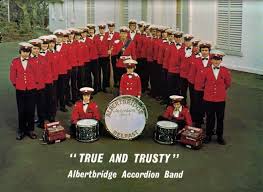
Albertbridge were extremely lucky in that throughout their illustrious history they have retained members who were totally dedicated and had the band–and the culture it stood for–at heart.  Stalwarts from those days worth mentioning were Big Scotty–Bobby Dowds–Brian Nelson–The Long brothers–Geordie Coulter–Alex Gordon–The Dane brothers–Bobby Duncan, Jimmy Nicholl and a long host of others.  During this time there was great camaraderie within the band and one of the more colourful characters was the much missed John Halliday–the original Doc.  Who will forget the Doc on the many occasions acting Drum Major–always sure of a laugh there!!–a departure from his usual role of “Playing the Flag”.  In the mid sixties the uniform was slowly changing to trousers with an added stripe and pullovers plus caps that were all the same!!  In 1968 the Bridge made history by becoming the first band from these shores to march in the Toronto parade.  In the months leading up to it they went into overdrive as far as gathering funds went because not only did they pay their own way to Canada but purchased a new uniform at the same time.  This was the first uniform proper and was a signal that after eleven years of blood, sweat and tears the band had arrived.  At the same time they were establishing themselves as a very talented outfit with a wide repertoire of songs.
Being an accordion band meant that they were hard to put a label on–certainly not “kick the pope”–the forerunners to todays “blood and thunder ” bands.  They could just as easily play complicated marches as well as the traditional Orange tunes.  This was illustrated on their first LP which was released around this time..To The Field and Back.  One of the abiding memories I have of the band after the Canadian trip was them including the Maple Leaf Flag in their innovative colour party–aptly named The Flying Squad.  That was a big talking point.
Upwards and onwards could have been Albertbridge’s motto in those days because they certainly went from strength to strength.  But nothing was achieved by resting on their laurels and the continuing hard work of the core members paid dividends.  There are still a considerable group of members with over 25 years service–others who have over 30 years service–and then Bap himself–who is still the treasurer!!  An important addition from the not too distant past has been that of female members–something that would have been unheard of in the heady days of the 50’s or 60’s.  The colour party has since been disbanded and “The God Squad” formed.  The band always had a number of practicing Christians within the ranks and in 1992 the idea was hatched that a sub-band be formed to play only Gospel type music.  Scotty, Victor Dane, Sam Ritchie and Robert Foster were amongst the first exponents and they made their debut in Cregagh Congregational church not long after.
In recent years Albertbridge have cemented their place in the folklore of accordion bands.  Their name is synonymous with good music–they continue to play music the way it should be played–their reputation is second to none and they are welcome wherever they go.  As a young boy in the early sixties,  involved in flute bands it was always refreshing to hear bands from a different genre.  Then, there were many silver and pipe bands to brighten every parade.  It is with pride I fondly recall hearing the strains of Blackman’s Dream–or a reel like Marie’s Wedding as the Bridge approached.  What memories!!

Share

David Ervine Response To MLK Site:2003

Share

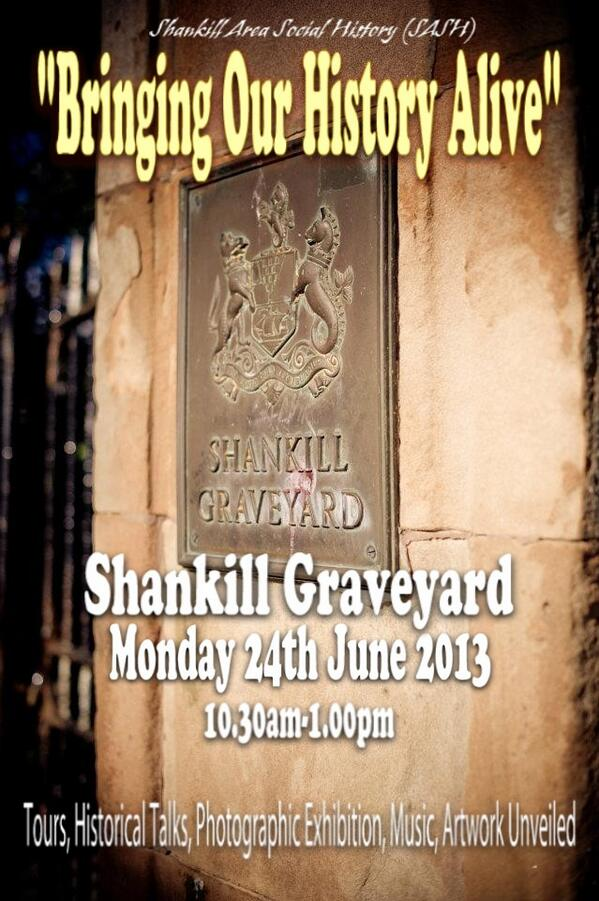
Bringing Our History Alive: SASH Group

Where can you find millionaire business men, with the poor and desolate, war heroes and traitors, Loyal Orangemen and a Nationalist MP all together? 

Answer – SHANKILL GRAVEYARD


Date for your diary

MONDAY 24th JUNE-10.30am-1.00pm at SHANKILL GRAVEYARD


“Bringing Our History Alive” is a Shankill Area Social History (SASH) event for all ages that will bring the fascinating history of the Shankill Graveyard and the people buried there to the local community. Through music, art, guided tours, historical talks, archive photographic exhibition, and characters in period dress, your history will be brought alive for the day.


The proceedings will involve the unveiling of a striking ceramic art piece which SASH have been working on with artist Daniela Balmaverde highlighting the Graveyard’s history.  The unveiling will be by renowned local poet and historian Albert Haslett who may even treat us to a wee reading of one of his many poems about the Graveyard or the history of the Shankill.  Music will be provided by local musician and song writer Jackie McArthur who has written many songs about the social history of the Shankill.  Informative and engaging tours of the graveyard will be provided by local historian Bobby Foster and you may even bump into a few Victorian gentry, soldiers or mill workers while on the tour.  The event will conclude with talks on significant characters from the area and a photographic exhibition in the neighbouring St Mathews Parochial hall.  Throughout the event there will be food and refreshments and best of all everything is free and everyone is welcome.


Shankill Area Social History (SASH) is a voluntary based historical group who aim is to promote the history & culture of the Shankill. The group meet every Monday morning 10.30am in the Spectrum Centre 133 Shankill Road and is open to all who have an interest in the Shankill.  SASH group activities involve regular guest speaker on historical themes, visits to historical sites, and a range of projects such as community archive, art projects and social media to promote the history & culture of the Shankill and its people.

To contact SASH group about this particular event or if you are interested in becoming involved please use the following contacts

Rev Jack Lamb (Chairperson) mob: 07720293941

Billy Drummond Tel: 028 90311420

Twitter: twitter.com/shankillhistory

Email: sashgroup@hotmail.co.uk

Website: www.shankillhistory.com

Facebook: Shankill Area Social History


Share

People of the Arches by Bobby Cosgrove

Continuing the fascinating insight into the years gone by in East Belfast through the eyes of local historian Bobby Cosgrove.

PEOPLE OF THE ARCHES


Having written about the early days of Newbridge Village & The Holywood Arches and how the area was developed from a few cottages into one of the major industrial areas in Ireland. No story of districts like the Arches would not complete with out talking about the people and what life was like for them living in an industrial area like Connswater.

Most of what you will read is from my personal memories as a boy growing up at the Arches, and also those of others from the area as one told me we were not just neighbours but a large family “That tells all”


Early Memories.


One of the first and lasting memory is that of noise, and people on the move all the time, noises like the banging of the riveters hammers while they were building the great ships in the yards of H.W, or the wee shipyards of Workman Clarke. Then of course there was the wonderful sound, and sight, of steam engine trains travelling along the high embankments, on their way over the Hollywood Arches and on to places like Comber, Newtownards, & Donagadee, not forgetting the line to Ballygowan and on to Newcastle. Another series of noises that would bring back memories is the factory horns, each company had a different sounding horn, and some like the Rope works give two blasts, the first was called the minute’s horn giving their workers a two-minute warning to report for work. The second blast was the starting horn, and if you were not in through the gate when this horn sounded you were locked out and a days pay was lost.  These sounds along with the noise of the trams going along the Newtownards Road, and also the clatter of horses hoofs going over the square sets on the streets, meant that everyone looked forward to Sunday a day of not only rest but peace and quiet.


Hard Life / Wonderful People


Life even at this time was still very harsh, as wages were still very low, and the housing was no better than slums, but the people were wonderful and the comradeship and community spirit, that was shown at times of need were unbelievable, with the motto being “we have nothing but will share it with you”. One story often told was of two men who broke into a house in Oakdale St, but instead of stealing anything they left a 10 bob note on the mantle piece, with a message that stated, your are worst off than us this will help you put food on the table. My Great Grandmother Rowley lived at number 10 Manderson Street, which is off Townsley St, the last Street on the left hand side of the Newtownards Rd just before the Hollywood Arches, and I myself along with my parents also lived in this Street at no 16, these two streets even by Belfast standards was unique as they consisted of 19 houses, 3 stable yards, 1 boat yard, 1 bookies, and the rear entrance to 2 pubs, it also had a blacksmiths shop, with the N.I labour party rooms above it. This was what in Belfast terms was called a dead end Street, as there was only one way in and the same way out, today they would be called “cul- de-sacs” to-day.  The boat yard is still producing boats after 75yrs, and although Harland & Wolff and the Workman Clarke yards have now all but gone the art of boat building for so long the life blood of East Belfast workers and their families, is still carried on by the Duffin family in Manderson Street

The Toss, the Peelers, and the Lookouts.


The bookies which was owned by Clarke Groves, was a house to the front but inside it was large as an extension was build out the back of the house into Holland’s yard.   On a wet Sunday this became our indoor soccer pitch, as we would have helped Sammy Allen to clean the place and as a reward he would let us play football with a tennis ball in the bookies shop. Almost every Saturday afternoon there would be a “pitch & toss”, this was held on the embankment of the now defunct railway track and embankment at the rear of the houses, at times you would also have had the Crown & Anchor board man.  Both these forms of gambling were illegal, and the people that ran them paid the young lads from the street to keep a lookout for the peelers coming, if the Police came to make a raid it was usually along the railway line, the lookout job was to shout out a warning. When this happened they would lift the linen sheet, or newspapers with the money on them, and take off over the nearest yard wall, and through someone’s house into the street, sometimes there would be police in the street to catch them, but most times they would have got away, and the lookouts would then lift up the odds that were left lying, as they made their escape from the police. Many a fish supper or and ice cream was bought on a Saturday night when this happened, of course when people like Hughie Bowers did lookout, the shout of here comes the peelers was called every time, Hughie had it sussed out how to get extra money from the toss.

Drinking & Bare Knuckle Fist Fights.


Manderson Street was notorious on a Friday & Saturday night for its bare knuckle fist fights at the rear of the Bloomfield Bar, and quite a sight it was to see two hard men striped to the waist fighting with bare fists only, as the use of anything else, i.e. feet, head, or weapons were not excepted. When it was over they shook hands and went back into the bar were the loser bought the drink. There was many a bet placed on these fights and some of the fighters made a name for themselves as a hard men. One of the hardest men associated with the fighting was Walter Cunningham a brother of Hard Screw Cunningham one of the most famous characters in the Area.

Well Known Characters


Pastor Joe Glover was a well known character in the east end of the city, he worked as a bag filler in the coal quays and enjoyed his drink at the weekends he had a family of 5 and his wife Martha was born in the street he also had a small stable and kept a donkey and trap. There are two different stories as to how he got the name Pastor, the first is that it was because of the wide brimmed hat he wore when he got dressed up in his Sunday best clothes this was the same as that worn by Pastors. The other story is that every now and again Joe would get religious, he had joined the Coalman’s Mission and would along with Martha be seen standing outside the Clock & Bloomfield bars handing out tracks and was giving the nickname Pastor by the locals. But the truth is that Joe was the son of a Pastor.


Others that were well known in the area would have been Winkie Bowers, Rocky Burton, Freddie (Blowie up) Robinson—he was a big man who cried at the simplest thing, one day he called at our house to see my budgie and on hearing that the cat had killed it he cried like a baby, and every time he passed my house on his way to his brothers house, down the street he cried for Joey the budgie. The reason he was nicked named blowie up was because he drank cheap wine called blowie up wine.

From Ashdale Street there was a man called Hardscrew Cunningham you could fill a book with what this man did but one story is about a wake for an uncle of mine called Co Magill of Oakdale St, it seems that Hardscrew visited the house to wake the deceased with a few drinks in him and brought in fish & chips he sat on the stairs beside the coffin he asked for salt & vinegar but was only given the vinegar and on being told there was no salt he said that’s alright. He then reached over and took some salt out of the bowl of salt that had been placed in the coffin to ward of evil spirits; he then sprinkled the salt on his chips and eats away at them.

Another great story is that while attending a funeral of a relative of Winkie Bowers and as the procession moved through Ballyhackmore, and on towards the green fields of Knock, on its way to Dundonald Cemetary, Hard screw suggested to Winkie that they should have a farewell drink with the deceased, as he would not be coming back with them, so they all retired to Paddy Lambs Pub with the coffin and had a farewell drink

The last story about Winkie again relates to a friend of his that died, and when he went round to the house of the deceased there was only the brother of the deceased in. Winkie then decided to play a trick on the mourners. Once again the coffin was placed beside the stairs and he placed a piece of thread around the little finger of the corpse, he then worked it up into the front bedroom where he lay in wait as the house filled up with family and an friends. When someone said he looks so peaceful and happy hardscrew pulled the thread and as the arm of the deceased was raised the room emptied in two seconds flat, these are just a few of the many stories that can be told about him.

We cannot leave this part without mentioning the hobby horse man, William “Bull” Ellison, this man was running hobby horses for years before the late Mickey Marley got on the road. The bull was a veteran of the bore war, and kept stables in the street that housed many horses, and a number of carts, traps, and of course the famous Hobby Horses.

Ghosts, Food, & Entertainment.


Millen’s supper saloon at the bridge was our fast food outlet, and a penny worth of broken biscuits from the Inglis biscuit factory shop, or the Home & Colonial Stores was our treat, ice cream or hot peas from Fuscos, “boy how the Italians could make ice cream” this was our heaven. Sweets from Maureen’s newsagents, and toys from Barlow’s fancy goods & toys shop. Our meat was from Thompson’s, the largest butchers shop in Belfast. Carryouts of the cheap wine came from Courtney’s off license at Westminster Ave at the bottom of which was a number of aluminium bungalows. As I was saying earlier about noise the same can be said about smells, and if anyone ever smelt the connswater on a summer day at low tide the stink was revolting, but the sweet smells from the biscuit factory made up for it we, also had a resident ghost in the building that housed Irvines Shoe shop at the bottom of Bloomfield Avenue this lady was seen on a number of occasions walking round the upper rooms of the building.

Pigs feet and bacon ribs were another Friday & Saturday night favourite and a man used to go round the bars on a bike with a basket on the front selling them to the patrons, Our escape was the Saturday morning minors club with Uncle Mac in the A.B.C. Strand or the New Princess with its wooden seats and of course Costa Victoria with its outdoor swimming pool and boating lake once you had a swim in the pool at Victoria you could have swam in the Artic in the Autumn was up to the big houses in Strand town to collect the windfall apples falling in the orchards (sounds better than raiding the orcies) and of course in July collecting for the bonfire took up a lot of our time. The 1st of July was always a great night with the Orange Parade coming down through the Arches on its way back to Templemore Ave the music from the bands the wonderful colours on the banners, families out together in a carnival mood sucking on ice creams from Fuscos and eating Fish & Chips from Millen’s this was utopia.

We also had our own all year round toboggan run as we would sit on tin sheets, and go sliding down the railway embankment, of course on going home we would get told off for having ripped the arse out of our pants. Their was no ice cream that night, other lasting memories were the site of thousands of bicycles on the Roads and Streets, as men made their way to work in the shipyards, Shorts men went by bus or car.  The Rope works produced many characters and one of the most famous was a man known to one and all as Daft Eddie, famed for wearing safety pins all over clothes— it was claimed he would do anything for a pin. The Ropeworks employed most of the women from the area and without there income many people would have even in the 50s starved.

I hope you have enjoyed this trip around the Arches of yesteryear to those who lived around the Arches it is a living memory and to those others who did not, I hope it has given an insight into life in Belfast Streets in the 50s & 60s and I also hope that any names given will not cause offence to any living relatives.

Bobby Cosgrove

Share

100th Anniversary of Willowfield Unionist Hall: Jason Burke

THIS ARTICLE FIRST APPEARED ON   www.jasonrobertburke.blogspot.co.uk
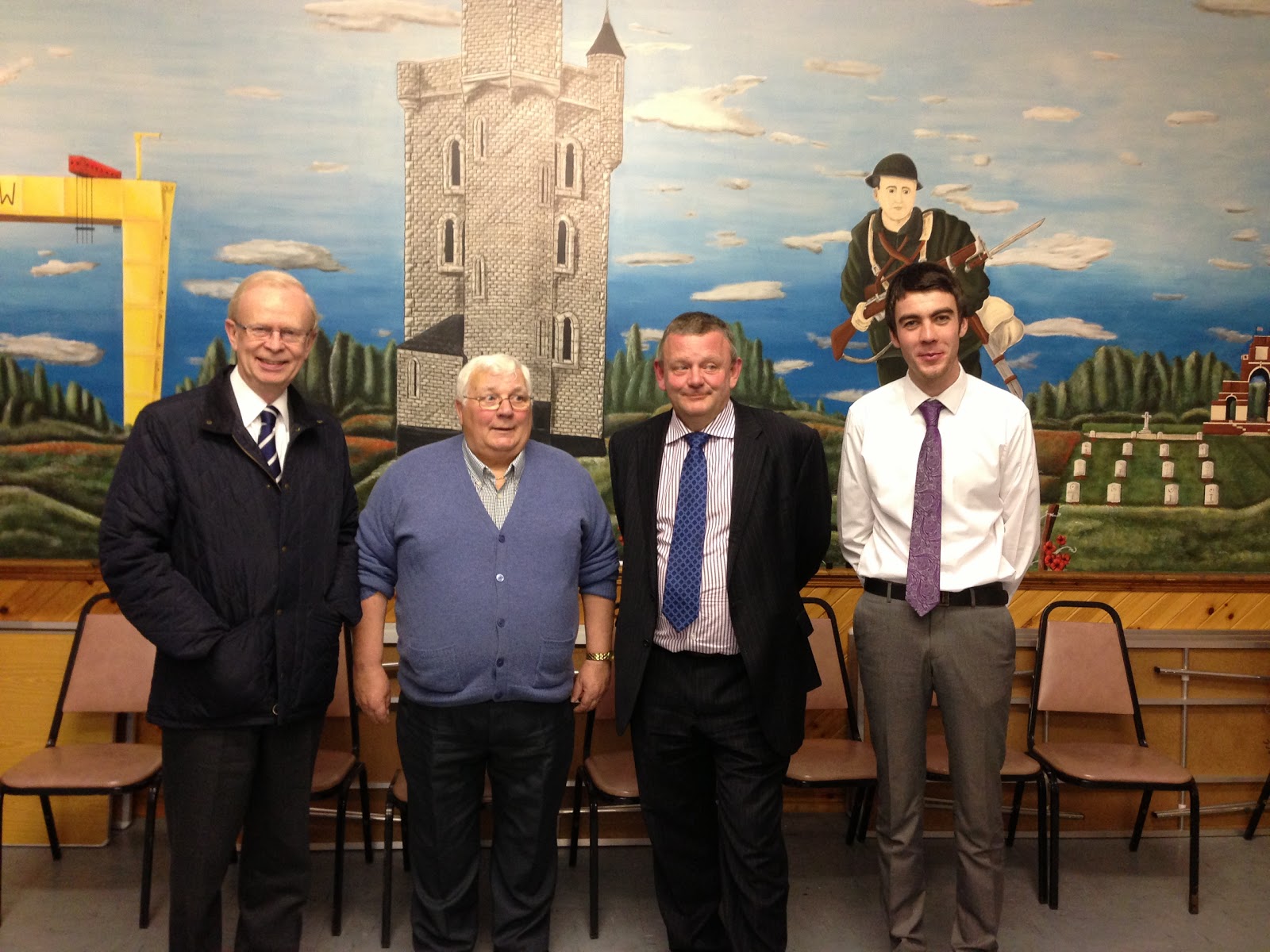
Sir Reg Empey, Bobby Cosgrove, Michael Copeland MLA, and Jason Burke
Thursday 16 May 2013 marked 100 years to the day since the official opening of the Willowfield Unionist Hall by Sir Edward Carson in 1913.
The occassion was celebrated at an event staged in the Albertbridge Accordion Band Hall and hosted by Jason Burke and Bobby Cosgrove.  Among the invited guests were Sir Reg Empey (the last Unionist candidate to be selected from the Willowfield Hall) and East Belfast MLA Michael Copeland.
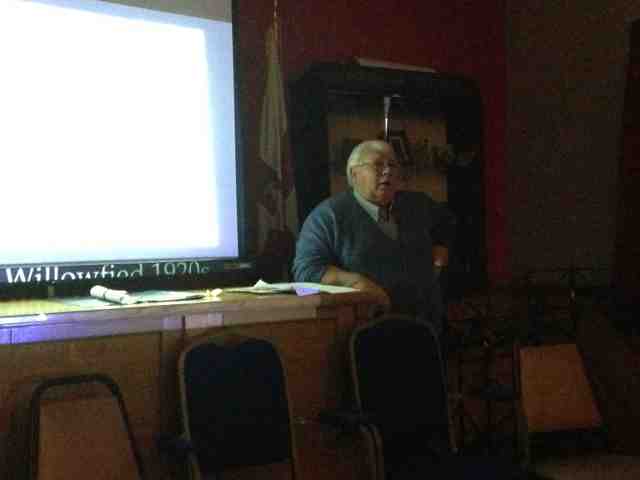
Bobby Cosgrove opened the evening and went on to lay out the context of the Willowfield area up to and including the Ulster Covenant in September 1912.  Jason Burke then provided a presentation of research which he has accumulated and outlined the events surrounding the opening ceremony itself, this included photographs of Edward Carson at the hall and also extracts from the speech he gave that evening.
A short interval was followed by an excellent musical performance from the UVF Regimental Band, East Belfast.  They spoiled the audience with some musical selections befitting the 1913 era including ‘Tipperary’ as well as the Colonel Bogey March.  The fact that the band were dressed in period costume including flat caps, puttes, and haversacks only added to this reminiscent spectacle.
Bobby Cosgrove shares some of his memories of Willowfield Unionist Hall
Bobby Cosgrove humorously brought the story up to present day by sharing the sporting successes of the associated football, bowls, and cricket clubs, before indulging in some of his own memories from in and around the hall. At the end of the evening there was an opportunity for members of the audience to share their own memories of the hall, one man in particular had retained the most vivid of memories as at one stage he lived in the hall!
Michael Copeland MLA then brought the evening to a close with a few concluding remarks.
Thanks to everyone who attended on the night, I hope I did justice to the occassion.
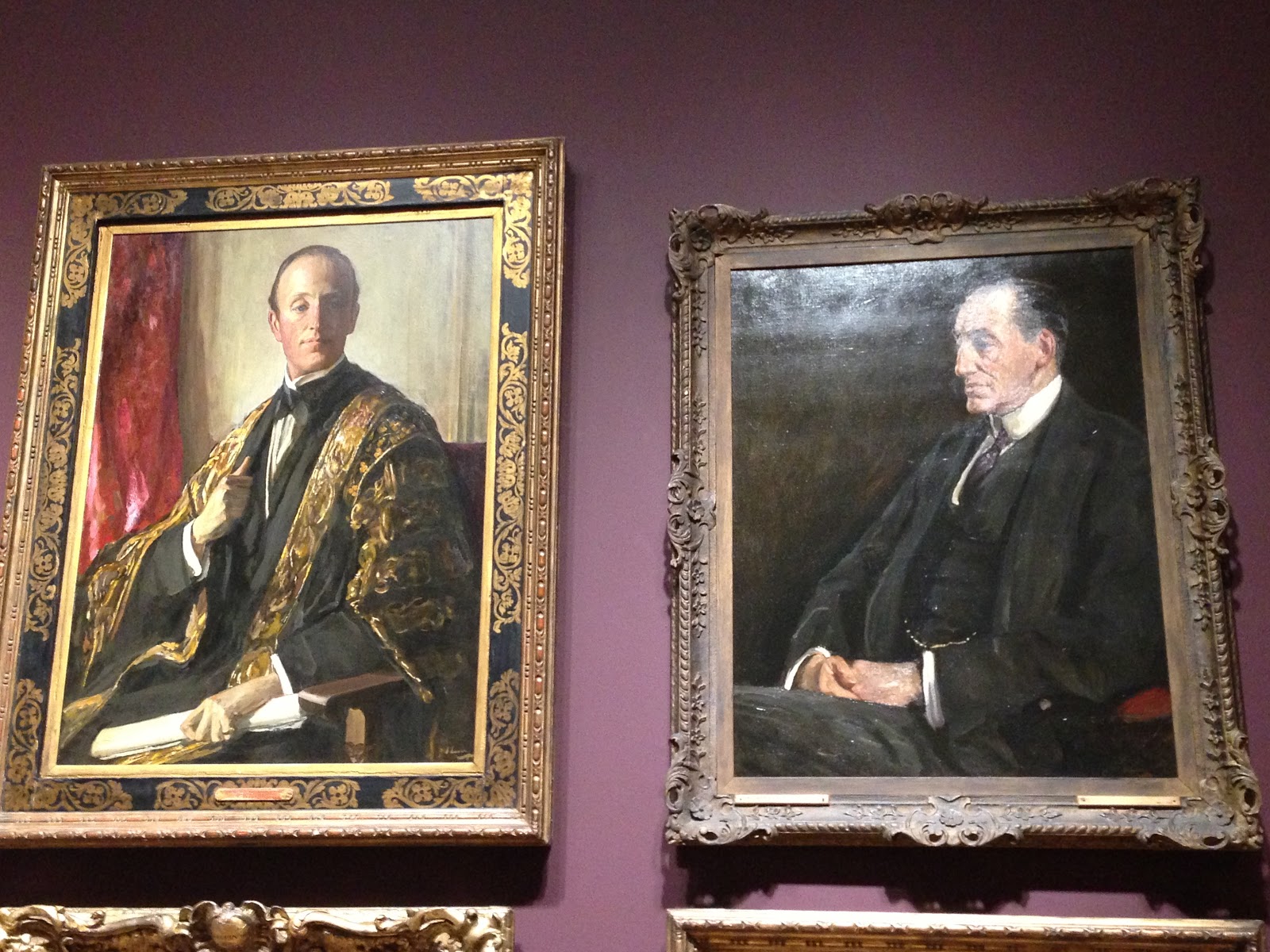
Lord Londonderry and Sir Edward Carson, both were present at the opening of the hall in 1913

Share

When Did Protestants Lose Out?: Gareth Mulvenna

PSA Paper – 15May 2013

Intro

Has the Protestant working class lost out in the Peace Process? This is a question that many people have been asking since April 1998. The issue has, however, come into sharp relief in the past ten years or so and over the past five years it has been magnified. Have we reached the crisis point? Or did we reach it in 2012, 2011, 2005 or 2000? Arguably we have to go back to before the ‘peace process’ even existed. If we want an accurate picture, we have to revisit the start of the Troubles: arguably that is when the Protestant working class truly lost out.


I: Tartan Letter

I have recently been carrying out research into the loyalist ‘Tartan’ gangs of the early 1970s. During my research I came across an ‘open letter’ in the Belfast Telegraph by the political commentator Barry White. The letter, from May 1972 was written in response to a recent upsurge in Tartan violence. Here are a few excerpts –

I don’t suppose you give a damn, but I think I know why you did what you did in East Belfast last week-end. You are young, it is spring, there is nowhere to go, nothing better to do, so you go looking for trouble. I’ve done it myself.

It’s not the pleasantest place to live, East Belfast. The houses are small, overdue for demolition, and the only playing fields are the streets. Youth clubs are fine, but they’re dull when there’s some excitement to be had outside.

It’s the people who make the place. They’re tough on the outside, but couldn’t be kinder to their own sort. They’re proud to come from the wee streets, and most of all they’re proud to be Protestant.

Since those civil rights people started marching you’ve seen your little world crumbling. First they got their way by marching and rioting, and then – when the Protestants hit back – by getting their houses burned down. They couldn’t lose, and since the IRA took over, they’ve done even better. Nothing even slowed them down – certainly not internment – and by murdering, maiming and destroying they have succeeded in toppling your Protestant Parliament.

It was enough to make any Protestant blood boil, and it isn’t really surprising that you hit the top last week-end. Those two bombs in Castlereagh Street softened you up, and those pictures of the IRA in the Bogside and the internees getting out were the last straw, even if you don’t count the Vanguard rally in Templemore Avenue.


Substitute ‘Tartans’ in that letter for the phrase ‘some flag protestors’; or ‘IRA’ for Sinn Fein; or indeed ‘Vanguard’ for DUP and you have a letter describing a situation which is still familiar to some working class Protestants 41 years on. Indeed it is a situation that was played out on a few occasions in east Belfast during the weeks that followed the initial vote to limit the number of days on which the Union flag would fly over Belfast City Hall.


II: The Early 1970s & Community Fragmentation: A very British concept?

If things are so similar in that respect, perhaps it is worth revisiting that era briefly to try and figure out the possible roots of some of the problems that the Protestant working class in Belfast are currently enduring.

McAuley and McCormack have rescinded the notion that the Protestant working class constituted a ‘labour aristocracy’ in Northern Ireland and have noted that ‘By the mid-1950s…it had become clear that the traditional industrial base of shipbuilding, textiles and engineering could not guarantee a viable and prosperous economy.’

In this environment a lack of education could have proved fatal to the aspirations of the Protestant working class.  For many it was precisely this fissure that made Protestant working class males prone to a social and economic disparity with their Catholic counterparts who by the late 1960s had begun to see the progression of a first generation of adults who had benefited from the Education (Northern Ireland) Act of 1947.  The fact that the Troubles were on the horizon meant that any misery endured by the Protestant working class through the process of industrial decline would only be compounded by the problems which civil unrest brought.

While deindustrialisation occurred in other parts of the UK after the 1960s, and the shipyards of the Clydeside, Tyneside and Merseyside suffered, these working-class communities did not have the added pressure of political violence to contend with. The essence of understanding the Protestant working class and their sense of angst I feel is to understand them as part of a wider British working class community: an ‘East-West’ perspective is needed. The early 1970s was certainly a shock to the system for both sides of the community in Northern Ireland. Catholics suffered indiscriminately at the hands of roaming loyalist murder gangs, while both Catholics and Protestants had to endure the IRA’s reckless bombing campaigns that destroyed the commercial vitality and viability of Belfast city centre. This combination of violence and deindustrialisation affected the Protestant working class in a unique manner which is perhaps best understood by referring at least in part to Paul Willis’ 1978 work which was entitled Learning to Labour.

In Willis’ study he noted that the ‘lads’ (a group terminology used by Willis to describe his working-class research subjects) formed an ‘oppositional culture’ to education, feeling that they were pre-destined to an unskilled job in the industrial workplace. I don’t think that the perceived indifference of the Protestant working class to education prior to the Troubles is a completely satisfactory reason for the current malaise. One need only look at Orangefield, Carolan, Grosvenor and Annadale to see good schools with a strong reputation which were filled with Protestant working class children. The general consensus however is that the Protestant working class attitude to education was similar to the lads in Willis’ study. Due to the process of deindustrialisation the jobs that would have been available to Willis’ ‘lads’ and Protestant working class males in Northern Ireland from the 1970s onwards became redundant. Linda McDowell (the sociologist, not the journalist), in her 2003 study Redundant Masculinities, picked up on this phenomenon and its negative effects. She states ‘In the UK, today still a predominantly white country, male manual workers are, of course, the group currently most threatened by deindustrialisation, economic change and the growing dominance of the service sector. Rates of unemployment are consistently higher for men in old manufacturing districts…’

Speaking to a community worker in East Belfast six years ago, he was of the opinion that to be a Protestant working class male was to be at the bottom of the pile. The exclusion of young men from the so-called ‘feminised’ labour market is best summed up when the community worker in question stated that he had young Protestant men come to him and state that they wouldn’t go for a job in Tesco as a ‘replenishment officer’ as it was too ‘high-powered’ for them; above their station. Here, the language of the labour market is a stumbling block.

In the early years of the conflict, many Protestant working-class communities were decimated as people fled the threat of the Provisional IRA at interfaces and intracommunally the dreadnoughts of their local loyalist paramilitaries. The grip of civic guardians such as those involved with the Protestant churches and consequently the Boys’ Brigade and other uniformed organisations was dissipating; indeed many of these so-called community leaders fled Protestant working-class areas as the temperature rose, seemingly content to leave the emerging problems of violence and high unemployment behind. Trade unionists who would have provided reasonable voices and strong leadership qualities in Protestant neighbourhoods were overtaken or subsumed by the emergence of more militant workers groups, notably the Loyalist Association of Workers.

Of course there was another important process at work during the early 1970s and that was the redevelopment of the Shankill due to the Belfast Urban Motorway project which gave rise to the Westlink. As Ron Wiener demonstrated in his seminal work The Rape & Plunder of the Shankill the strong sense of community which had been present in the Shankill prior to the Troubles was decimated by fanciful city planning which pushed working class people further out into the suburbs and thereby breaking up solid community and family networks. The Shankill, with an ageing population, has never truly recovered from this. Divorced from the violent context what happened to the Shankill is more or less the same as what had happened to another proud working-class community in London’s East End during the late 1950s. As Phil Cohen has noted, plans to ‘‘modernize’ the pattern of East End life’ were a disaster and did not allow for ‘any effective participation by a local working-class community in the decision-making process at any stage or level of planning.’ While housing in places such as Dagenham and Greenleigh were substantially better than the slums that people had inhabited, the kinship network which had sustained community morale was destroyed. Add the violence of the early 1970s to the redevelopment of an area such as the Shankill and the population movements happening across Belfast and you can envisage a disorientated component part of British working class life struggling to adapt to a place apart.


III: Conclusion

I purposefully avoided dwelling too much on the conflict in this brief and informal paper. I wanted to demonstrate how many of the losses suffered by the Protestant working class at the start of the Troubles led to a sense of frustration owing to the disaggregating effects of social forces and political violence on their sense of Britishness. That is not to say that the Protestant working class felt or feel any less British themselves, but an opportunity was perhaps lost for the Protestant working class to keep in tune with the ongoing refashioning of contemporary British identity. While the white working class of the East End have adapted to this refashioning or withdrawn into a familiar sense of British identity by moving away, the Protestant working class in parts of Belfast are arguably still coming to terms with the breakdown of community and civic structures which occurred in the early 1970s. The Tartans who rioted in 1972 and the flag protestors who rioted in 2013 share the same core issues of unemployment and a lack of a vision for the future; problems which young people across the UK faced then and now. However with a peace process that is perceived to be designed for the benefit of republicans and a perception of being cut adrift from the rest of the British working class which once reflected their hopes, dreams and ambitions it is little wonder that the Protestant working class feel marginalised and without direction.


Share

FROM THE SHIPYARD TO THE SOMME: JASON BURKE


FROM THE SHIPYARD TO THE SOMME – by Jason Burke
A number of excellent publications have been produced in recent years as interest in The Great War continues to grow, particularly as we are in sight of various associated centenaries However, drama has an equally (if not more) important role in telling stories of the past whatever they may be. Drama has an amazing ability to inject raw ‘reality’ into a story, it can bring a tear to one’s eye and put a smile on one’s face, and in many ways this is more powerful than a history book, it brings the history book to life in ways that nothing else can.  With this in mind I wish to place on record my delight that this play has come to fruition, I commend all those who have been involved from its inception to its execution before us in this theatre today.
For someone to have grown up recently in a unionist/loyalist community it would not be surprising if they were aware of the story of the‘gallant’ 36th (Ulster) Division at the Somme, a story involving heroic loyalty to king and country by volunteering for war and ultimately resulting in slaughter on the battlefields of France.  For other people, the same story will have had more depth, perhaps set in the context of the Home Rule crisis, the formation of the Ulster Volunteer Force, their ‘inevitable transformation’ into the Ulster Division, but crucially, the same outcome, slaughter on the battlefields of France.  Commemoration within the unionist community has a tendency to focus on the sacrifice of the Ulster Division, usually to the exclusion of other regiments who served in The Great War.  It’s time for a wider approach in terms of commemoration and I hope to display this stance in a book I’m currently writing; East Belfast and The Great War. We are equally as indebted to those soldiers who were not Ulster Volunteers or indeed did not serve with the Ulster Division as those men who did.  Not all U.V.F. men enlisted in the 36th(Ulster) Division, of the 100,000 strong U.V.F. there were only 17,000 men in the Ulster Division. David Fitzpatrick has claimed that only 48.7% of the Protestant enlistment figure had served with the U.V.F. before the outbreak of war.
Share

The Ulster Volunteer Force: Negotiating History: Roy Garland 1997

An article first produced by Roy in 1997 makes very interesting reading today–16 years on.  Bear in mind his assertions were made before the Good Friday Agreement.

Seeking a Political Accommodation

The Ulster Volunteer Force: Negotiating History.

Roy Garland. A Shankill Community Publication, 1997. £1.50.

The author of this pamphlet is an Ulster Unionist councillor on Lisburn Borough Council. Mr Garland is a member of the Shankill Think Tank and a regular columnist in the Irish News. He explains in his preface that when the troubles started he was an evangelical Protestant and high up in the Unionist Party and the Orange Order. Today he is a well-known spokesman for the liberal wing of the UUP and a further education lecturer in sociology, religion and politics. He is ‘happy’ to be a ‘positive’ Protestant with an Ulster identity and UK citizenship but he also rejoices ‘that I have found a means to reflect and enjoy my Irishness.’

This is an interesting clue that Councillor Garland has not entirely rejected his own roots. Mr Garland neglected to mention in his preface that he first found a means to ‘reflect and enjoy’ his ‘Irishness’ when he was second-in-command of Tara – an evangelical Protestant paramilitary group with a strong ‘Irish emphasis’ – which took its name from the seat of the ceremonial High Kings of Ireland.

Although there have been many books written about the IRA and its history very few have dealt with the history of the loyalist paramilitary groups. Steve Bruce has written two useful studies, The Red Hand and At the Edge of the Union. Ulster’s Uncertain defenders, the only other study, appeared a decade earlier in 1984. The last book on the UVF was published in 1973!

This concise booklet is an edited version of an earlier dissertation for a university degree, The UVF: Negotiating Identity. This has been serialised in Progressive View, the journal of the Progressive Unionist Party. Would-be readers can be thankful that this booklet has been heavily abridged. The unreadable purple prose and tortuous sociological jargon which marred the original has been eliminated.

Mr Garland takes us from the foundation of the modern UVF in the mid-sixties up to 1976. A short appendix looks at the situation from 1991 to the present day. This work looks largely through the eyes of Gusty Spence, the UVF’s veteran political guru. Spence claims that the UVF was set up by rightwing elements of the Unionist Party to undermine Terence O’Neill, the Prime Minister. O’Neill banned it under the Special Powers Act after two brutal murders in May 1966. Spence and two others were convicted of these killings.

Garland traces the growth of the UVF after the outbreak of the present troubles and its short-lived relationship with Tara. This broke down in a welter of mutual recriminations and bitterness after 1971. Garland observes that the Shankill UVF were working class men who – unlike Tara – did not see themselves as fighting a religious war, but as ‘serving Ulster’. He quotes Spence in support of his belief, that nevertheless, this did mean that the organisation was fighting Catholics. In their efforts to strike back at the IRA, ‘If it wasn’t possible to get at the IRA then some thought “we’ll get those who are harbouring them, succouring them, comforting them and supporting them” – a completely erroneous theory.’ This pamphlet largely ignores the UVF’s military activities and killings and concentrates on the organisation’s attempts in the mid-seventies to find a political rôle for itself.

The supporters of the UVF resented their portrayal in the media as a ‘privileged’ community. As Spence observed, very few working-class Protestants were politically aware, and they felt helpless in the face of constant attacks and misrepresentations in the media. Spence and others found time to reflect on all these things in prison. ‘We had seminars on everything… The men were ready, not for indoctrination, but to be set in pursuit not only of truth but of some form of political ideology.’ Similar soul-searching was taking place inside the UVF outside the prisons. In the UDA, a parallel debate led to that organisation espousing negotiated independence for Ulster as a means to transcend the religious divide and offer a common focus of allegiance for the communities.

In the UVF, Garland argues that the ‘concensus seemed to favour conciliation, and a form of Democratic Socialism which retained the link with the United Kingdom.’ This is partly true, but it was also open to other more radical opinions. The first political group to speak for the UVF was the Ulster Loyalist Front in 1973. Some of the material which emanated from that source was very positive. ‘Its policies included a “return to democracy” and increased use of referenda, workers’ partnership schemes, and although in favour of private enterprise it wanted to curb “international monopoly capitalism”.’ Despite what Garland seems to think, this talk was not socialist but was common at that time in the radical Britain First wing of the National Front. Indeed, articles from NF publications were occasionally reprinted in the UVF’s journal Combat.

The UVF’s first foray into politics ended in failure with a violent resumption of bombings and killings in October 1975. Garland puts this down to an apparently all-embracing conspiracy between Tara, rightwing unionist politicians, the RUC and the British security services to destroy ‘the independent and Socialist thinking of working-class Loyalists.’ There is no doubt that the UVF did come under a lot of criticism at that time but it often gave as good as it got in reply. The simple truth is more likely that loyalist voters seemed to have decided that politicians do politics and paramilitants do war. However, Ken Gibson’s statement in 1974 that ‘organisations such as the UVF will no longer allow themselves to be used by politicians who will not listen to their views’ set out an attitude that has remained constant in the UVF and UFF ever since.

There can be no doubt that traditional unionism is a dead doctrine and it needs to be swept aside if our Ulster homeland is to survive, let alone thrive. In this, Garland, Spence and the ‘new thinkers’ in the UVF of the mid-seventies were spot-on. It is a shame that they chose the blind alley of socialism. Socialism promises much but delivers equality of impoverishment to all except the party oligarchy.

The New Ulster Political Research Group were much nearer the mark in 1979 when they advocated an independent Ulster with social justice for all. Spence is right. Ulsterfolk do need to be guided by some form of political ideology. That ideology ought not to be socialism – which is just as much a reactionary dead-end as traditional unionism – but radical Ulster-nationalism. Mr Garland, who is a liberal-leftist member of the UUP, will probably never admit this, but perhaps some of the people he has written about will. That said, buy this book. It’s well worth £1.50. Copies are available from Clancy’s Bookshop, The Haymarket, 16 Gresham Street, Belfast BT1 1JN.

Share

ULSTER VOLUNTEERS: 100 YEARS ON

Saturday 20th April was the date chosen to commemorate to 100th anniversary of the formation of the Ulster Volunteer Force.  It was many months in the planning and the end product lived up to all the expectation.  What we seen was a spectacle and a re-enactment of how are forefathers mobilised in the face of errant danger.  There was colour–paegentry–organisation–discipline and above all, a sense of pride in the festivities.  Many thanks are due to many people but its best to congratulate all those who took part both in the procession or as spectators.  The weather held up on a day when many thousands took to the streets to witness this spectacular.  The massed ranks consisting of many Loyalist organisations right across the spectrum ensured a gala atmosphere for the jubliant onlookers, and they were’nt disappointed.  From the first steps on the Ravenhill Road to the prepared field at Craigavon House–and back–the massed throngs played their part on cheering the ranks along.  It was reminiscent of any 12th day and to me even surpassed the mini twelfth.  And how ironic that the crowds were abundant on the Belmont Road–a timely contradiction to those who queried the erection of flags a few days previously.  A studiously organised and incident free parade was also a slap in the face of those who cast aspersions on it beforehand.  Indeed the twin tabloids on Sunday had to resort to the ludicrous suggestion that the parade had been “hijacked” by the modern day UVF.  At least, in their respective reports both gutter newspapers got the size of the procession right in terms of the amountof people taking part!!  Hard to try and say anything else–as the many thousands of photographs produced would hardly lie.  There were many highlights on a extraordinary day–a day that will live long in the memory.  However, for me it was with some poignancy that I stood on the slopes below the imposing building that has its in place in history as the birth place of the Ulster Volunteers.  I couldnt help but wonder what the thinking is behind the non action of the Unionist Party in addressing the delapidated state of Craigavon House?  It is indeed shameful that it has been allowe to fall into such disrepair.  14 years ago I was part of a small focus group who lobbied the same party–for they supplied the bulk of trustees on the Craigavon House board–to no effect.  At best we were ignored.  Our S.O.S.–Save Our Somme–pleas fell on deaf ears.  Those same ears still refuse to listen to the clamour to restore the House to its former glories.  The truth is that if Craigavon House had the same historical value to Republicans as it did for Loyalists it would now be a museum, attracting tens of thousands of visitors–it would be an icon.  It’s not too late to save it.  So hopefully the diligence and fortitude of the small number of volunteers who decorated the House for Saturday’s parade will serve as a lesson to those who are actually in a position to do something about it.

Share

On Behalf of Class–The Officials and The UVF: Connal Parr

Connal Parr is a PhD candidate, teaching assistant and freelance writer based at Queens Ubiversity, Belfast.  Since completing his undergraduate Modern History BA at Oxford University and MA with Distinction at Queen’s, he has been published in academic journals ( Irish Political Studies, Irish Studies Review ) and printed and online media ( Fortnight, the detail ).  Connal is the Grandson of former SDLP politician and Westminster MP Paddy Devlin.

On Behalf of Class – The Official IRA and UVF


Introduction


Relations between Loyalists and Republicans should not be romanticized. The largest and deadliest paramilitary group during the Troubles – the Provisional IRA – tended, at best, to look down on Loyalists as a ‘lower class’ of combatant. As part of Sinn Féin’s retrospective, largely dubious ‘socialist’ analysis, the British security forces have been revised as the main problem while Loyalists have increasingly been cast as part of a (duped) ‘fellow working class’. However the only fraternal relationships of substance to spring up in the jails during the Troubles occurred between the Official IRA and UVF. This dialogue was mirrored on the outside when, from 1972 until 1974, Chief of Staff of the Official IRA Cathal Goulding met regularly with UVF leaders Gusty Spence, Ken Gibson, Jim Hanna, and Billy Mitchell in Belfast and Dublin to discuss areas of mutual political agreement at the height of some of the worst violence of the Troubles. According to private papers of Gusty Spence, the UVF leadership voted to meet both the Provisional and Official IRA in January 1974, and at subsequent meetings at the Old House Pub in Albert Street the UVF and OIRA swapped captives – Protestants held by the OIRA and Catholics captured by the UVF (Irish News, 30 April 2012). Some of these meetings were curtailed following the Dublin and Monaghan bombings in May 1974 (Tiernan, 2006: 141–5), but the Officials kept channels to progressive Loyalist leaders throughout the 1970s, especially inside Crumlin Road Gaol and Long Kesh (see Nelson, 1984: 105; Garland, 2001: 119–28, 213–4; Novosel, 2013: 73–5).


Read more »

Share