Category Archives: Current Affairs

The ACT Initiative – Greater Shankill


‘Communicating culture’

The July celebrations are approaching, flags are flying and band music is in the air. The people of the Shankill are proud of their culture, and celebrate it well…but how much do our young people know about our culture? How many opportunities to learn about our culture are young people offered? Who shares their knowledge of culture with our young people?

Read more »

Share

The Impotence Of The Orange Order: A response to John Coulter

John Coulter has the knack of creating stimulating debate in his many articles.  This latest should fare no different than anything that has went before. John argues that the Orange Order needs to play a more active role in influencing and in many ways leading a Loyalist revival.

Being a former member of the Junior Orange and for a very short period in the early seventies the Orange Order I have my own views on this.  I left a flute band as a sixteen year old in 1971 and within a year–following an ancient family tradition joined a local East Belfast lodge.  Within months however I was destined for Long Kesh. On July 12th 1972 I–along with my best friend who I grew up with–carried the banner for the first time–to the old field at Finaghy.  One year on and I was part of the Long Kesh LOL 11–at its inaugural parade around the Compound–replete with banner and band.  But the similarities between the two lodges stopped there.  Despite the fact that most of those men marching on the inside–to uphold their culture and tradition and to show solidarity to our Brethern on the outside–and apart from giving 2 fingers to the authourities–were Orange Order members–they had already been disowned by the powers that be in OO Headquarters. To be a Loyalist prisoner then was a total anathema to the OO.  Many individuals were expelled from lodges and the OO distanced itself from any of the paramilitary organisations.  Some ex prisoners upon release organised protests against the Orange and many were scathing of their non stance on the Loyalist predicament.  In the years to follow the OO were conspiciously missing on all fronts relating to the conflict.  Where they should have been leading they were skulking away.  Rather than this huge influential organisation lead from the front–they didnt even bring up the rear–they hid at a time when their influence would have been priceless.  In more recent times we have seen how they have mismanaged virtually every situation they have found themselves in.  On the Drumcree issue, when the world was calling for the OO to engage with residents groups–who they could easily have exposed as being nothing more than fronts for the IRA and who had no interest in compromise–their intransigence saw them prorcrastinate–to a point where that particular parade was lost for ever and many others suffered accordingly.  At this time the Apprentice Boys of Derry played a masterstroke in engaging with residents groups there and gave a lesson in how to play such situations.  My opinion now is that the OO are slowly beginning to realise that they are an organisation stuck in the dark ages–reticent to change–especially when asked to–and are trying to make up for all those lost opportunities dating back almost half a century.  I am also of the opinion that they will only engage when it suits them and will not dance to anyone else’s tune.  And sadly I firmly believe that despite it’s size and seeming influence in Protestant or Loyalist culture–they now have very little to offer.  I think there is an undercurrent of feelings amonst the Loyalis population that the OO had their chance–chances–and on each of those occasions abrogated their responsibilities–to a community that for a long time was rudderless and adrift.

Share

A Fresh Role For Orangeism In The Loyalist Community: Dr. John Coulter

A FRESH ROLE FOR ORANGEISM IN THE LOYALIST COMMUNITY

The Orange Order must use the 2013 Marching Season to re-launch its role in the Loyalist community. Former Blanket columnist and Radical Unionist commentator, DR JOHN COULTER, maintains that the Order is at a new crossroads in its history. In this exclusive article for Long Kesh Inside Out, Dr Coulter outlines his way forward for the Loyal Orders.

This year’s Marching Season will be absolutely vital in dictating which direction, and how much influence, the Loyal Orders – and Orangeism in particular – have among the Loyalist working class community.

While there can be no doubt republicanism has embarked upon a campaign of political ethnic cleansing against British culture in Ireland, north and south, the Orange Order must return to its Home Rule roots of a century ago and play a key role in mobilising the pro-Union community in Northern Ireland.

In similar mobilisation campaigns of the current conflict – in 1974 against the Sunningdale Agreement and 1985 against the Anglo-Irish Agreement – the Orange Order played an important role in organising Unionist resistance.

But what the Orders (Mainstream Orange, Independent Orange, Black and Apprentice Boys) could not accomplish in 1974 was to provide a political alternative to the Sunningdale Executive when it collapsed after the Ulster Workers’ Council strike.

What Orangeism failed to do in 1974 was the ‘Devo Max’ alternative which Scottish National Party leader and Scottish First Minister Alex Salmond has planned should Scots vote to remain in the Union next year.

By ‘Devo Max’ I mean increased legislative powers for the Scottish Parliament, which ironically would be as near Home Rule for Scotland as makes no difference. In the original Home Rule crisis for Ireland a century ago, many Scottish Unionists volunteered to help defend the Irish Unionist position in 1913.

‘Devo Max’ would be, in political practicalities, Maximum Devolution. A ‘Devo Max’ solution to the Scottish situation would have clear ‘knock-on’ benefits for the Stormont and Welsh Assemblies. It would mean more powers for the people of Northern Ireland; a greater say in the running of our communities, which was a trait of democracy we were denied during the dark days of Direct Rule.

Had Orangeism’s Grand Lodge of Ireland and the ruling bodies of the other Loyal Orders produced a grassroots ‘Devo Max’ solution for the then Unionist Coalition (United Ulster Unionist Council, or Treble UC), it would be highly unlikely the Unionist community would have to eventually deal with a Provisional Sinn Fein partnership government at Stormont.

Had Unionists offered a workable alternative to the Sunningdale Executive, Direct Rule would not have been imposed on Northern Ireland, and the British administration would have allowed the Northern Ireland Parliament to eradicate the Provisional IRA in the same way as the Northern Ireland Parliament smashed the IRA Border campaign from 1956-62.

People may point to the role which the Loyalist paramilitaries had in 1974 in de-stabilising the Sunningdale Executive. There was also the influence of switching off the electric and the fact the British Army did not want to face down the Loyalists.

Clearly the memories of the famous Curragh Mutiny of March 1914 lingered long in the mind of the British establishment. Would the British Army be prepared to supress a Loyalist Rebellion in 1974 as it had done years earlier in Kenya against the Mau Mau?

At the height of the Home Rule crisis in Ireland in 1914, almost 60 officers of the 3rd Cavalry Brigade stationed at the Curragh Army camp in County Kildare, near Dublin, informed their commander-in-chief that they would prefer dismissal rather than impose Irish Home Rule on the Unionists of Ulster. The British establishment backed down, but was really saved by the outbreak of the Great War later that year.

In 1974, the Orange Order in particular acted as a conduit between the middle class Unionist parties’ leadership and the working class Loyalist leadership of the paramilitaries. But Orangeism’s problem has been, and always will be, that whilst it can mobilise, it cannot control.

The Provisional IRA and INLA leaderships always possessed a power to be able to turn the tap of violence – especially republican rioting – on and off at will. Orangeism possesses no such discipline.

For example, in 1986, Unionism organised a Day of Action against the Anglo-Irish Agreement of the previous November. The Orange Order played a major role in bringing people onto the streets, just as it had done in the Ulster Says No rallies at Belfast City Hall and across Northern Ireland.

However, the March ’86 Day of Action marked a significant turning point in the Ulster Says No campaign. Orangeism failed to prevent the activities of that day descending into mob violence. The media coverage of Loyalists attacking the police turned many middle class Unionists off the Ulster Says No campaign.

As with 1974, the Loyal Order leaderships failed to read the political situation correctly in 1985/86. The protest Westminster by-elections of 1986 merely resulted in the loss of the Newry and Armagh seat to the SDLP, as around 2,000 Sinn Fein voters merely switched tactically to give Seamus Mallon victory.

Unlike the Sunningdale Agreement, the Anglo-Irish Agreement signed at Hillsborough gave the Irish Republic its first say in the running of Northern Ireland’s affairs since partition in the 1920s. The Dublin government was able to establish the Maryfield Secretariat near Belfast.

But what Unionists failed to grasp was the ability to return the serve and demand a say in the running of the Republic. Although the IRA pogroms against the Southern Protestant community had driven many families into the new Ulster state or to Scotland, a strong Protestant community remained intact in the border counties of Donegal, Monaghan, Leitrim and Cavan. Orangeism also maintained a fairly strong showing in these counties, as demonstrated at the annual traditional Rossnowlagh Orange parade on the Donegal coast.

Orangeism should have demanded and established a Unionist Embassy in the heart of the Dail at Leinster House to champion the civil rights of Southern Protestants. Ironically, we should not make the assumption that all Southern Protestants are Unionists.

Many Southern Protestant families who remained in the 26 Counties integrated themselves into the Southern political system, especially Fine Gael. Even the thought of a Southern Irish Unionist Party to represent Protestants in the republic became a political non-starter.

Perhaps to survive, many Southern Protestant churches adopted an ecumenical approach with the Irish Catholic Church. Religiously, this took place in an era when the Irish Catholic Bishops dominated the Southern political agenda – especially during the de Valera period – before the clerical sexual abuse scandals became common public knowledge.

The Southern republicans’ Achilles’ Heel is that it cannot tolerate – and fears – Unionist involvement in the affairs of the 26 Counties. Dail parties are quite content to moan about matters affecting nationalists in Northern Ireland, but they get exceptionally nervous about Britain – or Unionists – returning this serve and demanding an equal say in the running of the republic.

In 1986, instead of tramping the streets of Northern Ireland with the Ulster Says No campaign, helping to form the Ulster Clubs network and the red-bereted Ulster Resistance paramilitary group, the Orange leadership should have used its Border county Grand Lodges to set up the Unionist Embassy in Dublin.

The 1974 Dublin and Monaghan Loyalist bombings, which killed more than 30 people, demonstrated the fear of the Southern nationalist regime in Leinster House to any militant Loyalist activity in the republic.

While Britain has the economic clout to ‘soak up’ even the most sustained of republican bombing campaigns, the republic – conversely – could be brought to its knees financially within a fortnight if Loyalists embarked on a similar campaign across the 26 Counties.

The UVF was always blamed for the Dublin and Monaghan bombing, although republicans have always equally claimed British security forces’ collusion given the sophistication of the no-warning devices.

The current Dublin government needs to use its influence to ‘rein in’ the demands of Provisional Sinn Fein in the Northern Ireland Assembly to ensure a dissident Loyalist movement does not emerge within the Protestant community, as has developed within the republican community.

With Provisional Sinn Fein now a significant voice in the Dail under former West Belfast MP Gerry Adams, Southern nationalists can no longer dismiss the ‘Sinn Fein issue’ as a solely Northern Ireland problem.

The Orange Order and the other Loyal Orders have a similar role to play in channelling Protestant frustration over a lack of benefits, the Union flag debacle, the parades controversies, and the Maze shrine debate, away from street or paramilitary violence.

For years, traditional Loyal Order parades through nationalist areas took place unhindered. But ever since the notorious Obins Street confrontation in Portadown in the mid-1980s, nationalists suddenly saw the benefits of forming so-called residents’ groups to oppose the Loyal Orders.

Republicans had clearly recognised the role of Orangeism within the Protestant political community. Orangeism was the cement which bound the various strands of the pro-Union community together. Break those ties, and republicanism could severely – perhaps fatally – weaken Unionism.

The Orange lodge was the place where the middle class Protestant businessman could sit side by side with the Protestant working class labourer and call each other ‘brother’ as equals. If republicanism could drive a wedge between the Unionist middle class and the Loyalist working class, it would make strides in weakening the Union.

Drumcree was republicanism’s master stroke. The violence of 1997 and 1998 succeeded in driving that wedge between the two Protestant classes. The Union flag protests has seen the British security forces confront Loyalists on the streets of Northern Ireland in a manner which would have been unthinkable in 1974.

Orangeism has been effectively backed into a political corner because of the parades disputes. Part of this has been due to the domination of so-called nationalist residents’ groups by hardline republican spokesmen. The nationalist residents’ groups knew such people would be a ‘red flag to the Orange bull’ and the outcome was predictable – the Loyal Orders would not hold face to face talks with residents’ groups for an agreed solution.

Had the Loyal Orders entered negotiations with the residents’ groups and called the republicans’ bluff over parades, many so-called contentious parades routes may never have existed.

This situation has forced the Orange Order in particular to re-invent itself as a cultural organisation rather than as a Salvationist religious movement. The emphasis has been on a ‘family day out’ experience rather than spreading the evangelical Gospel of ‘Jesus Saves’ to a wide audience.

Orangeism is now at the crossroads. Religiously, it must return to its roots as an evangelical Christian outreach movement akin to the Qualifications of an Orangeman oath. Politically, it must act as a Protestant civil rights movement to ensure that as many Unionists as possible are not only registered to vote, but come out to vote on polling day.

In a Northern Ireland population of around 1.8 million, a few thousand first preference votes could see Provisional Sinn Fein returned as the largest party in the Stormont Assembly at the next expected poll in 2016 – the centenary of the failed Easter Rising.

All four of the Loyal Orders must rekindle and develop their links with religious Protestantism’s two dozen-plus separate and independent denominations, all claiming to be the inheritors of the Reformed Faith.

While many Loyalist young people are joining the growing marching band fraternity in Northern Ireland and the Southern Border counties, how many of these young people are also joining the Loyal Orders?

The Loyal Orders must also step up to the mark in working for the Protestant working class. There is the real danger the Orders will become viewed as nothing more than middle class Unionist rural outfits who don’t care about the austerity cuts facing many urban working class Loyalist communities.

In 1998, the year of the Good Friday Agreement, I completed my Masters in politics at Queen’s University, Belfast. The title of the thesis was: “The contribution of the Orange Order to the development of Pan Loyalism during the period 1968 to the present day.”

Having witnessed the splits, rows and fragmentation within Unionism since completing that thesis, my conclusion is that the Orange Order still has to make that much-needed contribution to Pan Loyalism.

If the IRA, SDLP and the Dublin government can form the so-called Pan Nationalist Front, what is stopping the Orange Order from becoming once again the cement which formed a Pan Loyalist Front? Time is not on Orangeism’s side.

As frustration grows within the Protestant community, at some time Loyalism may return to Orangeism’s real roots – in the violent Peep O’Day Boys who carried out raids on Catholics. US President Barack Obama laid great emphasis during his G8 speeches on the type of society which would be inherited by Ulster’s youth.

Does Orangeism and the rest of the Loyal Orders want that legacy to be that it actually – unlike in 2013 – it abandoned the Loyalist community in its time of need? I was a member of the Orange Order for over two decades and literally donned the sash my father wore.

I only left the Orders because of the pressures of writing. I want to be able to tell future generations that I was proud to be an Orangeman, as I remember the many religious events which I attended where the Gospel of Jesus Christ was preached. I especially love to hear my father, a senior Orange and Black chaplain and Presbyterian minister, preach these Gospel sermons to the assembled brethren, Sir Knights, band members and members of the public.

Ideally, I want the Loyal Orders to follow Christ’s example as set out on His Sermon on the Mount in Matthew’s Gospel. The Loyal Orders are at their crossroads – religiously, socially and politically. Let’s hope and pray they make the correct decision for the good of the Loyalist community.

Share

Why Does The Loyalist Family Fear It’s Own Diversity?: William Ennis

Why does the Loyalist family fear its own diversity?

In a recent debate a fellow loyalist exclaimed to me how most loyalists found my left wing brand of loyalism bewildering.   It took me back I can’t deny it.  None of us are impervious to the sting of disagreement where agreement was sought and so I have been pondering the gentleman’s statement ever since. 

The Principles of Loyalism, which is a constitutional document of the Progressive Unionist Party (and can be downloaded from its website), is a bold and necessary framework.  It is from this document that I take my political counsel.  Its four outlined principles are as follows…

  1. The material wellbeing of the people of Northern Ireland
  2. Civil and religious liberties for all the people of Northern Ireland
  3. Equality of Union (in other words, if it is good enough for the people of London, Fife or Cardiff, then it is good enough for the people of Belfast, Londonderry and Newry )
  4. The reserved right to resist any infringement upon any of the above

These are all arguably left leaning principles and none are the least bit inconsistent with political Unionism or cultural Loyalism.

This spun me into a train of thought regarding the PUL family.  This is a wonderfully warm metaphor to which I affectionately subscribe, always have and always will.  The Loyalist family is and should always be just that, a family.  This is a stark contrast to the much more cold and militant movement that is Irish nationalism.

But let us pursue that metaphor properly.  What have we all experienced of families?  A family has many members, some of which we may not particularly like in the personal sense.  Some we may at times find embarrassing, and some we outright can’t stand!  But being a family is supposed to be more important than that, and it is, usually at Christmas; the paper hats, burying of hatchets and exchanging of hugs (or smile-punctuated handshakes) show that family is indeed an important thing.

For the Loyalist family to sustain it must remain so.  Diversity is strength, and the real-politic debates of left vs. right, conservative vs. liberal must take place with full gusto and purpose within the greater PUL sphere.  Isolation or hostile language toward another PUL (as opposed to the presentation of a reasoned argument against his/hers) will be a harmful habit to adopt, and we do so at our peril.

The debates within Unionism are fascinating, and the greatest aspect of them lately has been the tidal-wave of young PUL talent bursting onto the scene through both social media and community activism.

Let’s encourage respectful and fruitful political debate within Unionism, but never to an exclusionary degree, because then we foster the actual demise of the family.

I read recently that the new party NI21 about which there has been plenty of main-stream media bluster shall declare itself Unionist reluctantly????  A showcase, as if one was needed, for the consequences of the exclusion of unionist peripheral argument.

The chap who questioned my left-leaning social politics and I have since debated much, and get on just fine.  We will no doubt disagree again, we shall no doubt challenge each other again, we shall no doubt fail to reach consensus on certain issues.  But we shall always return to chat.  We shall always get on when it comes down to it.

Why?

We’re family.


William Ennis

Progressive Unionist

Share

FOR GOD?—AND ULSTER?: CHARLIE FREEL

“FOR GOD?–AND ULSTER?”

Young Jason Burke, recently entered a very interesting article concerning our Loyalist Working Class Culture. As one of the old Volunteers of the early seventies, I was very interested in reading the opinions of one of the young men, on whom our countries political and geographical future depends.
Possibly it is a sign of the times, hopefully it was unintentional youthful inexperience, but in listing his four main components of our Culture, Jason neglected to include the main cornerstone and rock, upon which the unshakable foundations of our Loyalist Working Class Culture has been constructed.
I am of course referring to our Protestant Faith and the sincerely sworn oath of our Fore-Fathers, “For God and Ulster”.
To our Fore-Fathers this Sacred Oath, was much more than mere words on a badge or a casual throw away drunken slogan and those of us today who casually, carelessly, and unthinkingly misuse this Sacred Oath, do so at our Countries peril.
The long troubled history of the Nation of Israel, should be a perfect lesson for us all on just how dramatically a Nations fortunes can rise or plummet, as a result of its peoples sincerity or lack of sincerity, with regard to our Creator.

During the past conflict, many of us who originally proudly proclaimed, “For God and Ulster,” slowly but surely excluded God from the equation, as we sought to repay indiscriminate sectarian terrorism, with an even greater dose of indiscriminate sectarian terrorism.
Slowly but surely in defence of the democratic right of the people of Northern Ireland to decide their own future and despite our original sincerity, we foolishly, gradually abandoned the moral high ground in the pursuit of, the satisfaction of revenge.
The end result of this distancing of ourselves from God was that, most of us eventually ended up in Long Kesh or dead.
With greatest respect to young Jason and Davy Ervines dear Wife, I sincerely believe that it is not a return to the culture of obsolete, totally useless languages, such as Irish and Ulster Scots, that our young people need.
I believe that what is required, is a sincere return to the basic Cultural Foundations of, our Protestant Faith and the sincerity of the Sacred Sworn Oath of our Fore-Fathers, “For God and Ulster.”
The totally useless, obsolete Irish  language, has long been used by the Roman Catholic Church and the Roman Catholic education boards, as a means of deliberate legalised discrimination, to deny Protestant teachers employment in Roman Catholic Schools, while at the same time Roman Catholic teachers have been able to seek and receive employment, throughout the entire education system.
I have absolutely no objection to anyone learning Irish or Ulster Scots at their own expense, in their own time, however I believe that, obsolete totally useless languages, train-spotting, tiddly winks and blow-football, should not be unwillingly subsidised by the vast majority of taxpaying non-participants.
Jason rightly points out that Irish was once a part of upper-class Protestant Culture, at a time when the vast majority of the Protestant Working Class, were unable to write in either English or Irish. It was however never a part of Loyalist Working Class Culture.
In reality the return of the Irish Language is about as culturally desirable to Working Loyalists, as a return to sitting with frozen clinkers in a leaking outside toilet in the back yard, on a freezing cold winters night with a damp ink-smudged page of the Belfast Telegraph for a toilet roll.
Personally I have absolutely no desire for the return of either.

Charlie Freel. 

Share

MLK: A SHRINE OR RECONCILIATION CENTRE?–THE MAD MONK

MLK: A SHRINE OR RECONCILIATION CEBTRE?

Why are the DUP so intent on facilitating SF’s motion of a shrine for the justification of IRA violence and murder ? Only those within the DUP can answer this , yet they remain silent when challenged by victims and those opposed to anything other than the Maze being raised to the ground . It’s evident that they’re on the defensive , at present they’re attacking anyone from the unionist community with such venom not seen since the attacks on Trimble’s UUP a decade or more ago. We see puppets for Robinson attacking those who speak out against their agenda to go ahead with this centre, which will include the actual hospital wing were Sands died . Only today we had Jimmy Spratt calling victims groups nutters and Donaldson recently stated that he’d had family members murdered too , a poor excuse to justify the DUP’s stance I must say , but yet , who hasn’t ? Is his families victims above mine or yours in that his opinion is more worthy than any of ours ? If the DUP would listen to the growing list including the loyal orders , victims groups , all the unionist political parties bar the UPRG and groupings such as the UDA , they’d realise that bar their party alone and those connected to the UDA no-one wants anything except the bulldozers to occupy the Maze . Are the DUP so caught up in this power sharing appeasement that they don’t realise that the likes of Bik McFarlane , Gerry Kelly , Dermot Finucane etc will be catapulted into world wide stardom for their exploits when the prisoners from H7 escaped , Kelly shot an officer from point blank range in the head , Finucane stabbed 2 officers more than 3 times each , numerous others inflicted untold violence onto unarmed officers without hesitation in injuring them to the point that 27 officers received serious injury. Without doubt this was a great plan , executed to precise detail and I’ve yet to mention the hunger strikes etc which the IRA gained great support from. Do you honestly believe anyone is coming to the Maze to view loyalism or prison officer life ? Seriously ? Are the DUP so misguided that they don’t know this or do they and they’ve made some deal with SF ( not for the first time ) regarding another subject which allows SF to have the Maze as their own ? Who knows apart from those within the DUP. I see no reason why the hospital wing were Sands etc died should be kept , listening to Donaldson say it’s not part of the Maze redevelopment I’ve this question , why keep it then ? Are the DUP denying that SF/IRA are not going to turn the Maze into a shrine to hunger strikers and that escape let alone trying to justify IRA men as pow’s instead of criminals? I’ve heard that Republicans are planning to invest into tourism, like the open top double decker bus kind of set up , only involving those who served time in the Maze taking the tours and they’re going to target Irish America , sounds about right if you think about it , cruise ships will be targeted on arrival to Belfast , something I suspect is starting to develop as a taxi driver told me that he took visitors to the international wall in West Belfast and that his visiting fare was told that when they return in 5 years they’d be able to go to the Maze to view the great escape and were Sands died with those who fought the Brits and brought them to their knees. Is this what we’re going to have happen to something that should , in my opinion , be ripped apart and torn down , respect , shared future , equals etc , all SF language , how about respecting your victims and halting this project now before we have people taking out judicial reviews etc as to why it shouldn’t/should go ahead .The only outcome I see is to hold a poll , quite simple , who is for , who is against , a simple yes or no , bring your Id to your local council office , register and vote for or against redevelopment , winner takes all so to speak , the message is quite clear from the Unionist community , tear down the Maze now , I actually believe that the Maze shrine has always been Sf’s agenda and they opposed the national stadium being there so they could have what we’ve ended up at today , a shrine to the IRA cause . In closing, i refer to the words of David Ervine, quote,  ” Bulldoze it, too much pain, too many victims, it is a blot on the landscape. Lets bring down the curtain on this part of our history”.

THE MAD MONK

Share

Redefining A Culture: Jason Burke

Redefining A Culture

Posted by on Jun 19, 2013 in Politics N. Ireland | 0 comments

Thia article first appeared on www.jasonburkehistory.com

Republicans (specifically Sinn Fein) have continually posed a question to the Protestant/Unionist/Loyalist community; “What is your culture?”. The PUL response over the years has been far from convincing. Within the nationalist community a perception exists that unionism/Protestantism is void of any substantial cultural heritage, and this belief has led some individuals to ask a similar question of themselves; “What is our culture?”. This has occurred to such an extent that northern unionists have almost brainwashed themselves into believing that they possess no tangible culture, and it continues to this day as PUL’s will readily tell anyone who will listen that they are in some way lacking a cultural identity.  The PUL community can be assured that an identity is within their grasp, if only they could be brave enough to embrace it.

Today it appears that PUL culture can be narrowed down to Ulster-Scots, Orangeism, Loyalist marching bands, and historical achievement/sacrifice.  These four strands are at times inextricably linked which can hamper any potential exploration of diversity and in turn cements the pigeon holes in which we are placed.  It is important to note that not every unionist has an Ulster-Scots background, nor is he/she a member of the Orange Order, or has sufficient free time to play in one of the 700+ marching bands in the province.  Does this mean that these people do not have a cultural identity? Surely not.

Politicisation of the languages (amongst other things) by Republicans, and also by mainstream unionists, has created an entrenchment of cultures in Northern Ireland, whereby unionists are almost being force-fed Ulster-Scots as ‘their’ culture and being scaremongered into believing that everything Irish and Gaelic is to be resented and feared.  These same unionists need to be aware of their own history when it comes to the Irish language, as it was in fact Ulster Protestants who were the principal custodians of this language until the movement was infiltrated and hijacked by revolutionary republicans, namely the Irish Republican Brotherhood.  It could be said of the 18th and 19th centuries that the Irish language belonged to the educated Protestant people as it was they who comforted it during it’s hour of need. Ironically, Catholics in those days were forced by some churches to say their confessions and mass in English as Gaelic Irish was not acceptable.  Today the East Belfast Mission are providing Irish language lessons on the Newtownards Road.  Linda Ervine (wife of former PUP leader Brian Ervine) is the Irish Language Development Officer at EBM and deserves immense credit for her foresight and bravery in ensuring that this programme continues.

20121119-healing-tongue-dscn0827

In terms of music the PUL community will forever be associated with it’s marching bands fraternity, where without doubt the talent is above and beyond what any outsider can ever imagine.  The myth that these bands simply ’kick the Pope’ and exist to intimidate Catholics could not be further from the truth.  I recently conversed with a Catholic school teacher who plays a flute in Loyalist band, this individual was happy to endorse my argument that the marching bands do not exist simply to offend others, and if anything quite the opposite is true.  Many scores of music have crossed the political divide and are used by Loyalist bands,  recently I have heard bands play Rakes of Kildare, Dear Old Donegall. When Irish Eyes Are Smiling, Lough Erin’s Shore, and The Gael amongst many others.  It leads me to assume that a process has already begun whereby Irish traditional music can be more widely accepted into Protestant/Unionist/Loyalist culture, whether knowingly or unknowingly this is a progressive step which will only add further ingredients to the PUL culture.   There is no shame in admiring music that belongs to a shared island, that music is as much yours as mine.

It is often mentioned that Northern Ireland is working towards a shared future, but it must also be remembered that we come from a shared past and unfortunately some have taken a greater share than they are entitled to.  Republicans will continue to apprehend particular elements of the past which are not ’rightfully’ theirs, Saint Patrick is an important example, the 1798 rebellion is another, but that should not scare off anyone wishing to engage in associated events.  Saint Patrick’s day tends to be met with some hostility from unionist quarters due to the flag waving antics of those who participate, but the only way this can be changed is by taking part and actively re-claiming a share of the Patron Saint who was nether Protestant, Catholic, or even Irish. Imagine a St. Patrick’s day parade where the magnificent Dunloy Accordion Band could lead the procession through Belfast… Why not?

2022258874_77bfa7657f_z

With regards to the 1798 rebellion Belfast Protestants honoring Wolfe Tone at Bodenstown in 1934 were attacked by nationalist Tipperary IRA men who seized their banners.  One of these proclaimed “Wolfe Tone Commemoration 1934 – Shankill Road Belfast Branch – Break the link with Capitalism”. The resulting melee was described as “A Day of Shame”.  Two men carrying the banner, William Tumilson and Jim Stranney, later died in the Spanish Civil War.  Fifty years later in 1984, socialists, including some from the Shankill Road, returned to re-enact the parade. Protestants/Unionists/Loyalists should seek to re-engage with those episodes of the past which have eluded them more recently.

Shankill Road workers at Bodenstown

Imagine loyalists combining the language movement (Irish and/or Ulster-Scots), with music (traditional Irish and/or marching bands), Orangeism, Protestant faith, shared history (including British History), and the various strands of Ulster-Scots/Irish culture, the result is a new redefined culture with an undoubted substance for the PUL community to buy into. Ulster Protestants are in a remarkably fortunate position, for they are able to identify themselves as both British and Irish.  Some folk from around the world would give anything in order to be able to label themselves one or the other but Ulster Protestants have turned their noses up at the chance to embrace both identities thus far.

It leads me to believe that the PUL community has a wealth of cultural attributes in it’s midst while accusations that this community is void of culture is nothing short of psychological belittlement.  It is my belief that the unionist people can successfully set about a process of redefinition and reclamation which will lead to a healthy, confident future for PUL culture.

Share

SEGREGATION OR INTEGRATION IN SCHOOLS?: DR. JOHN COULTER

State schools areclass act: Obama’s ‘integration’ talk is nonsense


(John Coulter, Irish Daily Star)

Stop wasting cash on the integrated education myth and pump the money into the well-run existing Catholic and State schools.

If I was a Yank, I’d be an avid Tea Party campaigner, but even I had to commend the well-composed Waterfront speech by President Barack Obama – until he went off the deep end on integrated schooling!

If integrated education was the solution to the Irish conflict, surely someone over the past 800 years of sectarian strife in Ireland would have thought of it by now?

But Obama has gone home, and life in Fermanagh has returned to normal – except all the swivel-eyed loons and trendy lefties under the sun will now be screaming about ‘integrated schooling’.

We already have had an outstanding integrated education system operating successfully in our Northern universities and colleges of further education – affectionately still known locally as the ‘Techs’ – for over a century.

So why do we need to waste millions of taxpayers’ hard-earned cash building new ‘integrated’ schools as if by the wave of this magic wand, all the bitterness and hatred will mysteriously disappear?

Waken up and smell the coffee! The reason many integrated schools are successful in the North is not because they bring Protestants and Catholics together – it’s because they have very good teachers.

As an education journalist, I travelled the length and breadth of the North and found dozens and dozens of examples of terrific quality teaching and facilities in Catholic and State schools.

But it’s time to face a reality check on the way forward. The key to ‘integrating’ our Protestant and Catholic young people in the classroom has been achieved by the ‘Techs’ and our magnificent universities. That’s the model to follow.

The red tape body, the Northern Ireland Council for Integrated Education, should be disbanded immediately.

Shoving Catholics and Protestants together in a single classroom is not the solution. The answers lie in who does the teaching, and what is taught, not where they are taught.

Faith is still important to many families in the North. There is the real danger that oddball secularists and militant atheists will hijack the ‘integrated’ education bandwagon to eradicate Christian teaching in our schools.

The Catholic Bishops need to put down their foot down hard and fight to retain the Maintained sector.

In State schools, Christian morning assembly and prayers form an inspirational start to the day.

Many ‘Techs’ and the universities have thriving Christian Unions. Stormont has plans to create a single education authority for the North.

That’s fine, provided it does not mean that our existing Catholic and State schools will be left short of good teachers and physical resources.

What is needed is an integrated curriculum so that students can learn about their history and culture from their teachers.

Sectarianism can only be contained; the bitter medicine is that it will never be fully eradicated.

Is the legacy of Obama’s G8 visit that we will have to listen to a bunch of self-appointed ‘do-gooders’ preaching to us on the merits of ‘integrated’ education?

These people need to remember the maxim – if it ain’t broken, why fix it?

Leave the Catholic and State schools alone and let the teachers get on with what they do best – teaching, not healing the rifts of eight centuries! That’s the politicians’ job.

June 25, 2013________________


This article appeared in the June 24, 2013 edition of the Irish Daily Star.

Share

Strike Up The Band: Black Skull Corps of Fife and Drums.

BLACK SKULL CORPS OF FIFE AND DRUMS


In October 1980 a group of young men from Darnley inSouth Glasgow got together with the intentions of forming a flute band.  Of that group only two had any musical expertise and could play an instrument.  The remainder–boys and girls–were total beginners. They chose the name–The Young Protestant Crown Defenders–and, not having any money with which to buy uniforms or instruments they set about fundraising on a grand scale.  Soon. the first of the instruments were bought and practice began–the fluters learning by the old ABC method.  Within a few months they had progressed enough to know enough tunes at an adequate level of musicianship and by May of 1981 were able to fulfill their first engagement with Finlay Drive District, Glasgow.  Two months later the band began their love affair with Northern Ireland by walking for the first time in the 12th July parade with the Sandy Row District.
The fundraising continued for the following years engagements but in September 1981 the decision was made to change the band’s name–after much debate–to Black Skull.  So where did the name come from?  In the summer of 1981 the band had a black skull painted on the bass drum.  By coincidence a band called The Orange and Blue had arrived from Ulster for the Glasgow demonstration.  Both bands got talking and it emerged that the visiting band came from a litlle village called Blackskull in County Down.  It was then decided to change the name and the rest is history.
The forward thinking band members wanted to not only establish themselves as a band but to also set themselves apart from the run of the mill.  To do this they acquired another new uniform and personalised drums but probably more importantly changed their style of music to incorporate more marches on the road to becoming a true melody flute.  This proved more difficult than first imagined and it was a long hard road.  Within the next few years however they had progressed to playing counter melody along with their jigs and reels.  A big turning point in the metamorhisis as far as playing went came when a lad from Londonderry joined the band.  he had a great musical knowledge and he imparted this to those who were most willing to learn.
Another huge turning point in the Black Skull fortunes came around 1994 when the new direction took them to the realms of playing part music for the first time and changing to  Corps of Fife and Drum.  To implement this new style of playing of 1st-2nd and 3rd part of course meant investing in a new range of instrument-F flutes..again at great cost. The move proved beneficial for the band and indeed was the catalyst in changing the mindset of many other bands who followed suit.  The band was moving from strength to strength but nothing was achieved without hard work and dedication.  However there were setbacks along the way.  As stated Black Skull were by now frequent visitors to belfast to take part in the annual 12th Orange demonstration.  In the late 1980’s a fall out with Orange Order members over a petty issue involving band members dressing up in funny costumes led to the receiving a sine die ban from the Orange Order.  A huge change in both fortunes and circumstances came about when an approach was made in 1991 from the Independent Orange Order to the band to accompany Mossley LOL 134 Glengormley during the East Antrim celebrations.  So started a long relationship between band and lodge that remains in place today.
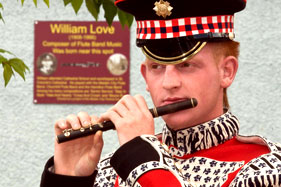
Always looking for an innovative approach the Skull changed their uniform–yet again–from the preferred Guards style to that more akin to the United States Marine Corps.  This happened in 2004 but only lasted for a couple of years before they reverted back to the Guards style we have all come to recognise and love.  There have many other milestones along the illustrious road.  Taking part in the Maiden City Festival Concert must rank very highly in the list of Black Skull achievments.  Thet were invited to play compositions made famous by William Love–an icon in Londonderry music circles and composer extrodinaire.  William was a member of one of this countires finest bands–past or present–Churchill Flute.  A CD was subsequently made incorporating the Black Skull recordings of William Love’s music–The Prince of the Realm.
The Black Skull list of achievments is truly staggering…
Act of Union Concert 2007
Concert at Drogheda on the banks of the Boyne 2008
Photographic Exhibition in the Bloomberg Art Gallery 2008
An exhibition in the Glasgow Gallery of Modern Art by Rodney Buchanan the famous visual artist entitled Here I Am.   This focused on the challenging views of culture, heritage and perceived sectarianism.
There really is very little else for the band to achieve.  In their short history they have fulfilled a lifetime of ambitions and have taken bandsmanship and musical ability to new levels.  The biggest compliment we can pay them is to point to the fact that they are one of the bands that most others in their particular field aspire to.  They are much imitated but rarely equalled and never surpassed.
Here’s to the next 33 years!!


Share

Draw A Line Now: Professor Pete Shirlow

Draw a Line Now

Is it not strange that those who did not attend Sinn Fein’s conference entitled Belfast: A City of Equals in an Island of Equals at the Europa Hotel, have been able to label the event in so many ways? Those non-republicans who participated have been described as those having taken part in a ‘love in’ and of having being duped by Sinn Fein’s hypnotic abilities. As if Gerry Adam’s sat at the back slowly swinging his grandfather’s pocket watch and gently stating ‘look into my eyes!’ If anything the majority of those who spoke shared a common concern that Sinn Fein needed to adopt better listening skills and appreciate that there is more than their truth, history and victims. The event if anything provided for what were necessary but robust conversations. The brilliance of those conversations was not that they happened or that they were forceful but that they were mannerly. The possibility being provided to tell Sinn Fein how others see their approach and ideas as wrong or requiring much greater reflection.

One respondent reminded Sinn Fein that the Union Flag drapes the coffins of loved ones returning for war in Iraq and Afghanistan and wondered if they really understood the significance of that when voting for its removal from City Hall. Others embraced the idea of Unionist alienation not in itself a flaw in the Unionist character but in the action and discourse of republicanism. I presented quotes from people who questioned Sinn Fein’s motives, language and behaviour. If this was a ‘love in’ I would not have liked to have seen the fight.

One of the more forceful comments was made by Matt Baggott who explained that “At the moment we are spending huge resources because we are required by law to relentlessly go back into the 70s, 80s and 90s whether that is through inquests or inquiries.” One could sense the frustration of trying to roll out civilian policing but being made to constantly go back to Pol Pot’s Year Zero. His contribution in itself gets to the nub of the question about the past. When oh when does it stop?
We have a dangerous system at present regarding the past which is based upon the flawed architecture of rearward actions. To put it simply republicans and nationalists have been able to put the state in the dock as it were due to legal obligations placed upon the state. HET may prosecute the odd former paramilitary, but that is not the same infrastructure to examine non-state ‘corporate’ responsibilities. This imbalance is infuriating to some Unionists who see delving into the past as one sided and wonder why Sinn Fein wants state personnel up before the courts and not others. I assume the DUP and UUP want the same outcome but the other way round. Either position is untenable, and merely repeats what conflict does which is to create the moral good and the moral bad. Corporate responsibility is nonsense if it only runs through demanding that the other opens its murky books. It is an act in reiterating societal divisions without any safety net when the ‘other’ side bites back.
The whole process is not only problematic because it is read as uneven but in that it simply indulges selective views of the past.  As Matt Baggott has indicated we are spending scarce resources in confirming what people already believed. What this mess actually does is make sharing the ‘narrow ground’ difficult as we daily underline the nature of the Groundhog Day in which we are compelled to live. A place in which we will never make history and hope rhyme as the former is over invested in while the latter in under-invested upon. I understand that we must consider the feelings of victims but what Professor John Brewer’s work at Queen’s University has shown is that victims are the people who most want to move into a future and not be dragged down by criminalising the past.
If we are going to move on we have to either have a proper truth process or draw a line under the past. At present approach will not make scales fall from eyes as the conflict was experienced in different ways. If anything it keeps them in place. At present in what was does dealing with the past present a future. We seriously need a political leadership that either draws a line or goes for a mechanism of truth recovery. If our political elite were to acknowledge that our present process is merely opening old wounds and drawing inspiration away from forward movement then we would be going somewhere. The old cliché that the past drags the future down is replete with accuracy.  The muddle we now have is just painful and I think re-traumatising.  I would personally opt for line drawing and do more for victims and their personal needs. Courts and inquires do not determine the complete truth nor reconcile victims. So why use them? Could we not go for conversation and exchange between those who survived? Cheaper than investigation with the added benefit of being more likely to affect reconciliation. Maybe start with the observation that all tears are the same. The people are capable of that whereas inquires and courts are not.
On a final point, we were reminded on Friday of David Ervine’s contention that ‘republicanism is not contagious’. I was the same person when I walked into the Europa on Friday and the same one who walked out. The only difference was I had my say.

Pete Shirlow

Share