Category Archives: Current Affairs

Northern Ireland – Amnesty?


For the first time the UK government have admitted they’re considering a general amnesty arising out of the Troubles.  Although an amnesty is not government policy, the admission came in a Lords debate instigated by the former Chief of General Staff of the Army Lord Dannatt, supported by other former top brass and former secretaries of state. What remains unclear is  how this would affect the Legacy package of the Stormont House Agreement, including the proposal for an independent Historical Investigations Unit (HIU) the terms for which came under sustained attack. Read more »

Share

When does Boyhood end?


When does boyhood end?

For some it’s leaving school

To get a job or leaving school

To get no job at all, or buying

A drink for the first time on your own

Or the first time, properly that is,

With a girl or having to shave

The bristles off and not just fluff

Or for some the day you learned to drive

Or the day you had to dress

In a suit and tie for a grandad’s

Funeral or else some other

Personal, private, unforgotten thing,

Too personal in fact to mention.

For me, the night my father

Left me to the boat will count for that.

Eighteen and able to marry,

Able to vote, able to fight

In her Majesty’s Army, I was still

Inside a child, away to university

In England in a Liverpool ferryboat,

Packed tight with home-bound

Squaddies, watching at two or three

In the morning, the lights of

The Isle of Man sail by

As I stood on the deck and felt the cold

Wind rise on the Irish Sea and

Heard the gulls and knew that when manhood

Starts, in a sense, you’re on your own.

Philip Orr is a Writer, Historian and Political Commentator


Share

no stone unturned

‘No Stone Unturned’ – The Lawyers Speak Out To Irish-America, Blame PSNI For Arrests

PSNI CONCERN WAS IF FILM DAMAGED THEIR ABILITY TO RECRUIT AND MAINTAIN INFORMERS

This is an edited version of a statement issued to Irish-American activists by Niall Murphy, solicitor for film-makers Trevor Birney and Barry McCaffrey who were arrested at the weekend and questioned about the alleged theft of documents from the Police Ombudsman’s office in Belfast during the production of  ‘No Stone Unturned’, the expose of the 1994 Loughinsland killings.

The journalists were arrested and questioned by officers from the Durham police but lawyers for the two men insist the operation was really a PSNI affair.

Barry McCaffrey and Trevor Birney – their arrests was entirely a PSNI operation claims their lawyer Read more »

Share

Northern Ireland Demographic Future

Paul Nolan

There are two developments that could transform the deadlocked political situation in Northern Ireland. The first, which has received much commentary in the media, is the slow motion explosion of Brexit. The second, which has commanded very little attention, is the changing demography of the northern state, the effects of which will be even more profound.

The issue is likely to come sharply into focus with the next census, scheduled for 2021, which also happens to be the year that will mark the centenary of the creation of the Northern Ireland state.  It would be a considerable irony  –  cruel for some, pleasing for others  –  if it turns out that a state that was set up to provide security for the Protestants of Ulster by providing them with a permanent in-built majority should, 100 years on from its creation, end up with a Catholic population larger than the Protestant one.  Is that a real possibility? Read more »

Share

MID HUT – C21


The Middle Hut.

    The middle hut in Compound 21 also known as Passchendaele.  Here was Special category Status in Long Kesh. All the huts had place names from the First World War. (There was also the end hut and the half hut) Can anyone recall what the other huts in 21 where called?  Had not seen this photo before so it brought a back a few memories.  Stayed here for a decade of my life. On the left would have been Flints cube when I first arrived.  On the right (I think) were Davy Mc and Ginger Top the footballer. LOL. The chairs in the foreground, handmade by the men from whatever scraps and material they could glean.  There were some craftsmen and tradesmen in that place.   We painted this hut on the inside and kept it very clean.  It’s a fond memory when I think back to taking the bars off the windows, painting and then putting the bars back on. Read more »

Share

Why on Earth are we still talking about restoring the Executive? : Cllr: Julie-Anne Corr-Johnston

Why on earth are we still talking about restoring the Executive?


The 16th of January 2017 marked the fifth suspension of the Northern Ireland Assembly since its inception merely twenty years ago. Attempts to secure its operation on a permanent basis have been exhausted and frustrated by disagreements. Describing the different types of Executive we have had since December 1999, Political Commentator Alex Kane said that we have had “one with the UUP/SDLP/SF and the DUP neither in nor out. Then one with the DUP/SF/UUP/SDLP. Then one with the DUP/SF/UUP/SDLP/Alliance. Then the UUP left. Then the latest one, with DUP/SF/Claire Sugden. And all of them, every single one of them, has included walkouts, in/outs, suspensions, show downs, crises, instability, threats of legal action, emergency talks, potential collapse and round-the-clock briefing against each other.” 

Which begs the question; Why on earth are we still talking about restoring the executive?

Besides broken relationships, calls for Direct Rule (or as we’ve recently heard ‘Joint Authority’) suggest that there is a consensus that the present system of devolved governance – mandatory coalition – is not only broken but beyond repair. 

Let’s be honest. The institutions envisaged in the Good Friday Agreement were a compromise, agreed at a time when an honourable outcome and stability were desperately needed. However, those structures were not designed to last forever. They were specific to their context and, just like the devolution of justice or an extension of fiscal responsibility, the institutions grow and change as the political landscape does.

With speculation that the agreement is dead in the water, perhaps now there is opportunity for the Northern Ireland Secretary of State to uphold its content and exercise the review legislated for under strand one section thirty-six. It reads “After a specified period there will be a review of these arrangements, including the details of electoral arrangements and of the Assembly’s procedures, with a view to agreeing any adjustments necessary in the interests of efficiency and fairness.”   

Perhaps now as we begin a new year, we can have conversation about new beginnings, a new system of governance that deinstitutionalises sectarianism and paves the way for a truly progressive and pluralist Northern Ireland.

A new devolved legislator formed in the image of successful institutions where delivery is the rule not the exception.

Cllr Julie-Anne Corr-Johnston

Progressive Unionist Party N.I.

Share

Prof. Pete Shirlow’s speech at Sinn Fein Conference


University of Liverpool Logo

Prof Peter Shirlow’s speech at Sinn Fein annual conference

Published on

Peter Shirlow


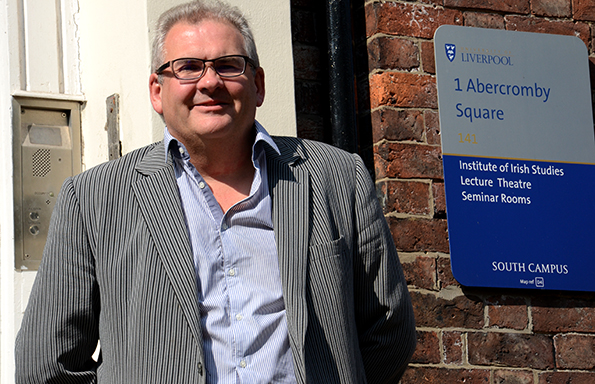
Professor Peter Shirlow FAcSS, Director of the Institute of Irish Studies, addressed Sinn Fein’s Ard Fheis (Annual Conference) earlier this month, speaking on the theme of sectarianism. As Prof. Shirlow is from a unionist community background, such invitations are rare.

His talk focussed on themes including; the idea that being pro-union is inherently sectarian is not only wrong it is inherently sectarian and asked questions such as; ‘How could the treatment of Catholics in the North and Protestants in the South not make us suspicious of each other?’ and ‘How could the violence of the past not make us fearful of each other?’

Prof. Shirlow said;

“Although my family circle and I have been affected by republican violence, I saw this invitation as an important part of a wider healing process. I have worked for many years in the area of anti-sectarianism and I hope that sharing my critical thoughts has helped embed such endeavours.”

Find out more

Download Prof Peter Shirlow’s speech (pdf)


Watch


Share

Why Maze film should act as a timely reminder not to trust republicans: Jamie Bryson

Editorial: Why Maze film should act as a timely reminder as to why we must never trust republicans

By Jamie Bryson

untitled

The Maze 1983 film is an opportunity for the Unionist community to remind ourselves of the sheer folly of ever trusting the republican movement or their pretence of ‘reconciliation’.

After the Hunger Strikes a new strategy emerged within the jail. It was conceived by the prison leadership which included current senior Sinn Fein members such as Bik McFarlane, Gerry Kelly and Bobby Storey.

The strategy was slow and painstakingly disciplined. It involved republican prisoners pretending that they had accepted the regime. They smiled and got along with the prison guards; they relaxed the whole system by pretending they were happily operating within it. The account of their strategies is outlined in various accounts of the escape and in even more detail within the book ‘Nor Meekly Serve My Time’.

Read more »

Share

To be opposed to the ‘Peace Process’ is not to be opposed to ‘Peace’: Jamie Bryson

To be opposed to the ‘Peace Process’ is not to be opposed to ‘Peace’ – By Jamie Bryson


This article first appeared on Eamonn Mallie’s Blog


In recent days the debate around dual Nationality and dual citizenship has been re-ignited, following revelations that BBC presenter Stephen Nolan has obtained an Irish passport to compliment the British one already held.

This issue goes much wider than dual Nationality, which was freely available prior to the Belfast Agreement.

This poses the key question in relation to the intent- in a contested state- of availing of such.

The Belfast Agreement went much further than reaffirming the right to hold dual nationality, and instead provided for parity between Britishness and Irishness and the right to hold citizenship in relation to both.

The Belfast Agreement was sold to Unionism under the plainly false assumption that Nationalism would prioritise their equality agenda over the constitutional issue and would accept the legitimacy of Northern Ireland, providing that they felt they were able to play a full and meaningful role.

There was the false notion, fed because the agreement meant all things to all people, that dual citizenship would create the environment whereby Nationalists could live happily and play a meaningful role in a settled state.

Of course Nationalism never had any intention of dividing their ‘equality’ agenda, of which the citizenship  strategy is a key part, from the constitutional question.

The rightful rejection of this equality agenda by Unionists is framed as ‘bigoted, sectarian and hard line’.

This is part of Sinn Fein’s strategy to use rights based language to advance political aims and present Unionism as regressive on the International stage.

Unionism’s resistance to the equality agenda is based upon the quite correct realisation that rather than Nationalism’s ever growing list of demands being part of a settlement for a stable Northern Ireland, it is a Trojan horse designed to undermine the legitimacy of the state and feed into the much larger Nationalist political aim of Irish unity.

The equality agenda is the art of dressing up political aims as civil rights.

The majority of people pursuing Irish passports do so in order to assert their rights as Irish citizens living in what they believe is an illegitimate state.

Some Unionists however have obtained Irish passports for cultural reasons because they identify with certain aspects of Irish culture, as is their right. If one holds two passports then this is a de-facto acceptance of the Nationalist position that Northern Ireland is neutral.

The next logical step is that if you accept the citizenship parity between Britishness and Irishness, then so too would you have to accept that the Irish national flag should be held in equivalence with the sovereign Union flag.

Of course to follow it right through to its logical conclusion, if you accept the aforementioned then the only end position is acceptance that- at the very least- Dublin and London should have joint-sovereignty over Northern Ireland.

The issue of citizenship is so crucial in a contested state because it provides those seeking to undermine the state with an avenue to demand parity of esteem for minority political aspirations.

It seeks to place an obligation on the state to recognise Irishness in parity with Britishness.

It is a demand not for parity for people, but rather for political aspirations. At its most basic level it is a demand that the minority aspiration of Irish unity be afforded equal standing with the democratic  wishes of the majority to remain British.

It is not only a back-door way of undermining the principle of consent, but is part of the overall trajectory of the ‘peace process’.

A process by its very definition has a beginning and an end. Therefore to discover the end of the peace ‘process’ it is only logical to look at the primary agreement underpinning it, and what end is envisaged within it.

The Belfast Agreement allows for only one ending, the trajectory leading only one direction, and that is towards a referendum on Irish unity followed by a continuous cycle of referendums every seven years until the Northern Ireland electorate decide they want to join a United Ireland. This is the end game, the end of the process.

To be opposed to the peace process is not to be opposed to peace.

All our political battles must be underpinned by a commitment from all that never again must violence take the place of democracy.

Peace must be an absolute commitment, not a commitment to peace only within the confines of the ‘process’.

Liberal Unionism labours under the false notion that granting dual citizenship rights and embracing Nationalism’s ever broadening ‘equality’ demands will reduce Nationalist hostility to the state and thus politically stabilise Northern Ireland.

This is a fool’s paradise. Northern Ireland is a contested state, the name of which Sinn Fein cannot even utter.

Unionism must be alert to the fact that citizenship and equality are not stand alone rights based issues, but rather the key battle ground in Nationalism’s overall political objective of achieving Irish unity.

Share

It Is Tempting To Conclude That SF Has No Strategy: Patrick Murphy

“it is tempting to conclude that SF has no strategy…”

on 9 July 2017 , 3:46 pm 31 Comments | 1,018 views
From yesterday’s Irish News, Patrick Murphy, once again, making direct contact with the head of the nail.


While the DUP’s future role in Westminster is far from predictable, it is easy to understand. Sinn Féin’s strategy, however, is less clear. Indeed it is tempting to conclude that SF has no strategy, other than to prolong the talks and hope for a lucky break, similar to the one the DUP received in Westminster.

Sinn Féin collapsed Stormont because of the RHI scandal. But this issue rarely appears on their current wish list. Instead they have a list of demands ranging from the vague but reasonable (Irish language recognition), through the distracting (equality, but not for the poor) to the downright silly (demanding respect).

Respect has to be earned. In view of the years they spent chuckling with Paisley, Robinson and Foster, some might suggest that if they did not respect themselves, they cannot reasonably expect others to respect them.

SF’s claim that nationalists were failed by Stormont is untrue. Stormont failed everyone, but because SF relies on nationalist votes, it re-wrote the assembly’s performance as having failed only nationalists and then expanded that claim into the current list of demands.

They have raised nationalist expectations, but it is difficult to see them getting all they seek. So are they deliberately making demands which they know will not be met, or will they re-write their shopping list in the autumn and settle for less? Re-writing has served them well in the past.

So the bad news about the talks breaking up this week is that our politicians missed watching the Irish Open on television in the comfort of Stormont Castle. But the talks prospects for the rest of July are good. Their agenda items will presumably include watching the Tour de France and possibly the Ulster Football Final.

This article first appeared in The Irish News 8th July.


Share